



Content Curator
Solutions are homogeneous mixtures of solids, liquids, or gases in different proportions, Solutions are made up of solutes and solvents. There are different kinds of solutions, based on the solute-solvent combination, solubility, and particulate quality. They are saturated, colloidal, and electrolyte solutions.
| Table of Content |
Keyterms: Solutions, solids, liquids, gases, homogeneous mixtures, saturated, colloidal, electrolyte solutions, solutes, solvents
What is a Solution?
[Click Here for Sample Questions]
The solution is a homogeneous mixture of two or more substances in relatively varied proportions. In general, a solution exists in a liquid state. But, in chemistry, the solution may be in any of the three phases like solids, liquids and gases.

Solution
Also Read:
| Related Articles | ||
|---|---|---|
| All about solutions | Types of solutions | Electrolytic cell |
| Concentration cell | Neo-electrolytes | Colloids |
| Thermochemistry | Acid Test | Solvent |
Parts of solution
[Click Here for Sample Questions]
Solutions consist of two parts namely, a solvent and a solute.
Solute + Solvent = Solution
Solute: The component of the solution which is dissolved in the solvent is called the solute. It is generally the smaller component of the solution.
Solvent: The component of the solution which dissolves the solute is called the solvent. It is generally the larger component of the solution.
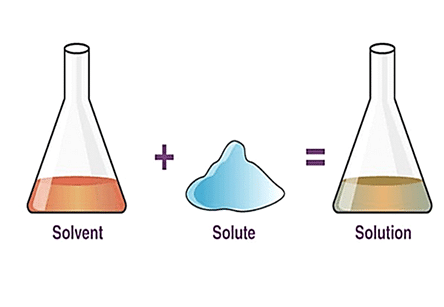
Parts of a Solution
Differences between Solute and Solvent
[Click Here for Sample Questions]
Following are the differences between a solute and a solvent:
| Particulars | Solute | Solvent |
|---|---|---|
| Definition | A substance that is dissolved by a solvent. | The substance that dissolves the solute. |
| Boiling point | More | Less |
| Solubility | Decreases in quantity and temperature | Decreases in quantity and temperature |
| Physical state | Solid, liquid, or gas | Liquid or gas |
Properties of Solutions
[Click Here for Sample Questions]
- A solution is a homogeneous mixture of two or more substances.
- The constituent particles of a solution are smaller than 1nm (10−9 meters) in diameter. So, the constituent particles in a solution cannot be seen by our naked eye.

Properties of Solutions
- In most cases, solutions cannot scatter a beam of light passing through them.
- Solute particles cannot be separated by physical methods like filtration.
- Neither solute nor solvent particles settle down even when left undisturbed.
- Solutions are stable at a particular temperature.
Types of Solutions
[Click Here for Sample Questions]
Solutions can be classified in various ways namely,
- Based on solute-solvent combinations
- Based on their saturation
- Based on the property of particles in solutions
Based on the solute-solvent combination they are 9 types of solutions as tabulated below:
| Types of Solution | Solute | Solvent | Examples |
|---|---|---|---|
| Solid-solid | Solid | Solid | Alloys like brass, bronze, copper in gold, etc. |
| Solid-liquid | Solid | Liquid | The solution of jaggery, sugar, salt, potassium permanganate, etc in water. |
| Solid-gas | Solid | Gas | Snow, dry ice, arsenic, iodine, camphor, etc. in the air |
| Liquid-solid | Liquid | Solid | Mercury in silver and tin (amalgams) |
| Liquid-liquid | Liquid | Liquid | Alcohol in water and benzene in toluene |
| Liquid-gas | Liquid | Gas | Aerosols like freon and water vapour in the air. |
| Gas-solid | Gas | Solid | Hydrogen in palladium |
| Gas-liquid | Gas | Liquid | Carbon dioxide in water(aerated drinks) |
| Gas-gas | Gas | Gas | Atmospheric gases |
Classification Based on Saturation
Based on their saturation solutions can be classified as follows:
Unsaturated Solution: The solution in which more solute can be added at a given temperature can be called an unsaturated solution.
Saturated Solution: The solution in which more solute cannot be further added or dissolved in the solvent at a given temperature can be called a saturated solution.

Types of Solutions
Supersaturated Solution: The saturated solution in which more solute can be added and dissolved by raising either the temperature, pressure or both can be called a supersaturated solution.
Classification Based on Saturation
Based on the properties of particles, solutions can be classified as colloidal solutions and electrolytic solutions.
Colloidal solutions: Colloids are microscopic particles dispersed in a solution. The size of these particles ranges from 1-1000 nanometres (10-9 m). Solutions containing colloidal particles are called colloidal solutions or colloidal systems. Colloids scatter beams of light falling on them. This phenomenon is called the Tyndall effect. Some common colloidal solutions are aerosols, clouds, smoke, air dust, gels, emulsions, milk, etc.
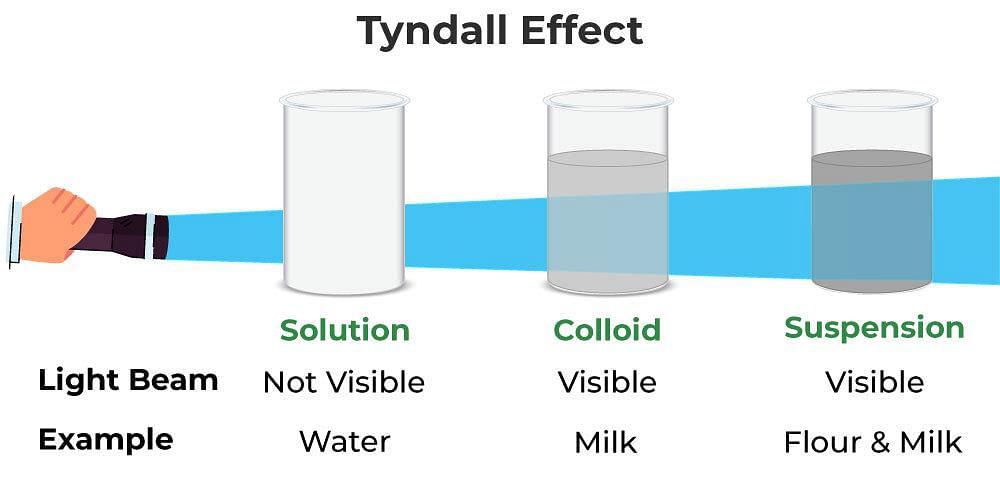
Tyndall Effect
Electrolytic solutions: The solution that contains electrolytes is called an electrolytic solution. The most common electrolytes are sodium, potassium, and chloride. Electrolyte solutions are also called ionic solutions because of the presence of ions. The most common electrolyte solution is 0.9% sodium chloride solution (saline) that is used as the intravenous fluid in the case of dehydration.
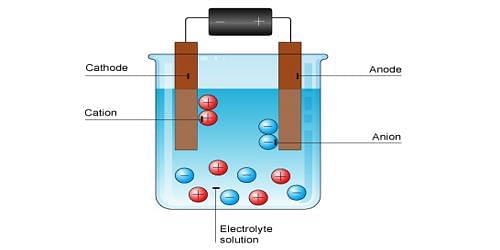
Electrolytic Solution
Things to Remember
- The solution is a homogeneous mixture of two or more substances in relatively varied proportions. Solutions consist of two parts namely, a solvent and a solute.
- The component of the solution which is dissolved in the solvent is called the solute.
- The component of the solution which dissolves the solute is called the solvent.
- Colloids are microscopic particles dispersed in a solution.
- The solution that contains electrolytes is called an electrolytic solution.
- The most common electrolyte solution is 0.9% sodium chloride solution (saline) that is used as the intravenous fluid in the case of dehydration.
Also Read:
Sample Questions
Ques: What is meant by a solution? What are its constituent parts? (2 marks)
Ans: A homogeneous mixture of two or more substances is called a solution. The solution consists of two constituent parts namely, solute and solvent. The substance that is more in quantity, and that dissolves solute particles is called a solvent. The substance that is dissolved by the solvent is called the solute.
Ques: Write any three important differences between solute and solvents. (3 marks)
Ans: The three important differences between solute and solvent are given in the following table.
| Solute | Solvent |
|---|---|
| A substance that is dissolved by a solvent is called the solute. | The substance that dissolves the solute is called the solvent. |
| Less in quantity | More in quantity |
| A solute may be solid, liquid, or gas | A solvent is generally liquid or sometimes gas |
Ques: What is a solution? Enumerate any five properties of chemical solutions. (5 marks)
Ans: A solution is a mixture of solute and a solvent.
Following are the different properties of solutions.
Properties of solutions
- A solution is a homogeneous mixture of solute and solvent.
- The constituent particles in a solution cannot be seen by our naked eye.
- Solutions cannot scatter a beam of light passing through them.
- Solute particles cannot be separated by physical methods like filtration.
- Neither solute or solvent particles settle down even when left undisturbed. Solutions are stable at a particular temperature.
Ques: What is a solution? What are the three types of solutions based on solubility? (5 marks)
Ans: A solution is a homogeneous mixture of two or more substances in various proportions. Solutions are of three kinds based on solubility. They are
Based on their saturation solutions can be classified as follows:
- Unsaturated Solution: The solution in which more solute can be dissolved at a certain temperature is called an unsaturated solution.
- Saturated Solution: The solution in which more solute cannot be further dissolved in the solvent at a certain temperature is called a saturated solution.
- Supersaturated Solution: The saturated solution in which more solute can be dissolved by raising either the temperature, pressure or both is called a supersaturated solution.
Ques: What is meant by a colloid? What are colloidal solutions? (3 marks)
Ans: Colloids are microscopic particles suspended in a solution. The size colloids range from 1-1000 nanometres (10-9 m). Solutions containing colloidal particles are called colloidal solutions. Some common colloidal solutions are aerosols, clouds, smoke, air dust, gels, emulsions, milk, etc.
Ques: What is meant by the Tyndall Effect? Give an example. (2 marks)
Ans: Colloidal particles scatter external beams of light falling on them. This phenomenon of scattering of light is called the Tyndall effect. Dust particles in a room are visible in the light, entering through a window.
Ques: What is an electrolyte? What are the common electrolytes? (2 marks)
Ans: An atom, a molecule, or an ion that carries extra electrons is called an electrolyte. Sodium, potassium, and chloride are the common electrolytes.
Ques: What is an electrolyte? What are electrolyte solutions? What is the most common electrolyte solution used in hospitals? What is its use? (3 marks)
Ans: An atom, a molecule, or an ion that carries extra electrons is called an electrolyte. Solutions that are rich in electrolytes are called electrolyte solutions. The most commonly used electrolyte solution in hospitals is saline. It is a 0.9% sodium chloride solution. It is used as the intravenous fluid in the case of dehydration of a patient due to diarrhoea-like situations. Saline improves the rehydration of the body.
Ques. Why does the conductivity of a solution decrease with dilution? (2 marks)
Ans: The conductivity of a solution is linked with the number of ions present per unit volume. With dilution, these decrease and the corresponding conductivity or specific conductance of the solution decreases.
Ques. Non-ideal solutions exhibit either positive or negative deviations from Raoult’s law. What are these deviations and why are they caused? Explain with one example for each type. (CBSE 2010) (3 marks)
Ans. Non-ideal solutions exhibit Negative deviation from Raoult’s law: For any composition of the non-ideal solution, the partial vapour pressure of each component and total vapour pressure of the solution is less than expected from Raoult’s law. Such solutions show negative deviation.
Example: Mixture of CHCl3 and acetone.
Non-ideal solutions show positive deviations from Raoult’s law on the mixing of two volatile components of the solution.
Example: Mixture of acetone and benzene solutions show positive deviation.
Ques. Define the terms, ‘osmosis’ and ‘osmotic pressure’. What is the advantage of using osmotic pressure as compared to other colligative properties for the determination of molar masses of solutes in solutions? (CBSE 2010) (3 marks)
Ans. Osmosis: The net spontaneous flow of the solvent molecules from the solvent to the solution or from a less concentrated solution to a more concentrated solution through a semipermeable membrane is called osmosis.
Osmotic pressure: The minimum excess pressure that has to be applied on the solution to prevent the entry of the solvent into the solution through the semipermeable membrane is called the osmotic pressure.
The osmotic pressure method has the advantage that it uses molarities instead of molalities and it can be measured at room temperature.
For Latest Updates on Upcoming Board Exams, Click Here: https://t.me/class_10_12_board_updates
Also Check:



Comments