




Online registrations for the All India Forensic Science Entrance Test (AIFSET) 2027 are currently being accepted on the official portal, aifset.com, for admission to B.Sc. and M.Sc. forensic science programmes at partner universities for the 2027-28 academic session. The registration window is being kept open until October 30, 2026, the exam has been scheduled for October 31, 2026, and the result is to be declared on November 2, 2026.
AIFSET 2027 is conducted online in a remote-proctored mode, and it can be attempted from a mobile, laptop or desktop; the paper comprises 100 multiple-choice questions to be answered in 60 minutes, with no negative marking.
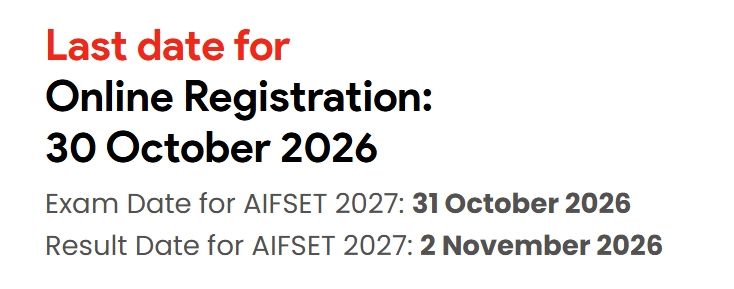
Source: Official AIFSET Website
AIFSET 2027 (All India Forensic Science Entrance Test) is a national-level online entrance exam for students who want to join B.Sc. or M.Sc. Forensic Science programmes at over 150 partner universities across India. The exam runs in multiple phases every year, giving you more than one chance to qualify and secure admission.
- Multiple Phases: AIFSET 2027 will be conducted across multiple phases. In 2026, four phases were held in January, February, March, and June, giving candidates up to 3 separate attempts to qualify.
- Counselling: After each phase result, you must submit the counselling form within 7 days and choose up to 3 partner universities. AIFSET has over 150 participating institutes offering B.Sc and M.Sc Forensic Science seats across India.
What is AIFSET 2027?
AIFSET stands for All India Forensic Science Entrance Test. It is a national-level entrance examination that helps students get admission to B.Sc. (Forensic Science) and M.Sc. (Forensic Science) programmes at recognised universities and colleges across India.
The exam is not conducted by a single institution. Instead, a consortium of over 150 partner universities runs AIFSET through a common platform at aifset.com. These universities collaborate to accept AIFSET scores for admission, which means qualifying once gives you access to a large network of colleges spread across multiple states.
AIFSET is a fully online exam — you can take it from your home on a mobile phone, laptop, or desktop with a stable internet connection. This makes it accessible to students across India, including those from smaller towns and cities without major exam centres nearby.
The exam is held in multiple phases every year. In 2026, four phases were held — in January, February, March, and June. This multi-phase structure is one of the biggest advantages of AIFSET. If you miss one phase or want to improve your score, you can appear in the next phase without waiting for a full year.
The paper has 100 multiple choice questions (MCQs) to be completed in 60 minutes. There is no negative marking, so you should attempt all questions. Students who qualify can apply to partner universities during counselling and secure seats in B.Sc. or M.Sc. Forensic Science programmes.
Forensic Science is a growing field in India. With courts, police departments, and investigative agencies modernising rapidly, the demand for trained forensic scientists, crime scene investigators, forensic toxicologists, and cyber forensics experts is rising every year. AIFSET is one of the primary national-level gateways to entering this field through a recognised degree programme.
AIFSET 2027 Key Highlights
The table below covers all important details of AIFSET 2027 at a glance. Check this before starting your preparation.
| Particulars | Details |
|---|---|
| Exam Name | All India Forensic Science Entrance Test |
| Short Name | AIFSET |
| Academic Year | 2027-28 |
| Exam Level | National |
| Conducting Body | Consortium of 150+ Partner Universities (via aifset.com) |
| Mode of Exam | Online — from home (mobile / laptop / desktop) |
| Duration | 60 minutes |
| Total Questions | 100 MCQs (one correct answer each) |
| Total Marks | 100 |
| Marking Scheme | +1 for each correct answer |
| Negative Marking | No |
| Courses Offered | B.Sc Forensic Science, M.Sc Forensic Science |
| Number of Phases (2026) | 4 phases (January, February, March, June) |
| Partner Universities | 150+ |
| Result Declaration | Within 2–3 days of each phase exam |
| Official Website | aifset.com |
AIFSET 2027 Important Dates
AIFSET 2027 will be conducted in multiple phases across the academic year. The 2027 phase dates have not been officially announced yet as of September 2026. The expected dates below are based on the confirmed 2026 phase schedule. Check aifset.com/important-dates.html regularly for official 2027 date announcements.
All 2027 phase dates in the table below are expected based on the 2026 cycle. Candidates must confirm official dates on aifset.com before registering for any phase.
| Event | Expected Date (AIFSET 2027) | 2026 Reference Date |
|---|---|---|
| 2027 Cycle Registration Opens | September 2026 (Open Now) | — |
| Phase 1 Registration Closes | Expected January 2027 | January 23, 2026 |
| Phase 1 Admit Card | Expected 48 hours before Phase 1 exam | ~January 22, 2026 |
| Phase 1 Exam Date | Expected January 2027 | January 24, 2026 |
| Phase 1 Result | Expected within 3 days of Phase 1 exam | January 27, 2026 |
| Phase 1 Counselling Deadline | Within 7 days of Phase 1 result | — |
| Phase 2 Exam Date | Expected February 2027 | February 21, 2026 |
| Phase 2 Result | Expected within 3 days of Phase 2 exam | February 24, 2026 |
| Phase 3 Exam Date | Expected March 2027 | March 28, 2026 |
| Phase 3 Result | Expected within 3 days of Phase 3 exam | ~March 31, 2026 |
| Phase 4 Exam Date | Expected June 2027 | June 27, 2026 |
| Phase 4 Result | Expected within 3 days of Phase 4 exam | June 29, 2026 |
| Phase 4 Counselling Deadline | Within 7 days of Phase 4 result | — |
Source: AIFSET Official Important Dates Page
Each phase has its own registration window, admit card release, exam, result, and counselling deadline. You can appear in up to 3 phases per year. If your score in Phase 1 is low, you can appear again in Phase 2 or Phase 3 — your best score will be considered during counselling for that phase.
AIFSET 2027 Eligibility Criteria
AIFSET has separate eligibility conditions for B.Sc and M.Sc Forensic Science programmes. Check your eligibility carefully before applying so that your admission is not rejected at the document verification stage.
For B.Sc Forensic Science
- You must have passed Class 12 (10+2) or an equivalent examination from a recognised board.
- Physics, Chemistry, Biology and/or Mathematics must be your main subjects in Class 12.
- You need a minimum aggregate of 50% marks in Class 12.
- If you are currently appearing in Class 12, you can still apply and take the AIFSET exam. However, your admission will only be confirmed after you pass with the required marks.
For M.Sc Forensic Science
- You must hold a graduation degree (B.Sc) from a recognised university.
- Your graduation can be in B.Sc Forensic Science or in any other B.Sc Science stream — such as Chemistry, Biology, Physics, Microbiology, or Biotechnology.
- You need a minimum aggregate of 50% marks in graduation.
- Students in the final semester of their Bachelor’s programme are also eligible to apply. Final admission depends on passing with the required marks.
Each partner university may have its own additional eligibility conditions beyond the basic AIFSET criteria. After qualifying AIFSET and receiving a seat allotment, check the specific requirements of the allotted university before completing the admission process.
AIFSET 2027 Application Process
The AIFSET application is completely online. You do not need to send any physical documents by post. Here is how to apply for AIFSET 2027 step by step:
- Step 1 – Register on aifset.com: Go to aifset.com and click on the registration or apply link. Enter your name, email address, and mobile number to create your account. Note your login credentials carefully.
- Step 2 – Fill the Application Form: Log in and fill in your personal details (name, date of birth, address), academic qualification details, and your course preference — B.Sc Forensic Science or M.Sc Forensic Science.
- Step 3 – Upload Required Documents: Upload a recent passport-size photograph and your signature in the format specified on the portal. Make sure the file size and dimensions match the guidelines given on the website.
- Step 4 – Select Exam Phase: Choose the phase you want to appear in from the available options — Phase 1, Phase 2, Phase 3, or Phase 4. You can register for a later phase if the upcoming one does not suit your schedule.
- Step 5 – Pay the Application Fee: Pay the application fee online through debit card, credit card, UPI, or net banking. The fee amount for 2027 will be displayed on the official website. Keep the payment receipt.
- Step 6 – Submit and Save Confirmation: Submit the completed form and download the application confirmation receipt. Save it for your records — you will need it for future reference.
Since AIFSET runs in multiple phases, you can register for each phase separately. Keep your login credentials safe throughout the year — you will use them to download admit cards, check results, and submit the counselling form.
Registration for AIFSET 2027 is currently open. Each phase has a separate registration window that closes close to the exam date — apply early and do not wait for last-minute deadlines.
AIFSET 2027 Exam Pattern
The AIFSET exam is student-friendly in design. It is a short, focused test of 60 minutes with no negative marking. The most important strategy here is that you should attempt all 100 questions — a wrong answer costs you nothing, but leaving a question blank means a guaranteed zero for that question.
| Aspect | Details |
|---|---|
| Mode | Online — from home (mobile / laptop / desktop) |
| Duration | 60 minutes |
| Question Type | MCQs — 1 correct answer per question |
| Total Questions | 100 |
| Total Marks | 100 |
| Marks Per Correct Answer | +1 |
| Negative Marking | No |
| Medium | English |
B.Sc Forensic Science — Subject-Wise Breakdown
The B.Sc AIFSET entrance test covers five broad subject areas. If you have studied PCB (Physics, Chemistry, Biology) or PCM (Physics, Chemistry, Mathematics) in Class 12, most of the science topics will already be familiar.
| Subject | Key Topics |
|---|---|
| Biology / Mathematics | Human physiology, cell biology, genetics, basic statistics and algebra |
| Chemistry | Atomic structure, chemical bonding, organic and inorganic reactions |
| Physics | Mechanics, optics, electricity and magnetism, thermodynamics |
| Forensic Science | Introduction to forensics, crime scene management, fingerprints, evidence types |
| Psychometric | Verbal and non-verbal reasoning, quantitative aptitude, general awareness |
M.Sc Forensic Science — Subject-Wise Breakdown
The M.Sc AIFSET exam is set at graduation level. It tests advanced forensic science knowledge along with core science concepts.
| Subject | Key Topics |
|---|---|
| General Chemistry | Advanced analytical chemistry, chromatography, spectroscopy |
| Police Science | Criminal law, IPC, CrPC, evidence handling and investigation procedure |
| Forensic Biology & Serology | DNA profiling, blood group analysis, biological evidence identification |
| Forensic Medicine | Forensic pathology, time of death estimation, injury pattern analysis |
| Forensic Toxicology | Drugs of abuse, poison mechanisms, toxicological screening procedures |
| Crime Scene Management | Scene reconstruction, evidence packaging, chain of custody, court procedures |
AIFSET 2027 Syllabus
The AIFSET syllabus tests your foundation in science along with your understanding of key forensic concepts. The syllabus differs for B.Sc and M.Sc — make sure you study the correct one for your target programme.
B.Sc Forensic Science Syllabus
The undergraduate syllabus is divided into six broad units. Most of the science content maps to the Class 11 and Class 12 NCERT curriculum, which makes preparation manageable if you have a strong school science base.
Physics:
- Mechanics: Newton’s laws, force, work, energy, power, and simple machines
- Optics: Nature of light, reflection, refraction, lenses, mirrors, and optical instruments
- Electricity and Magnetism: Current electricity, circuits, electromagnetic induction, Ohm’s law
- Thermodynamics: Heat transfer, laws of thermodynamics, temperature scales
Chemistry:
- Atomic Structure: Electron configuration, quantum numbers, periodic table trends
- Chemical Bonding: Ionic, covalent, coordinate, and metallic bonding
- Organic Chemistry: Basic reactions, hydrocarbons, functional groups, isomerism
- Inorganic Chemistry: Acids, bases, salts, redox reactions, metals and non-metals
Biology:
- Human Physiology: Digestive, respiratory, circulatory, excretory, and nervous systems
- Cell Biology: Cell structure, organelles, cell division — mitosis and meiosis
- Genetics: Mendelian genetics, DNA structure, heredity and variation
- Reproductive System: Male and female anatomy, fertilisation, reproduction
Forensic Science Fundamentals:
- Introduction to Forensic Science and its major branches
- Types of physical evidence: biological, chemical, trace, and digital
- Crime scene management, documentation, and reconstruction
- Fingerprint analysis — types, classification, and lifting techniques
- Forensic Biology and Serology: blood typing, biological stain analysis basics
- Forensic Toxicology and Drug Analysis: drug categories and detection methods
- Document Examination: handwriting analysis and forgery detection basics
- Police Science: criminal investigation fundamentals and evidence handling
Psychometric Section:
- Verbal and non-verbal reasoning: analogy, number series, coding-decoding, pattern recognition
- Quantitative aptitude: ratios, percentages, basic arithmetic
- General awareness: current events, science and technology, Indian criminal justice system
M.Sc Forensic Science Syllabus
The postgraduate syllabus covers advanced topics at graduation level. If you have a B.Sc background in Forensic Science, most of these topics will be from your graduation curriculum.
- General Chemistry: Advanced separation techniques — gas chromatography (GC), HPLC, mass spectrometry, UV-Vis and IR spectroscopy
- Police Science: Indian Penal Code (IPC), Code of Criminal Procedure (CrPC), Indian Evidence Act, types of offences, arrest and investigation procedures
- Forensic Biology & Serology: DNA fingerprinting methodology, PCR and RFLP techniques, species identification, blood group serology
- Forensic Medicine: Autopsy procedures, post-mortem changes, cause and manner of death, trauma and wound analysis, forensic odontology basics
- Forensic Toxicology: Drugs of abuse and their pharmacology, poison classification, analytical toxicology methods, forensic drug screening procedures
- Chemical Separation and Instrumental Techniques: Advanced chromatography, electrophoresis, colorimetry, and spot test chemistry
- Crime Scene Investigation: Scene security and photography, evidence collection protocols, labelling, chain of custody, court testimony preparation
- Forensic Document Examination: Handwriting analysis and comparison, ink and paper examination, alteration and forgery detection
Source: AIFSET Official Syllabus Blog
AIFSET 2027 Admit Card
AIFSET issues a separate admit card for each phase of the exam. You need to download the admit card before appearing in any phase — it serves as your entry permission and must be available when you start the online test.
How to Download AIFSET 2027 Admit Card
- Go to the official admit card page: aifset.com/admit-card.html
- Log in with your registered email ID and password
- Select the phase for which you have registered
- Download and save the admit card as a PDF on your device
- Check all details carefully — name, phase date, and exam instructions
What the AIFSET Admit Card Contains
- Candidate name and registration number
- Exam phase number and date
- Exam start time and duration
- Login details or access link for the online test
- Important instructions for appearing in the test
AIFSET admit cards for each phase are released 48 hours before the scheduled exam. Download it as soon as it is available. If you notice any error in your name, photograph, or other details, contact AIFSET through the official website immediately.
For AIFSET 2027, Phase 1 admit cards are expected approximately 48 hours before the Phase 1 exam — likely around January 2027. Admit cards for subsequent phases will follow the same 48-hour pattern.
Never attempt the AIFSET exam without downloading your admit card first. Keep your portal login credentials safe for every phase you register for throughout the year.
AIFSET 2027 Result
AIFSET declares results very quickly after each phase — usually within 2 to 3 days. In 2026, the Phase 1 result was out on January 27, just 3 days after the January 24 exam. Phase 4 result in 2026 came out on June 29 — just 2 days after the June 27 exam. This quick turnaround means you can move to counselling without a long wait after each phase.
How to Check AIFSET 2027 Result
- Go to the result page: aifset.com/result.html
- Log in with your registered email ID and password
- Select the phase for which you want to check the result
- View your scorecard and download it as a PDF
AIFSET 2026 Result Reference (Historical Pattern)
| Phase | 2026 Exam Date | 2026 Result Date | Exam-to-Result Gap |
|---|---|---|---|
| Phase 1 | January 24, 2026 (Over) | January 27, 2026 (Over) | 3 days |
| Phase 2 | February 21, 2026 (Over) | February 24, 2026 (Over) | 3 days |
| Phase 3 | March 28, 2026 (Over) | ~March 31, 2026 (Over) | ~3 days |
| Phase 4 | June 27, 2026 (Over) | June 29, 2026 (Over) | 2 days |
For AIFSET 2027, results for each phase are expected within 2–3 days of the exam, following the same 2-day to 3-day pattern seen throughout 2026. You will also receive an email notification at your registered email address once the result is ready. Save your scorecard — you will need it to submit the counselling form within 7 days of result declaration.
AIFSET 2027 Counselling Process
Once the result for any phase is declared, the counselling process begins. This is where you choose your preferred universities and get a seat confirmed. The entire process is online and must be completed quickly — the counselling form window stays open for just 7 days after result declaration.
AIFSET Counselling Steps
- Step 1 – Submit the Counselling Form: Log in to the AIFSET portal at aifset.com and fill the counselling form within 7 days of the result. Missing this 7-day window means you will not be considered for seat allotment in that phase and must wait for the next phase.
- Step 2 – Select Preferred Universities: Choose up to 3 partner universities in order of preference from the 150+ available options on the portal.
- Step 3 – Seat Allotment: Seats are allotted based on your AIFSET marks and the admission requirements of your chosen universities. Candidates with higher marks get priority for better university options and preferred specialisations.
- Step 4 – Document Verification: After seat allotment, submit your documents for verification. Required documents typically include Class 12 mark sheet and certificate (for B.Sc), graduation mark sheets and certificate (for M.Sc), photo ID proof, category certificate if applicable, and passport-size photographs.
- Step 5 – Pay Admission Fee: Pay the admission fee directly to the allotted university as per its fee structure. Fee amounts vary by university and programme.
- Step 6 – Confirm Provisional Admission: Complete all formalities at the university to confirm your provisional admission and reserve your seat.
If you are not happy with your Phase 1 score or the university allotted, you can appear in Phase 2 or Phase 3. Your improved score will be used in a fresh counselling round with the full list of participating universities. This is one of the most student-friendly features of the AIFSET multi-phase model — you are not locked in after one attempt.
Note: Each partner university has its own fee structure, hostel facilities, placement records, and additional eligibility requirements. After seat allotment, contact the university directly to understand all final admission steps and deadlines.
AIFSET 2027 Participating Colleges
More than 150 universities and colleges across India accept AIFSET scores for B.Sc and M.Sc Forensic Science admissions. This makes AIFSET one of the broadest forensic science entrance tests in India in terms of seat availability and geographical reach. You can find options across Rajasthan, Uttar Pradesh, Haryana, Odisha, Maharashtra, Himachal Pradesh, Chhattisgarh, and more.
Some well-known AIFSET partner universities for 2027 include:
| University | Location | Courses Offered |
|---|---|---|
| Vivekananda Global University | Jaipur, Rajasthan | B.Sc Forensic Science, M.Sc Forensic Science |
| Invertis University | Bareilly, Uttar Pradesh | B.Sc Forensic Science, M.Sc Forensic Science |
| G.D. Goenka University | Gurgaon, Haryana | B.Sc Forensic Science |
| C.V. Raman Global University | Bhubaneswar, Odisha | B.Sc Forensic Science, M.Sc Forensic Science |
| APG Shimla University | Shimla, Himachal Pradesh | B.Sc Forensic Science |
| MATS University | Raipur, Chhattisgarh | B.Sc Forensic Science, M.Sc Forensic Science |
| Bahra University | Solan, Himachal Pradesh | B.Sc Forensic Science |
| G.H. Raisoni University | Amravati, Maharashtra | B.Sc Forensic Science |
| T.S. Mishra University | Lucknow, Uttar Pradesh | B.Sc Forensic Science |
| KR Mangalam University | Gurgaon, Haryana | B.Sc Forensic Science, M.Sc Forensic Science |
| G.H. Raisoni Skill Tech. University | Nagpur, Maharashtra | B.Sc Forensic Science |
The complete and updated list of all 150+ participating universities for AIFSET 2027-28 is available on aifset.com. During counselling, you will see the full list and can filter options by state, city, or available specialisations.
Some universities within the AIFSET network offer specialisations in Cyber Forensics, Forensic Psychology, and Forensic Chemistry as sub-tracks within the B.Sc or M.Sc programme. Check each university’s specific programme details before finalising your preference list during counselling.
AIFSET 2027 Preparation Tips
AIFSET is not a highly competitive exam in the way NEET or JEE are — but you still need to prepare well to score high enough to get your preferred university. Here are the most practical tips to help you do well.
Understand the Test Format First
AIFSET has 100 MCQs in 60 minutes — that is an average of 36 seconds per question. You need to be quick and decisive. Since there is no negative marking, attempt every question. Do not spend too long on any single question — mark your best guess and move on.
For B.Sc Aspirants: Subject-Wise Strategy
- Physics, Chemistry, Biology: Revise Class 11 and Class 12 NCERT textbooks. These form the core of the science section. Focus on concepts rather than long derivations — AIFSET tests understanding, not complex calculations.
- Forensic Science: This section may be new if you have not studied forensics before. Read introductory books or take a short online course on forensic science basics. Focus on crime scene investigation, types of physical evidence, fingerprint classification, DNA basics, and toxicology fundamentals.
- Psychometric (Reasoning and Aptitude): Many students underestimate this section. Give it at least 15-20% of your study time. Practice basic reasoning puzzles, number series, and reading comprehension regularly to build speed.
- Sample Papers: AIFSET publishes practice papers and sample questions on its website. Solve at least 5 to 10 timed full-length mock tests before the exam to identify weak areas and build exam speed.
For M.Sc Aspirants: Subject-Wise Strategy
- Revise Graduation Notes: The M.Sc test is at B.Sc graduation level. Go through your forensic science, chemistry, and biology graduation notes systematically. Pay extra attention to topics that are both conceptual and practical.
- Police Science and Legal Framework: This section is often underestimated. It covers the Indian Penal Code (IPC), Criminal Procedure Code (CrPC), Indian Evidence Act, and police investigation procedures. Spend focused time here — it is a high-scoring area if you prepare it properly.
- Know Your Forensic Techniques: Be clear on how key procedures work — PCR for DNA analysis, chromatography for drug detection, autopsy procedures, and forensic toxicology screening methods. These types of questions are commonly tested in the M.Sc paper.
General Tips for All Candidates
- Register early for each phase — registration closes just days before the exam, and early registration avoids last-minute technical issues.
- Use the multi-phase structure to your advantage. If Phase 1 does not go well, improve your preparation and appear in Phase 2 or Phase 3.
- Test your device (mobile or laptop) and internet connection before exam day. AIFSET is a live online test — technical problems on exam day can affect your performance.
- Read all exam-day instructions in the admit card carefully so there are no surprises when the test window opens.
Career Opportunities After AIFSET
Qualifying AIFSET and completing a B.Sc or M.Sc in Forensic Science opens doors to several careers in law enforcement, scientific investigation, the legal system, and research. Forensic Science is one of the fastest-growing career fields in India as the criminal justice system and investigative agencies expand and modernise.
Government Jobs in Forensic Science
- Forensic Scientist at State and Central Forensic Laboratories: The Central Forensic Science Laboratory (CFSL) under the Ministry of Home Affairs, and state-level FSLs, hire B.Sc and M.Sc Forensic Science graduates as junior and senior scientific officers.
- CBI, NIA, and Intelligence Bureau: These central agencies recruit forensic experts for technical investigation support in complex criminal cases.
- State Police Forensic Divisions: Most state police departments have dedicated forensic science units that employ forensic scientists for crime lab analysis and field investigation support.
- DRDO and Defence Sector: Some defence research organisations hire forensic chemistry and biology specialists for specialised projects.
Private Sector and Independent Practice
- Private Forensic Laboratories: Several private labs provide forensic services for civil disputes, insurance cases, and criminal defence. They hire B.Sc and M.Sc Forensic Science graduates with strong practical skills.
- Cyber Forensics: Digital crime investigation is a booming field. Forensic Science graduates with additional skills in IT and digital forensics are in high demand at cyber security companies, banking fraud investigation units, and law firms.
- Forensic Consulting: Experienced forensic scientists can work as independent expert witnesses and consultants for lawyers, courts, and insurance companies.
- Hospital and Medico-Legal Work: Forensic medicine graduates can work in hospital medico-legal departments, supporting post-mortem examinations and clinical forensics.
Higher Education and Research
- After B.Sc Forensic Science, you can qualify for AIFSET again and pursue M.Sc Forensic Science at a higher-ranked partner university.
- After M.Sc, you can pursue Ph.D. in Forensic Science at universities like Panjab University, Manipal Academy of Higher Education, or LNMU.
- Qualifying the National Eligibility Test (NET) in Life Sciences opens paths to academic and research fellowship positions in forensic science departments.
FAQs
Ques. What is AIFSET 2027?
Ans. AIFSET 2027 (All India Forensic Science Entrance Test) is a national-level online entrance exam for admission to B.Sc and M.Sc Forensic Science programmes at over 150 partner universities across India. The exam is conducted in multiple phases throughout the year and can be taken from home using a mobile, laptop, or desktop with a good internet connection. Registration for the 2027-28 cycle is currently open at aifset.com.
Ques. Who conducts AIFSET?
Ans. AIFSET is not conducted by a single institution. It is managed by a consortium of over 150 partner universities that collectively accept AIFSET scores for admission. The official platform at aifset.com coordinates registration, exam delivery, results, and counselling across all participating institutions.
Ques. How many times can I appear for AIFSET 2027?
Ans. AIFSET 2027 will be conducted in multiple phases — in 2026, four phases were held in January, February, March, and June. Candidates can appear in up to 3 phases per year. If your score in one phase is low, you can register for the next phase and try again. Your best score is used for counselling.
Ques. Is AIFSET 2027 conducted online or offline?
Ans. AIFSET 2027 is conducted fully online from home. You can take the test on a mobile phone, laptop, or desktop computer with a good internet connection. You do not need to travel to any exam centre, which makes it accessible to students across India including those from smaller cities and rural areas.
Ques. What is the eligibility for AIFSET 2027 B.Sc Forensic Science?
Ans. For B.Sc Forensic Science through AIFSET 2027, you must have passed Class 12 (10+2) with Physics, Chemistry, and Biology/Mathematics as main subjects, with at least 50% aggregate marks. Students currently appearing in Class 12 can also apply. For M.Sc Forensic Science, you need a B.Sc degree (any science stream) with at least 50% marks from a recognised university.
Ques. Is there negative marking in AIFSET 2027?
Ans. No. AIFSET 2027 has no negative marking at all. You get +1 mark for each correct answer and zero for a wrong or unattempted answer. This means you should always attempt every question — guessing gives you a chance at a mark while leaving it blank guarantees zero for that question.
Ques. When will AIFSET 2027 Phase 1 exam be held?
Ans. The exact Phase 1 date for AIFSET 2027 has not been officially announced as of September 2026. Based on the 2026 pattern — where Phase 1 was held on January 24, 2026 — Phase 1 of AIFSET 2027 is expected around January 2027. Check aifset.com/important-dates.html for the official announcement.
Ques. When will AIFSET 2027 result be declared?
Ans. AIFSET results are declared within 2 to 3 days of each phase exam. In 2026, Phase 1 result was out 3 days after the exam and Phase 4 result was out in 2 days. For 2027, the same quick turnaround is expected for every phase. You will also receive an email notification when the result is available at aifset.com/result.html.
Ques. How many universities accept AIFSET 2027 score?
Ans. More than 150 universities and colleges across India accept AIFSET scores for B.Sc and M.Sc Forensic Science admission. These institutes are spread across Rajasthan, Uttar Pradesh, Haryana, Odisha, Maharashtra, Himachal Pradesh, Chhattisgarh, and other states. The complete updated list for 2027-28 is available on aifset.com.
Ques. What is the AIFSET counselling process?
Ans. After each phase result is declared, you must submit the counselling form within 7 days by logging into the AIFSET portal. You can select up to 3 preferred universities. Seats are allotted based on your AIFSET marks. After allotment, you complete document verification and pay the admission fee at the chosen university to confirm your seat. If you are not happy with Phase 1, you can improve your score in a later phase and go through counselling again.
Ques. Can I appear for AIFSET 2027 while still in Class 12?
Ans. Yes. You can apply for and appear in AIFSET 2027 while you are still in Class 12 (10+2). Appearing early lets you lock in a good score before your board exams are done. However, your final admission to B.Sc Forensic Science will only be confirmed after you pass Class 12 with at least 50% aggregate marks in Physics, Chemistry, and Biology/Mathematics.
Ques. What subjects are in the AIFSET 2027 syllabus for B.Sc?
Ans. The AIFSET B.Sc syllabus covers five main areas: Physics (mechanics, optics, electricity — Class 12 level), Chemistry (atomic structure, organic and inorganic reactions), Biology (cell biology, genetics, physiology), Forensic Science Basics (crime scene management, fingerprints, evidence types, toxicology basics), and Psychometric (verbal and non-verbal reasoning, aptitude). Most science content is at Class 11-12 NCERT level, making it accessible to recent school-pass candidates.
Disclaimer: The information about AIFSET 2027 provided above is based on the latest available data from the official AIFSET website (aifset.com) and verified data from the 2026 exam cycle as of September 2026. Exact phase dates, registration deadlines, and fee details for 2027 have not been officially confirmed yet. Candidates are strongly advised to check aifset.com regularly for official announcements on phase schedules, admit cards, results, and counselling processes for each AIFSET 2027 phase.






Comments
Found 6 Comments
To request a refund after admission through Vivekananda Global University under AIFSET, you should contact the admission office or accounts department. Submit a written refund application with fee receipt, admission letter, and ID proof. Refund will depend on university policy, withdrawal timing, and deduction rules, so act quickly for eligibility.
The AIFSET 2026 entrance test is accepted by over 150 partner universities across India, offering undergraduate and postgraduate forensic science programs such as B.Sc. and M.Sc. Forensic Science, Cyber Forensic, and related courses. Fees vary by university and course type, with B.Sc. forensic science programs costing around INR 1 - 5 lakh total and some private institutions charging higher depending on facilities and duration. For example, Parul University’s B.Sc. Forensic Science totals about INR 3.07 lakh over three years
To get into B.Sc and M.Sc universities like Vivekananda Global University, Bahra University Shimla Hills, Sanskriti University Uttar Pradesh, Renaissance University Madhya Pradesh, etc. candidates are required to qualify in AIFSET exam. You may check here to get all the details about the entrance test. AIFSET 2023
Candidates are required to qualify in AIFSET in order to get into B.Sc and M.Sc Forensic Science in the colleges mentioned. AIFSET is not the college neither the name of a job.
You are required to qualify in AIFSET 2023 in order to get into B.Sc and M.Sc in all the partner universities. To get into B.Pharma, you may required to check the sites of college offering the same.
Students who have registered for AIFSET can download their admit cards online. Admit cards will be available for download from 48 hours before the examination date. AIFEST 2023 is scheduled to be conducted on January 29, 2023.