



Exams Prep Master
Aluminium fluoride has the molecular formula AlF3 and is a colourless chemical substance. It's mostly utilised in the manufacture of aluminium. It can be found in the form of oskarssonite and rosenbergite in nature. It can also be produced synthetically. The majority of aluminium fluoride is made by combining hydrogen fluoride with alumina or aluminium oxide at 700 degrees Celsius. The chemical formula for the most frequent of these hydrates is AlF33.5H2O, which means that for every two molecules of aluminium fluoride in a crystal, seven molecules of water are present. Let’s understand the chemical compound in depth.
| Table of Content |
Read More: Number of Moles Formula
Physical Properties of Aluminium Fluoride
[Click Here for Sample Questions]
Aluminium fluoride has the appearance of white powder or granules. Furthermore, aluminium fluoride is odourless. Additionally, this substance is denser than water. At 25°C, its solubility in water tends to be 559 g / 100 mL. This substance is also marginally soluble in alkalis and acids. Aluminium fluoride is unaffected by even highly concentrated acid. The melting point of aluminium fluoride is 1291 degrees Celsius. At 1238 °C, it has a vapour pressure of 1 mm. Furthermore, when compared to trialkylaminums, the chemical is less susceptible to oxidation. In its natural state, aluminium fluoride is non-flammable. When this chemical reaches the point of decomposition, it emits very hazardous hydrogen fluoride vapours. Aluminium fluoride sublimates at a high temperature of 1272 °C and a pressure of 760 mmHg.
Small amounts of aluminium are added to certain metals to improve their qualities for specific uses, such as aluminium bronzes and most magnesium-base alloys; or modest amounts of other metals and silicon are added to aluminium in aluminium-base alloys. Aircraft construction, building materials, consumer durables (refrigerators, air conditioners, kitchen utensils), electrical conductors, and chemical and food-processing equipment all employ the metal and its alloys.
Also read: Dalton’s atomic theory
Chemical Properties of Aluminium Fluoride
[Click Here for Sample Questions]
Aluminium is a great heat and electrical conductor. It has half the heat conductivity of copper and two-thirds the electrical conductivity. It forms a face-centered cubic structure when it crystallises. Aluminium-27 is the stable isotope of all natural aluminium. Aluminium oxide and hydroxide, as well as metallic aluminium, are harmless. Most dilute acids destroy aluminium slowly, while intense hydrochloric acid dissolves it quickly. Concentrated nitric acid, on the other hand, maybe transported in aluminium tank cars since it neutralises the metal. Alkalies such as sodium and potassium hydroxide attack even very pure aluminium to produce hydrogen and the aluminate ion.

Finely divided aluminium will burn in carbon monoxide or carbon dioxide with the development of aluminium oxide and carbide if ignited, however, aluminium is inert to sulphur at temperatures up to red heat due to its high affinity for oxygen. Experts are aware of many hydrates of aluminium fluoride in addition to AlF3. Furthermore, these compounds have the formula AlF3.xH2O and contain monohydrate x=1, two polymorphs of a trihydrate x=3, hexahydrate x=6, and x=9 nonahydrate. Alumina is treated with hydrogen fluoride to produce the majority of aluminium fluoride. Furthermore, this occurs at a temperature of 700 degrees Celsius. Additionally, fluorosilicic acid can be used to make aluminium fluoride. Alternatively, thermal breakdown of ammonium hexafluoroaluminate can be used to produce aluminium fluoride.
Also read:
Structure of Aluminium Fluoride
[Click Here for Sample Questions]
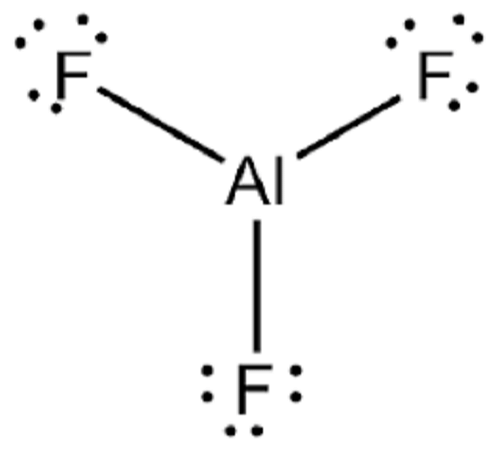
Aluminium fluoride has the formula AlF3, which means that each molecule has one aluminium atom and three fluoride atoms. The heart of the structure is an aluminium atom, which is surrounded by three fluoride atoms that are connected to it. When we look at the valence electrons (electrons in the outer shell) of aluminium and fluoride, we can see why this arrangement happens. You've probably used aluminium foil to cover a pan of food in the oven or to make campfire dinners when camping. Making aluminium fluoride is one of the most common ways to manufacture aluminium (for use in items like aluminium foil).
A variety of aluminium compounds are used in a variety of industries. Alumina, which occurs naturally as corundum, is also professionally manufactured in huge amounts for use in the production of aluminium metal, insulators, spark plugs, and other items. Alumina develops a porous structure when heated, allowing it to absorb water vapour. This type of aluminium oxide, known as activated alumina in the industry, is used to dry gases and liquids. It also acts as a carrier for numerous chemical reaction catalysts.
Uses of Aluminium Fluoride
[Click Here for Sample Questions]
Small amounts of aluminium are added to certain metals to improve their qualities for specific uses, such as aluminium bronzes and most magnesium-based alloys; or modest amounts of other metals and silicon are added to aluminium in aluminium-base alloys. Aircraft construction, building materials, consumer durables (refrigerators, air conditioners, kitchen utensils), electrical conductors, and chemical and food-processing equipment all employ the metal and its alloys. Commercial aluminium (99 to 99.6% pure) with modest concentrations of silicon and iron is robust and strong; pure aluminium (99.996%) is soft and feeble. Aluminium is a ductile and malleable metal that may be pulled into wire or rolled into thin foil. The metal has a density of about one-third that of iron or copper.
Most dilute acids destroy aluminium slowly, while intense hydrochloric acid dissolves it quickly. Concentrated nitric acid, on the other hand, may be transported in aluminium tank cars since it neutralises the metal. Alkalies such as sodium and potassium hydroxide attack even very pure aluminium to produce hydrogen and the aluminate ion. Finely divided aluminium will burn in carbon monoxide or carbon dioxide with the development of aluminium oxide and carbide if ignited, however, aluminium is inert to sulphur at temperatures up to red heat due to its high affinity for, oxygen. By using emission spectroscopy, aluminium can be detected in quantities as low as one part per million. The oxide form of aluminium can be quantified.
Also read:
Preparation of Aluminium Fluoride
[Click Here for Sample Questions]
Commercially, there are three methods for producing aluminium fluoride. The first approach involves treating alumina trihydrate (aluminium hydroxide; Al(OH)3) with hydrofluoric acid (HF). The second technique of manufacture is nearly comparable to the first, except that it is carried out in the dry state using dry alumina trihydrate and gaseous hydrogen fluoride. The addition of fluorosilicic acid (H2SiF6) to alumina trihydrate is the third approach. Because fluorosilicic acid is produced as a by-product in the production of fertilisers and phosphoric acid, the last of these processes is commercially appealing.
The heat breakdown of ammonium produces aluminium fluoride. This is an alternate way that a manufacturer might use in the manufacturing process. Aluminium fluoride is found in nature in the form of aluminium fluoride trihydrate. This chemical element can be found in the rare mineral form of rosenbergite. The non-hydrate form of aluminium floruide can also be found in minerals like oskarssonite.
Things to Remember
- Aluminium chloride is formed when gaseous chlorine reacts with molten aluminium metal; it is the most commonly used catalyst in Friedel-Crafts processes, which are synthetic organic reactions used to make a wide range of chemicals, including aromatic ketones and anthraquinone and its derivatives.
- Alumina develops a porous structure when heated, allowing it to absorb water vapor. This type of aluminium oxide, known as activated alumina in the industry, is used to dry gases and liquids. It also acts as a carrier for numerous chemical reaction catalysts.
- Pliny refers to alumen, now known as alum, an aluminium compound widely used to fix dyes in fabrics in the ancient and mediaeval worlds. Chemists like Antoine Lavoisier recognised alumina as a potential metal source in the latter half of the 18th century.
- Other gemstones that include aluminium include topaz, garnet, and chrysoberyl. Alunite and cryolite are two of the many additional aluminium minerals that have commercial use.
- Most dilute acids destroy aluminium slowly, while intense hydrochloric acid dissolves it quickly. Concentrated nitric acid, on the other hand, may be transported in aluminium tank cars since it neutralises the metal. Alkalies such as sodium and potassium hydroxide attack even very pure aluminium to produce hydrogen and the aluminate ion.
Read More:
Sample Questions
Ques: What does aluminium fluoride do? (2 marks)
Ans: Aluminium fluoride is a crystalline (sand-like) powder that is odourless, white, or colourless. It's used to make aluminium, as a welding flux, and in ceramic glazes and enamels, among other things.
Ques: Why is the formula of aluminium fluoride AlF3? (2 marks)
Ans: Aluminium fluoride has the formula AlF3, which means that each molecule has one aluminium atom and three fluoride atoms. Fluoride has seven valence electrons, while aluminium has three.
Ques: What is the chemical formula for aluminium oxide? (2 marks)
Ans: Aluminium Oxide has the chemical formula Al2O3. It is an electrical insulator, meaning it does not conduct electricity, and it has a high thermal conductivity.
Ques: What type of reaction are aluminium and fluorine? (2 marks)
Ans: Aluminium fluoride is formed when aluminium reacts with fluorine. This reaction occurs at a temperature of around 600°C.
Ques: Is aluminium fluoride ionic or covalent? (2 marks)
Ans: The chloride ion is larger than the fluoride ion in size. AlCl3 behaves as a covalent molecule due to its higher polarisation. Between Al and Cl, the electronegativity difference is 1.5, while between Al and F, it is 2.5. As a result, the bond between Al and F is ionic, while the bond between Al and Cl is covalent.
Ques: What is the ionic formula for Aluminium fluoride? (2 marks)
Ans: Aluminium fluoride has the formula AlF3, which means that each molecule has one aluminium atom and three fluoride atoms.
Ques: Why aluminium fluoride has a high melting point? (2 marks)
Ans: The melting point of Aluminium Fluoride is higher than that of Aluminium Chloride. This is due to its ionic character, as opposed to the covalent character of Aluminium Chloride. The Cation is the same in both compounds, but the size of the anion varies.
Ques: Is aluminium fluoride polar or nonpolar? (2 marks)
Ans: AlF3 has a trigonal planar molecular shape with a symmetric charge distribution on the central atom. As a result, this molecule is nonpolar.
Related links:



Comments