



Content Curator
Silicon Dioxide is a chemical compound made of silicon and oxygen is found abundantly in the earth's crust. The molecular formula of Silicon Dioxide is SiO2 . It is also called kalii bromidum, silicic acid, silica, and silicic oxide. SiO2 is found as quartz, tridymite, and cristobalite in nature. It has many uses and applications in day-to-day life.
Key takeaways: Silicon Dioxide, covalent bonds, Hazards, Chemical Compounds, Quartz,
Silicon Dioxide
[Click Here for Sample Questions]
Silicon dioxide is an oxide of Silicon. Which means it is made up of silicon and oxygen. It is given the molecular formula SiO2. It is known by several names including kalii bromidum, silicic acid, silica, and silicic oxide. SiO2 is found as quartz, tridymite, and cristobalite in nature. At suitable temperatures, these forms of silicon dioxide are interconvertible.
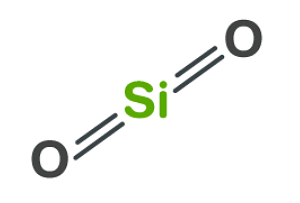
Silicon Dioxide
Silicon dioxide is classified into two types. One is amorphous silica (a-silica), also known as non-crystalline silica. And the other is crystalline silica (c-silica).
Read More:
Structure of Silicon Dioxide
[Click Here for Sample Questions]
Silicon dioxide(SiO2) has a linear structure. It is bonded by covalent bonds. In a three-dimensional structure of silicon dioxide, each Silicon atom is covalently bonded with four And Oxygen atoms and each Oxygen atom is covalently bonded with two Silicon atoms. The geometry of oxygen atoms around silicon is tetrahedral.

Structure of Silicon Dioxide
Read More: Difference between Elements and Compounds
Physical Properties of Silicon Dioxide
[Click Here for Sample Questions]
Some of the physical properties of Silicon Dioxide are given below.
| Property | Observation |
| Colour | Colourless to Grey |
| Odour | Odourless |
| Taste | Tasteless |
| Nature | Crystalline and Amorphous |
| Molar mass | 60.08 g/mol |
| Melting point | 1713° C |
| Boiling point | 2950° C |
| Density | 2.648 g/cm3 |
Read More:
Chemical Properties Of Silicon Dioxide
[Click Here for Sample Questions]
Some of the chemical properties of Silicon dioxide are given below.
| Property | Observation |
| Polarity | Zero |
| Reactivity | Less |
| Stability | High |
| Dielectric strength | High |
| Conductivity | Less; used as semiconductor or insulator |
Read More: Atomic Mass of Elements
Applications Of Silicon Dioxide
[Click Here for Sample Questions]
- Silicon dioxide is used in powdered food products. It keeps the powder from clumping thus the powdered foods do not stick to each other and remain free-flowing.

Anticaking agent
- Silicon dioxide is one of the best materials for manufacturing food packaging products. It is used in manufacturing paper bags, adhesives, etc.
- As a defoaming agent, silicon dioxide performs excellently. That is why it is used in drinks such as beers.
Preparation Of Silicon Dioxide
[Click Here for Sample Questions]
Silicon dioxide can be prepared by acidification of sodium silicates. The silica gel obtained in this process is washed and dried to obtain microporous silica.
The reaction of sodium trisilicate with sulfuric acid gives silicon dioxide.
Na2Si3O7 + H2SO4 → 3SiO2 + Na2SO4 + H2O
Silicon tetrachloride on reacting with water gives silicon dioxide.
SiCl4 + 4H2O → SiO2.2H2O + 4HCl
Dehydration of silicic acid gives silicon dioxide.
Si(OH)4 → SiO2.2H2O
Soluble sodium silicate on reacting with hydrochloric acid gives silica gel which on further dehydration gives silicon dioxide.
Na2SiO3 + 2HCl + H2O → Si(OH)4 + 2NaCl
Si(OH)4 → SiO2.2H2O
Read More:
Reactions Of Silicon Dioxide
[Click Here for Sample Questions]
Reaction of fluorine with silicon dioxide is given as
2F2 + SiO2 → SiF4 + O2
Hydrofluoric acid on reaction with silicon dioxide gives hexafluorosilicic acid.
SiO2 + 6HF → H2SiF6 + 2H2O
The reaction of sodium hydroxide with silicon dioxide happens as follows
SiO2 + 2NaOH → Na2SiO3 + H2O
Read More: Difference between baking soda and baking powder
Uses Of Silicon Dioxide
[Click Here for Sample Questions]
- Silicon dioxide is used in several industries such as pharmaceutical, food, chemical, electronics, construction, etc.
- In the pharmaceutical industry, silicon dioxide is used as an additive in medicines. It absorbs water and keeps the medicines moisture-free.
- In the food industry, silicon dioxide is used as an anti-caking agent in spices. It is also used as a fining agent in juices, wines, and beers.

Uses as Desiccant in many Industries
- In the chemical industry, silicon dioxide is used in several manufacturing processes.
- It is used to manufacture anti-adhesives, adhesives, corrosion inhibitors, dyes, absorbents, sealants, porcelain, paint additives, ceramic, pesticides, etc. In column chromatography, silicon dioxide is used as an absorbent.
- In the electronics industry, optical fibres are largely composed of silicon dioxide.
- In the construction industry, silicon dioxide is used in the production of concrete, and hydraulic fracturing. Silica gel on the addition of (NH4)2CoCl4 acts as a humidity detector.
Also Read:
Health Hazards Of Silicon Dioxide
[Click Here for Sample Questions]
Silicon dioxide is not toxic in small quantities. But it can cause poisoning when consumed in large amounts. That is why only 10 mg/day of silicon dioxide should be consumed. Silicon dioxide dust on the other hand is very dangerous. The fine crystalline particles enter through the nose and lodge in the lungs. This causes a high risk of silicosis, lung cancer, lupus, rheumatoid arthritis, and bronchitis.
Things to Remember
[Click Here for Sample Questions]
- Silicon dioxide (SiO2) is an oxide of Silicon.
- SiO2 has a linear structure.
- SiO2 can be prepared from sodium silicates and silicon tetrachloride.
- SiO2 reacts with fluorine, hydrofluoric acid, and sodium hydroxide very easily.
- SiO2 is used in pharmaceutical, food, chemical, electronics, construction, etc industries.
- SiO2 is toxic when inhaled but non-toxic when consumed orally.
Read More:
Sample Questions
Ques. Where is Silicon Dioxide found in nature? [4 Marks]
Ans. Silicon dioxide is abundantly available in nature. More than 95% of the earth's crust is made up of silica. Quartz is a special type of silicon dioxide. It is also found in the earth's crust. Almost 12% of the earth's crust is made up of quartz. Silicon dioxide is also found in water, animals, and plants such as green leafy vegetables, cereals, oats, grains, etc. It is also found in the human body but its role is unknown.
Ques. What is the structure of silicon Dioxide? Is it tetrahedral or linear? [3 Marks]
Ans. The structure of silicon Dioxide is linear. The silicon atom is connected to two oxygen atoms with double bonds. The hybridization is sp hybridization. There is no residual charge on the silicon atom. In polymer form, silicon dioxide is tetrahedral in shape.
Ques. Why is silicon Dioxide used in foods? [3 Marks]
Ans. Silicon dioxide is naturally found in several foods such as grains, vegetables, cereals, etc. So it is clear that silicon dioxide can be consumed. It is not toxic on oral administration. That is why silicon dioxide is used as an additive in several food items. When added in appropriate amounts, silicon dioxide is very good for the preservation of foods.
Ques. What is the function of Silicon Dioxide? [3 Marks]
Ans. Silicon dioxide has application in many fields. It is used as an additive in foods. It is used in the manufacturing of adhesives. It is used in electronic devices to give them a semiconductor nature.
strong>Ques. Explain the production of Silicon Dioxide. [3 Marks]
Ans. Silicon dioxide is obtained through mining. Processes such as extraction, chemical processing, processing of ferrosilicon, and purification enable the extraction of silicon dioxide. The most common reaction for the production of silicon dioxide is
Na2Si3O7 + H2SO4 → 3SiO2 + Na2SO4 + H2O
Ques. Give the uses of Silicon Dioxide. [3 Marks]
Ans. Silicon dioxide is used in:
- Production of concrete in the construction industry
- Manufacturing of electronic devices in the electronics industry
- As an additive in the food industry
- Manufacturing of metallic compounds in the engineering industry.
Ques. Is silicon Dioxide toxic to humans and animals? [3 Marks]
Ans. Silicon dioxide is not toxic to humans and animals when administered orally. But if one inhales fumes or particles of silicon dioxide then it is highly toxic. The fine particles of silicon dioxide lodge themselves in the lungs. These further cause respiratory distress and illnesses such as lung cancer, bronchitis, silicosis, etc.
Ques. What are the physical properties of Silicon Dioxide? [5 Marks]
Ans. The physical properties of silicon dioxide are:
- The colour of silicon dioxide is Colourless to Grey.
- Silicon dioxide is odourless.
- Silicon dioxide is tasteless
- Silicon dioxide is found in crystalline as well as amorphous forms.
- The molar mass of silicon dioxide is 60.08 g/mol.
- The melting point of silicon dioxide is 1713° C.
- The boiling point of silicon dioxide is 2950° C.
- The density of silicon dioxide is 2.648 g/cm3.
Read More:



Comments