



Content Writer
Apoplast and symplast pathways are two channels of water and solutes that are used in the plant root system. A +ve hydrostatic pressure gradient or a -ve hydrostatic pressure gradient is used to achieve bulk flow.
- The apoplast is referred to as the space outside the plasma membrane in which material can disperse freely.
- It is broken up by the air spaces between plant cells, the casparian strip in roots, and the plant cuticle.
- The surface area available for absorption is increased by root hairs.
- Diffusion allows water and minerals to be absorbed by the millions of root hairs at the root tips.
- On the other hand, symplast refers to the space inside the plasma membrane which have more than one nucleus.
- In this pathway, water and low-molecular-weight solutes are diffused easily.
- The apoplast and symplast pathway is used for transporting absorbed water deep into the root layers.
Key Terms: Apoplast, Symplast, Apoplast and Symplast Pathway, Diffusion, Root System, Plants Cells, Difference between apoplast and symplast, Plasma Membrane
What is Apoplast?
[Click Here for Sample Questions]
Apoplast is a form of pathway in which water moves between intercellular spaces in plants. This is the primary pathway for water to flow from a plant's root cortex to the endodermis.
- Munch coined the term "apoplast" in 1930 to distinguish the living symplast from the dead apoplast.
- All the cell walls in plants, as well as the water that resides within them.
- It forms a linked system (the cell wall is composed of cellulose fibres, between which are spaces filled with water).
- The apoplast route is the transport of water (including dissolved ions and solutes) through cell walls.
- It includes all non-living spaces between the cell membranes and the cells.
- Apoplasts do not include protoplasms in plant tissues.
Also Read:
| Relevant Concepts | ||
|---|---|---|
| Tracheids | Anatomy Of Flowering Plant | Transportation In Plant |
Apoplast Pathway
[Click Here for Sample Questions]
Apoplast pathway also known as apoplast route is used to carry water from root hair to xylem through the cell walls of adjacent cells. It is least affected by the root's metabolic status because the apoplast is made up of non-living components.
- A casparian strip of endodermal cells blocks the apoplastic pathway.
- As a result, the symplastic pathway is used to transport water and ions through the cortex.
- It does not require any metabolic energy for its functioning.
- The apoplast pathway will transport water from the soil to the roots and then up through the stem and into the leaves.
- It acts as a physical barrier that restricts the movement of ions and macromolecules.
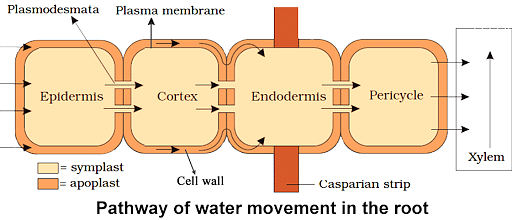
Apoplast Pathway
What is Symplast?
[Click Here for Sample Questions]
Symplasts are interconnected living cells that undergo active absorption, which involves the use of protoplasm. These cells have many nuclei. Cytoplasmic streaming aids the transport of water in the symplastic pathway.
- In this part of the plant, water and low-molecular solutes like amino acids and sugars are freely disseminated between cells.
- It is used for transporting solutes from the epidermis cells to the endodermis with the help of the cortex.
- The processed solutes will reach the pericycle, from which they are transferred to the xylem.
- This pathway undergoes long distance transportation.
Symplast Pathway
[Click Here for Sample Questions]
The symplastic pathway refers to the ion and water pathways formed by symplast. It is also known as the transmembrane pathway since it penetrates the cell membrane.
- The symplastic pathway should cross cell membranes because water reaches the cytoplasm of the cell through the plasma membrane.
- Since the root cells' selective plasma membrane handles ion and water intake, this pathway provides resistance to water flow.
- Symplasty is also influenced by the root's metabolic status.
- In plants with secondary growth, the symplastic pathway occurs beyond the endodermis.
Difference between Apoplast and Symplast
[Click Here for Sample Questions]
The difference between apoplast and symplast are as follows:
| Apoplast | Symplast |
|---|---|
| The apoplast is the non-protoplasmic components of a plant, including the cell wall and the intracellular spaces. | Symplast is the continuous arrangement of protoplasts of a plant, that are interconnected by plasmodesmata. |
| It consists of non-protoplasmic parts such as cell walls and intracellular space. | It comprises of protoplast |
| The pathway is composed of nonliving parts of a plant. | This is composed of living parts of a plant. |
| In apoplast, the water movement takes place by passive diffusion. | In symplast, the water movement takes place by osmosis. |
| The water movement is rapid than in symplast. | The water movement is slower in the symplast. |
Also Read:
Things to Remember
- The apoplast, inside the plant, is the outer space of the plasma membrane within which material can diffuse freely.
- Water enters the plant through the root hair, while solutes are transported by the xylem and phloem, which use the root, stem, and plant to transfer them.
- The apoplastic pathway leads to the vascular cell through the epidermis and cortex's open gaps and cell walls.
- Along the borders of the secondary roots is another apoplastic channel that offers direct access to the xylem and phloem.
- Water and nutrients are carried to the xylem by both the apoplast and symplast.
Sample Questions
Ques. What is not involved in apoplast? (2 marks)
Ans. The apoplast is a region outside of the plasma membrane made up of intercellular spaces where material can easily diffuse. It affects the non-living portions of the plant, such as the cell wall and intercellular gaps, rather than protoplasm in the plant tissues.
Ques. Explain: (A) Is apoplast active or passive absorption
(B) What is the force behind guttation? (2 marks)
Ans. (A) The apoplast is the passive absorption that occurs through the root's apoplast, which includes the cell wall and intercellular gaps.
(B) Guttation is the loss of liquid water from plants via hydathodes. Positive root pressure is the force that causes guttation.
Ques. What is the importance of the Casparian strip? (2 marks)
Ans. The Casparian strip is a waterproof tissue band located on the sidewalls of the root endodermis. The strip keeps water out of the pericycle, which is crucial for producing root pressure.
Ques. What is an apoplast? (4 marks)
Ans. The area outside the plasma membrane where material can diffuse freely is called the apoplast. It is broken up by the plant cuticle, the air spaces between plant cells, and the casparian strip in the roots.
- The apoplast pathway is a more effective means of transporting solutes and water throughout an organ or tissue.
- Plants' cell walls, which are made of cellulose fibers with spaces filled with water in between, work together to form a connected system with the water that sits inside of them.
- Water travels through cell walls via the apoplast pathway, along with dissolved ions and other solutes.
- Water travels via this main route from the root cortex of a plant to the endodermis.
Ques. How does water move through the apoplast pathway? (2 marks)
Ans. The apoplastic pathway is one of two major water transport mechanisms in plants, with the symplastic system being the other. Water and minerals travel upward via the apoplast to the xylem in the root via apoplastic transport. Some ions do not make it to the xylem after entering through the roots.
Ques. Which is faster apoplast and Symplast? (2 marks)
Ans. The apoplast process is quicker, while the symplast pathway takes a little longer. The metabolic status of the root has no effect on the apoplast route, but it has a direct impact on the symplast pathway.
Ques: What are the similarities between apoplast and symplast? (5 marks)
Ans: The root hair cells absorb water or moisture from the soil with the help of osmosis. The water is then transported to the xylem to the root through the root cortex. Transportation takes place by osmosis. The apoplast is the route through which the water moves from the cell walls and intercellular space of the root cortex.
- The water moves through the protoplasts of the root cortex in the symplastic route.
- The apoplast route is the fully permeable route wherein the water movement occurs in passive diffusion.
- While the symplast is a selectively permeable route wherein the water movement takes place by osmosis.
- The endodermis prevents the water along with any solutes dissolved in water, from passing through this layer through the apoplast pathway.
- By crossing the membrane of endodermal cells twice, water can also pass through the endodermis. Water moving in and out of the xylem, which is a part of the apoplast, can be regulated as it must enter the symplast in the endodermis.
Ques: What is transpirational pull? (2 marks)
Ans: Water flows upward via the xylem at high rates in plants (up to 15 m/hr). Transpiration pull is the primary force that pulls water through the plant. It is type of propelling force. The cohesion-tension-transpiration pull model of water transport is what it's called.
Ques: What are different ways to prove the existence of root pressure? (5 marks)
Ans: Early in the morning, when there is still some moisture in the air, cut a delicate plant stem horizontally towards the base. The sliced stem oozes drops of solution. This is because the root pressure is positive. Evaporation is low at night and early in the morning. As a result, extra water gathers as droplets around particular vein openings near the tips of grass blades and leaves of various herbaceous components.
- Guttation is the term for this type of water loss in the liquid phase.
- Water transfer can only be aided by a little amount of root pressure.
- It has no significant influence on the transport of water up tall trees.
- The most important function of root pressure is to re-establish continuous chains of water molecules in the xylem, which frequently break due to transpiration-induced stresses.
- The majority of water is transported through transpiration pull in most plants.
Ques: What is root pressure in apoplast? (2 marks)
Ans: Water follows (its potential gradient) and increases the pressure inside the xylem as ions from the soil are actively carried into the vascular tissues of the roots. Root pressure is the name given to this positive pressure. It aids in the movement of water up the stem to tiny heights.
Ques: What pathways for root absorption through apoplast? (3 marks)
Ans: Through the epidermis and cortex's open gaps and cell walls, the apoplastic pathway leads to the vascular cell. Along the borders of the secondary roots is another apoplastic channel that offers direct access to the xylem and phloem. The pericycle, a cell layer just inside the endodermis, gives rise to the secondary root. The casparian strip distinguishes the endodermis. The symplast, which consists of cell walls and spaces between cells in which water and solutes can readily circulate, was previously characterized as apoplast.
Read Also:



Comments