



Content Curator
Symplast, is a part of a plant which forms the interior portion of the plasma membrane. Here the water and other low-molecular solutes such as amino acids, sugars, and other ions are freely disseminated between cells. In plants, it is also known as the protoplast. Simplast' cells have more than one nucleus. The plasmodesmata ensure that all small molecules can freely move and flow, whereas larger molecules, such as plant viruses and transcription factors, can be dispersed with acting structures.
| Table of Content |
Key Takeaways: Symplast, Transport, Root, Xylem, Phloem, Translocation, Apoplast
Symplast
[Click Here for Sample Questions]
Symplast is the inner part of a plasma membrane of a plant where water and light molecules diffuse freely. The water and minerals are transported from cytoplasm to cytoplasm, as well as concentration gradients. It is primarily used to transport all nutrients from the soil to the root systems. It transports these solutes from the epidermis cells to the endodermis using the cortex.

Symplast
When the transport begins, the solutes travel to the endodermal cells via apoplastic transport. Because of the Casparian strip's occupancy, these solutes are then pushed into the Symplastic pathway. When all of the solutes have been peacefully processed, they arrive at the pericycle. They are transferred from the pericycle to the xylem, where long-distance transport occurs. Because it uses cell wall transport, xylem transport differs greatly from apoplastic flow.
Explanation of Transport: Xylem and Pholem
[Click Here for Sample Questions]
Plant transportation is carried out by two main tissues, which transport food and minerals in plants, i.e., xylem and phloem.
Xylem
The function of xylem transport is to transport water and minerals from the roots to the various parts of the plant. Xylem transports water throughout the plant. All amino acids and sucrose, on the other hand, are transported to other parts of the plant via phloem transport. Mature xylem is made up of many elongated dead cells that are arranged end to end to form a continuous vessel or tube. Various tubes are used in plants to transport water.
Mature Xylem Tubes:
- No cytoplasm is accommodated.
- Are water-resistant.
- Have thick walls with lignin, which is similar to wood.
Because a single tree contains many xylem tissues, xylem transport is very important in plants. This is how transportation in plants can be defined.

Xylem and Phloem
Phloem
In contrast to xylem, phloem contains living cells that are arranged end to end. Phloem is made up of cytoplasm that travels from one cell to another via various holes.
The phloem transports amino acids and sucrose throughout the plant. This process occurs between the sources and sinks. It is similar to where substances are created and where they are used or deposited. This entire process is known as translocation.
This entire process is known as translocation. The xylem and phloem transport systems are critical to plant growth.
This could imply, for example,
- Sucrose is transported from sources deep within the root to sinks deep within the leaf. This usually occurs in the spring.
- During the summer, sucrose is transported from the sources in the leaves to the sinks in the roots.
When chemicals, such as pesticides, are applied, they translocate inside the plant. In plants, phloem is also used to transport water.
Vascular Bundle
Xylem and Phloem tissues are found in clusters, also known as vascular bundles, throughout the transportation process in plants. The position of the vascular bundles varies between plants. In leaf, for example, xylem and phloem are typically found closer to the plant's base.
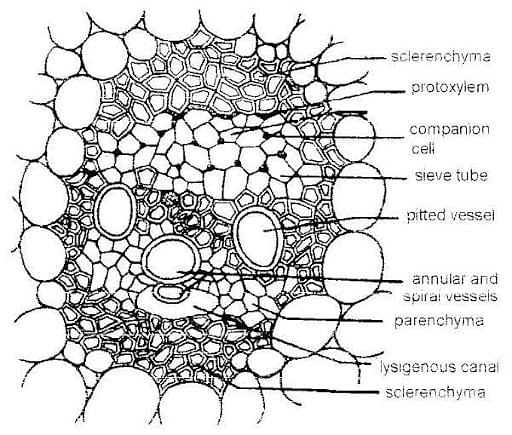
Vascular Bundle
Apoplast, Symplast, and Transmembrane Pathways
[Click Here for Sample Questions]
As we saw above, the transport of water and minerals in plants is done through the Xylem and Phloem vessels, which are various pathways that are used to pass water to the xylem vessels.
The proper transportation of food in plants determines plant growth. Every plant's root is designed in such a way that it aids in the growth of the plant.
Every plant's root is designed in such a way that it aids in the transport of water and other solutes in plants. Two major compartments are involved in the transport of minerals in plants along with water – the apoplastic and symplastic pathways.
What is the Apoplast Pathway?
The apoplastic pathway in plants allows materials to be transported into cell walls and extracellular spaces. In the transportation process, xylem transport plays a role. This is exactly what the term "apoplast pathway" refers to.
What is the Symplast Pathway?
Solutes and water move along the cytosol in the symplastic pathway. When the transport of substances in plants reaches this pathway, the materials must pass through the plasma membrane to move from one cell to the next. This is accomplished through the use of plasmodesmata.
What is the Transmembrane Pathway?
Water and dissolved minerals disperse from one cell to another via the transmembrane route, passing through the cell wall to exit one cell and enter another. Phloem transport contributes to the transportation process.
These three pathways or routes are not mutually exclusive; mineral transport in plants may use more than one pathway if necessary.
Also Read:
Things to Remember
- The symplast is the inner surface of the plasma membrane through which water and low-molecular-weight solutes can freely diffuse. Symplast cells have multiple nuclei.
- The apoplast is essential for all of the plant's interactions with its surroundings. The main carbon source, carbon dioxide, is first solubilized in the apoplast before it moves through the plasma membrane inside the cytoplasm of the and is utilised during photosynthesis by the chloroplasts.
- Acidification of the apoplast increases cell wall extensibility and root growth rate in nitrate-depleted soil. An apoplast also serves as a site for cell-to-cell communication.
- Water moves from one cell to another cell via osmosis in this symplastic pathway, i.e. as water enters one cell, this cell has a higher water potential than the adjacent cell.
Sample Questions
Ques: Why is symplast regarded as a living part of plant tissue? (2 marks)
Ans: Symplast is the living part of plant tissue that lacks a cell wall and intercellular spaces because it is made up of protoplasts connected by plasmodesmata, which are the living part of the cell.
Plant tissue is classified into two types: symplast and apoplast. Symplast, also known as cytoplasmic, is found on the inner side of the plasma membrane, whereas apoplast, also known as a cell wall, is found on the outer side of the cell.
Ques: How does water move in plants? (3 marks)
Ans: The food produced by photosynthesis is transported through the plant's phloem. The phloem tissue in plants is responsible for movement from the leaves to different areas of the plant. The transportation of food in the phloem is successful when the energy from the ATP is used. The material sucrose, for example, is moved into the phloem tissue using ATP energy. Xylem and phloem transport are also used to transport water in their own distinct ways. The two most important parts of the cell are xylem and phloem, which are directly responsible for the distribution of food throughout the plant.
Ques: What's the Distinction Between Symplast and Apoplast? (3 marks)
Ans: The symplast contains intercellular spaces as well as the cell wall, whereas the apoplast contains protoplasm. When it comes to transportation in plants, the two have different metabolic states. The movement of water is unaffected in the apoplast, whereas in the symplast, the flow of water is hampered by the metabolic state in the symplastic pathway. Water and ions are delivered through the apoplastic pathway to the cortex, whereas beyond the cortex it is delivered through the symplastic pathway. As a result, in plant biology, Symplast and Apoplast play critical roles in transport.
Ques: What does Symplast transport? (2 marks)
Ans: Symplasts are protoplasts found in plants that are linked together by plasmodesmata. It is the inner part of the plasma membrane that is responsible for transporting or allowing the free movement of water and other low-molecular-weight solutes such as sugars, amino acids, and other ions between cells.
Ques: What is the symplast pathway?(2 marks)
Ans: The symplastic pathway - It provides the movement of water from one cell to another cell by plasmodesmata. Symplast, can be referred to as the inner part of the plasma membrane.
Ques: What is the component of symplast? (2 marks)
Ans: The living cells and the connections between them are referred to as symplast. The symplast is where starch is stored. The symplast is made up of axial parenchyma, ray parenchyma, sieve tubes, companion cells, cork cambium, the cambium, and plasmodesmata.
Ques: Water is moved from one cell to another via plasmodesmata in which of the pathways? (2 marks)
Ans: Water travels from cell to cell via the symplast pathway via their protoplasm. It does not enter the vacuoles of cells. The cytoplasms of neighbouring cells are linked by plasmodesmata. Individual cell cytoplasmic streaming aids symplastic movement.



Comments