



Education Content Expert
Xylem is an intricate tissue found in vascular plants that plays a crucial role in the survival of a plant. It is composed of tracheary elements, vessels, xylem fibers, and xylem parenchyma cells.
- The primary function of xylem is to transport water and minerals from the soil to the leaves and stems.
- There are two types of xylem cells, primary and secondary, with the latter only present in angiosperms.
- Xylem provides structural support to the plant through lignified fiber cells and also serves as a storage area for parenchyma tissue.
- Wood, one of the most significant renewable raw materials in the world, is also known as xylem.
- The term "xylem" was first coined by Carl Nägeli in 1858.
- Xylem has been present in plants for over 400 million years and is essential for the process of photosynthesis, as plants need to take in water from the soil and carbon dioxide from the atmosphere to produce food.
Read More: NCERT Solutions For Class 11 Biology Chapter 6: Anatomy of Flowering Plants
Key Terms: Xylem, Tissue, Xylem Parenchyma, Angiosperms, Monocots, Dicots, Tracheids, Vascular Plants, Minerals
What is Xylem?
[Click Here for Sample Questions]
Xylem is a vital tissue found in vascular plants that plays a crucial role in the plant's survival and growth. It is responsible for the transportation of water and minerals from the roots to the rest of the plant, providing the necessary nutrients for photosynthesis and overall plant health.
- Xylem is composed of different cell types, including tracheary elements, fibers, and parenchyma cells, which work together to provide structural support and storage capabilities.
- Wood, also known as xylem, is one of the most important and abundant renewable raw materials on the planet.
- Understanding the functions and components of xylem is essential for understanding the inner workings of plants and the importance of their preservation.
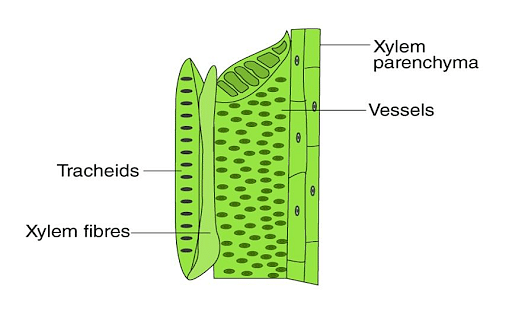
Xylem
Read More: Anatomy of Flowering Plants Important Questions
Functions of Xylem
[Click Here for Previous Year Questions]
Tall trees are constrained in height by xylem because it becomes more difficult to move resources against gravity as a plant gets taller. However, a lot of water evaporates when a plant's stomata, or tiny openings in its leaves that allow CO2 to enter, are open, evaporating considerably more than the CO2 that is taken in. Three factors that influence the flow of xylem sap are:
Root Pressure
Water can migrate through osmosis from the soil into the root if the water potential of the root cells is more negative than that of the soil, usually as a result of high solute concentrations.
- Positive pressure thus pushes the sap up the xylem and toward the leaves.
- The morning is when root pressure is at its highest before the stomata open and let transpiration begin.
- Varied plant species can have different root pressures even in the same area; examples include up to 145 kPa in Vitis riparia but nil in Celastrus orbiculatus.
Pressure Flow Hypothesis
Xylem transports water and minerals, which are much lighter solutes, whereas the phloem system maintains the sugars produced in the leaves and other green tissues.
- Phloem pressure can reach several MPa and is significantly higher than air pressure.
- Due to the selective connectivity between both systems, the high solute concentration in the phloem enables xylem fluid to be pulled upward by negative pressure.
Transpirational Pull
When water evaporates from the mesophyll cell surfaces and enters the environment, it creates a comparable negative pressure at the top of a plant.
- As a result, surface tension causes the xylem to experience negative pressure or stress, which sucks water away from the soil and roots.
- As a result, the mesophyll cell wall develops millions of microscopic menisci.
Read More:
Primary and Secondary Xylem
[Click Here for Sample Questions]
Based on where they come from, xylem cells can be divided into two categories:
Primary Xylem
Primary xylem is created as a result of procambium development.
- Both protoxylem and metaxylem are present in it.
- Growing order is protoxylem first, then metaxylem, then secondary xylem.
- Compared to metaxylem, protoxylem has thinner vessels and no tracheids.
Secondary Xylem
The vascular cambium gives rise to secondary xylem during secondary growth. Although secondary xylem is also observed in the gymnosperm communities Ginkgophyta and Gnetophyta and to a lesser extent in the members of Cycadophyta, conifers (Coniferae) and angiosperms are the two main groups in which secondary xylem may be found.
Xylem Structure
[Click Here for Previous Year Questions]
Xylem of a plant is made by four main types of elements:
Tracheids
The secondary cell wall has bordered pits and apertures that connect the tiny conductive tracheids to one another.
- In conifers without supporting cells, tracheids carry xylem sap and maintain the wood structure.
- Wood from gymnosperms (conifers) and angiosperms contains a large number of tracheids.

Xylem Structure
Vessel
It is known as a vessel element. The principal conductive cell type in angiosperms has a diameter that is typically greater than that of a tracheid and is arranged axially, one above the other, to produce lengthy tubes.
- Interconduit pits, which allow for axial transport in tracheary elements as well as lateral movement of solutes across adjacent conductive elements, are used to transport xylem sap.
- Additionally, pits can link conduits to the non-tracheary xylem parenchyma cells in the area.
Xylem Parenchyma
Xylem parenchyma can be oriented either axially or radially.
- Even though these cells typically have secondary cell walls that are quite thin and frequently lignified.
- They perform a number of key tasks that are crucial for wood and trees.
Xylem Fiber
Dead cells with lignified walls and a central lumen make up xylem fibers, which offer mechanical support for moving water.
Characteristics of Xylem
[Click Here for Sample Questions]
The characteristics of Xylem are as follows:
- Xylem is in-charge of moving nutrients and water from the plant's roots to its stem and leaves.
- It is made up of specialized water-carrying cells termed tracheary components.
- The first tracheary component found in the xylem was a tracheid.
- Tracheids are the only major component of some gymnosperms and other seedless plants for conducting water.
- The second tracheary element in the xylem is the vessel members.
- They are extremely specialized cells when compared to tracheids.
- Even though tracheids are present, the major component, also known as the vessel element, transports water in angiosperms.
Read More: Morphology of Flowering Plants
Xylems of Angiosperms and Vascular Plants
[Click Here for Previous Year Questions]
Angiosperms, usually referred to as flowering plants, are a significant subgroup of vascular plants. The other two are gymnosperms that produce naked seeds, such as ferns, and pteridophytes.
- The xylem tissues of these groupings can be used to distinguish between them.
- For instance, gymnosperms and ferns do not have xylem vessels, although they are found in the xylem tissues of flowering plants.
- They lack xylem vessels and solely have tracheids.
- The xylem vessels supply the main conducting element in the majority of angiosperms.
- Xylem vessels and tracheids, on the other hand, mature without protoplasts and become hollow and non-living.
- The polymer lignin is deposited to form a secondary cell wall.
- Xylem vessels' secondary walls, however, are thinner than the tracheids'. Both of them eventually develop pits in their lateral walls.
Xylem in Monocots and Dicots
[Click Here for Sample Questions]
Monocots (which comprise plants like orchids, bamboos, bananas, palm trees, grasses, and other species of a similar kind) and Dicots are the two primary divisions of angiosperms such as magnolias, roses, sunflowers, strawberries, oaks, sycamores, maples, etc.
- The presence of cotyledons, monocots have one, whereas dicots have two, is the main distinction between the two families.
- Their xylem tissues can be used to distinguish them in addition to the cotyledons.
Development of Xylem
[Click Here for Previous Year Questions]
There are several terms used to characterise the xylem's growth namely exarch, endarch, mesarch, and centrarch.
- Exarch: The xylem develops from the outside inward when there are many primary xylems in roots or stems. As a result, the metaxylem is placed close to the centre while the protoxylem grows close to the perimeter. For instance, vascular plants' xylem develops as an exarch form.
- Endarch: Because the xylem grows from the inside of the plant and spreads outward, the protoxylem formed close to the centre and the metaxylem close to the edge. One example of an endarch mode of development is seen in the stems of the seed plant.
- Mesarch: Xylem develops in each direction from the centre of the main strand. For instance, ferns' stems and leaves develop in a mesarch shape. However, the protoxylem filled the spaces between the metaxylem, which only covered the core and perimeter regions.
- Centrarch: As the primary xylem spreads outward from the cylinder created in the middle of the stem, metaxylem surrounds the protoxylem. For instance, a lot of terrestrial plants grow into centrarchid shapes.
The genesis and growth of xylem tissues occurs in two stages. Cells coming from the procambium differentiate into the primary xylem during the initial growth, also known as the first phase. The xylem tissue, for instance, is created by meristem cells from the procambium and vascular cambium. In the second stage, also referred to as secondary growth, a lateral meristem generates secondary xylem. Research suggests that genetic engineering can be utilized to enhance xylem development and achieve the desired outcomes.
Check More:
Things to Remember
- Xylem is a vascular tissue in plants that conducts water and dissolved nutrients upwards from the root.
- It is made up of Tracheids, Vessels, Xylem Parenchyma, and Xylem Fibre.
- Primary Xylem and Secondary Xylem are the two types of xylem cells based on their origin.
- It transports water and some soluble nutrients from the roots to the entire plant.
- Exarch, Endarch, Mesarch, and Centrarch are the few ways used to describe the growth of xylem.
Previous Years’ Questions
- A meristenatic region present between xylem and phloem… (Haryana PMT - 2007)
- The elements of xylem tissue that stores tannins are… (Haryana PMT - 2012)
- Xylem translocates… (NEET - 2019)
- The older resin clogged secondary xylem in the central… (COMEDK UGET - 2008)
- The chief water conducting elements of xylem in gymnosperms… (NEET - 2010)
- Water lost in guttation is…
- All the xylem elements, when mature, are dead except…
- The given figures are types of elements (A and B) which constitute… (JIPMER - 2018)
- Meristematic tissue inside mature vascular bundle is… (JIPMER - 2011)
- Phloem sap contains…
Sample Questions
Ques. What is Xylem? (2 Marks)
Ans. Xylem is a plant vascular tissue that is used to transport water and dissolved minerals from the roots to the rest of the plant. It also provides physical support to the plant. Xylem is made up of a variety of specialized, water-conducting cells known as tracheary elements. It is found in all vascular plants, including angiosperms and gymnosperms together with phloem.
Ques. Write some characteristics of Xylem (3 Marks)
Ans. The characteristics of the Xylem are as follows:
- It is composed of specialized cells known as tracheary components that convey water.
- Tracheid is the initial tracheary component discovered in the xylem.
- Some gymnosperms and other seedless plants only have tracheids as their main component for conveying water.
- The vessel members make up the second tracheary component of the xylem.
Ques. Write about Xylem in Monocots and Dicots. (5 Marks)
Ans. Monocots and dicots are two major groups of flowering plants that have distinct characteristics in their xylem structure.
- In monocots, the xylem is arranged in scattered, individual vessels, whereas in dicots, the xylem is arranged in a ring-like structure called a vessel element.
- Monocots have more fibrous xylem than dicots, which allows them to be more flexible and better able to withstand bending forces.
- In monocots, the xylem vessels are larger and fewer in number, while in dicots, they are smaller in size and more numerous.
- The xylem cells in monocots are also typically shorter and wider than those in dicots.
- The secondary growth in monocots is minimal as compared to dicots, which results in less developed and smaller xylem in monocots.
- The primary function of xylem is to transport water and minerals from the roots to the rest of the plant, but the structural differences in monocots and dicot xylem also give them different mechanical properties that adapt them to different environments.
Ques. What is Primary Xylem ? (2 Marks)
Ans. Primary xylem is a type of Xylem that is created when the procambium grows. Protoxylem and metaxylem are both present in Primary Xylem. Metaxylem and secondary xylem develop after protoxylem. As opposed to metaxylem, protoxylem contains thinner vessels and no tracheids.
Ques. What is Root Pressure Theory? (3 Marks)
Ans. Root hairs and xylem vessels transfer soil-borne water that has been sucked up by the roots.
- Mineral ions are ingested by plants' xylem tubes and subsequently absorbed by the roots.
- Water flows between areas with different water potentials.
- Xylem sap will dribble from a plant stem that has been transversely severed above the soil level.
- This implies that the xylem has positive pressure.This force is referred to as root pressure.
Ques. Does transpiration in plants have any beneficial purposes? (2 Marks)
Ans. Transpiration helps the xylem sap migrate. It improves the roots' capacity to take up mineral nutrients from the soil. While some of the solar radiation that is absorbed by the leaves is used for photosynthesis, other radiations heat the leaves. However, transpiration significantly reduces this warmth of the leaves.
Ques. What is Xylem Parenchyma? (3 Marks)
Ans. "Xylem Parenchyma" refers to the parenchyma cells attached to the xylem. In the secondary xylem, parenchyma cells mostly come in two varieties. Axial parenchyma cells are organized around the axis. The radial parenchyma is composed of cells organized in a ray pattern that radiates from a central point.
Ques. Define Xylem of Angiosperms. (3 Marks)
Ans. Angiosperms are an important subset of vascular plants sometimes referred to as blooming plants.
- The other two are gymnosperms like ferns and pteridophytes, which produce naked seeds.
- These groupings can be separated using their individual xylem tissues. While xylem vessels are present in the xylem tissues of flowering plants, gymnosperms and ferns do not have them. They only have tracheids and no xylem vessels.
- The bulk of angiosperms receive their primary conducting component from xylem vessels.
Ques. Explain the development of Phloem. (5 Marks)
Ans. Phloem Development is a complex process that occurs in vascular plants. It begins with the differentiation of cells in the apical meristem, the actively dividing region at the tip of a plant's shoot or root. These cells differentiate into various cell types, including the precursor cells for phloem.
- These precursor cells then divide and differentiate into the various cell types that make up the phloem, including sieve tube elements, companion cells, and phloem fibers.
- The sieve tube elements are elongated cells with perforated end walls that form the transport system of the phloem.
- They are responsible for transporting sugars and other organic compounds throughout the plant.
- Phloem fibers provide mechanical support to the phloem tissue.
- Phloem development is also regulated by various hormones and transcription factors.
Ques. What is Secondary Xylem? (2 Marks)
Ans. The vascular cambium creates secondary xylem during secondary growth. Secondary xylem can be present in angiosperms and conifers (Coniferae), as well as in the gymnosperm communities Ginkgophyta and Gnetophyta and, to a lesser extent, in some Cycadophyta members (Angiospermae).
Check-Out:



Comments