



Education Journalist | Study Abroad Lead
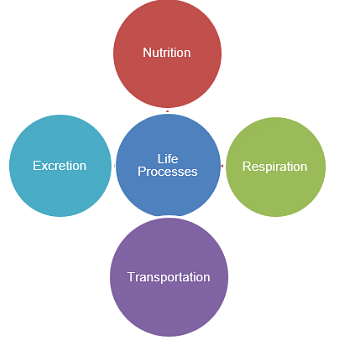
Our body keeps on functioning even when we are out of action. This is because all the living organisms depends on life processes that tells us we are alive. Life processes are referred to as series of actions which together perform the function of maintainance of life. Some of the examples of life processes are movement, respiration, nuitrition, circulation, excretion.
| Table of Content |
Key Terms: Life process, respiration, nutrition, circulation, excretion
Define Life Processes
[Click Here for Sample Questions]
- Living organisms are moving, resting, or sleeping so maintenance is required during each phase.
- Maintenance of “Life” is performed by various processes which together are termed as “Life Processes”.
- Examples of Life processes are Nutrition, respiration, circulation, excretion, etc.
- There are two types of cellular organisms: Unicellular and Multicellular
- In Unicellular organisms, all life processes are performed by a single cell. Example: Amoeba
- In Multicellular organisms, a group of cells becomes well-developed that performs various life processes.
Read More:
| Related Topics | |||
|---|---|---|---|
| Heterotrophic | Nutrition in Human Beigns | Transportation in Plants | |
| Autotrophic Nutrition | Excretion | Respiration | |
Nutrition
[Click Here for Sample Questions]
The process by which living organisms acquire food for nourishment and their sustenance is called Nutrition.
Modes of Nutrition

Modes of Nutrition
- Autotrophic Nutrition: - The type of nutrition where the organism makes its own food, with the help of sunlight or chemicals, is termed as “Autotrophic Nutrition”.
- Plants use the photosynthesis process by using sunlight for their nutrition, so they are called Photoautotrophs.
- There are some bacteria that use chemicals to get energy, so they are called Chemoautotrophs.
- Heterotrophic Nutrition: - The type of nutrition where the organisms are depending on other organisms for their food is termed as “Heterotrophic Nutrition”.
- Organisms depend on autotrophs to meet their nutritional requirements.
- Organisms that eat plants and their products are called herbivores.
- Organisms that eat the flesh of other animals are called Carnivores.
Read More: Life Processes Important Question
Types of Heterotrophic Nutrition
- Holozoic Nutrition:- It is the mode of nutrition in which animals take their food as a whole and the food will pass through 5 step process which is mentioned below:
- Ingestion:- The process of intake of food is termed Ingestion.
- Digestion: The process of breaking complex food into simple molecules is termed Digestion.
- Absorption: The digested food is absorbed by the process called Absorption.
- Assimilation: This process helps in utilizing the digested food to get energy for the body and for the repair of some body parts.
- Egestion: The process of removal of Undigested food from the body is termed as Egestion.
- Saprophytic Nutrition:- The mode of nutrition in which organisms feed on the dead and decaying organic matter is called Saprophytic Nutrition. In this kind of nutrition, food is digested partially outside the body of the organism and then absorbed. Example:- Fungi
- Parasitic Nutrition:- The mode of nutrition in which an organism feed on another organism’s body, which in turn can cause harm to the host body, is called Parasitic Nutrition. There are two types of parasites:-
- Endoparasite:- The parasite which lives inside the host body is called Endoparasite. For example- Ascaris
- Ectoparasite:- The parasite which lives outside the host body is called Ectoparasite. For example- Leech
Nutrition in Unicellular Organisms
- Nutrition Process in Amoeba
- Phagocytosis is the process by which amoeba engulf the whole food by using Pseudopodia i.e. false legs.
- The engulfed food then gets enclosed in the food vacuole.
- Food vacuole then passes through the cytoplasm where digestion, absorption, and assimilation take place.
- Food vacuole opens outside to remove the waste from the body by the process called egestion
Five Steps process of Nutrition

- Nutrition in Paramoecium
- Paramoecium has cilia that help them to engulf the food by an oral groove.
- Food is then enclosed in a food vacuole.
- With the help of cyclosis, process food passes through the cytoplasm which will absorb the digested food.
- Undigested food is given out through a tiny pore called cytopyge or anal pore.
Read More : Life Processes Revision Notes
Nutrition in Multicellular Organisms (Human Beings)
Humans are omnivores i.e. they eat plants as well as animals based foods. Humans’ digestive system process is complicated as they have a complex body structure. Five stages in the digestive system process are- Ingestion, Digestion, Absorption, Assimilation, and Egestion. Out of the above-mentioned stages of digestion- Ingestion, Digestion, Absorption, and Egestion takes place in the Alimentary canal while assimilation of food takes place in the whole body.
Steps of the Digestion Process
Digestion of food in the buccal cavity is a mechanical process where teeth chew the food and saliva gets mixed with chewed food and it forms “Bolus”. Salivary amylase gets secreted in the buccal cavity which will help in the digestion of starch which converts it into maltose. The food through the food pipe reaches to the stomach where churning of food takes place and food is broken down into simpler substances. In the stomach, digestion of protein starts which the help of the pepsin enzyme which converts them into smaller substances called “peptide”.
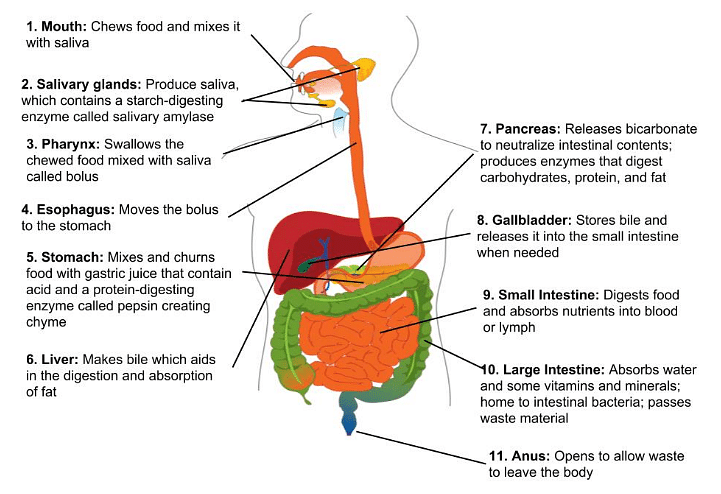
Bolus combines with gastric juice to convert bolus into soluble chyme. Chyme reaches the small intestine where complete digestion of food takes place with the help of various enzymes present in pancreatic juice, bile juice, and intestinal juice. The food is then absorbed completely with the help of villi and microvilli of the small intestine. The food which is left undigested then enters into the large intestine. The colon present in the large intestine is responsible for the absorption of water and salt whereas the rectum stores waste till the time it comes out from the body.
Do Check :
| Important Topics | |||
|---|---|---|---|
| DNA Packaging | DNA Replication | Trascription | |
| Difference between Arteries and Veins | Difference between Cell and Tissue | Breathing in Other Animals | |
Respiration
[Click Here for Sample Questions]
Respiration can be defined as the process through which an exchange of gases takes place in the body of an organism. It helps in the burning of food so that energy can be released.
Respiration is of two types:
- Aerobic respiration: - Burning of food to release energy in the form of ATP(Adenosine Triphosphate) with the help of oxygen is known as Aerobic respiration.
Glucose(From food) + Oxygen -------- > Energy (ATP) + Carbon Dioxide + Water
- Anaerobic respiration: - Burning of food in absence of oxygen is known as Anaerobic respiration
Transportation in Animals
The transportation process in human beings is done through the circulatory system. It mainly consists of blood, blood vessels, and the heart. It is mainly responsible for the transportation of oxygen to all parts and the removal of carbon dioxide.

Heart:
- It is the muscular organ that is located near the chest slightly towards the left in the thoracic region.
- It is divided into four chambers, 2 arteries and 2 ventricles which are responsible for the transportation of oxygenated and deoxygenated blood in the body
Blood vessels
- They are responsible for carrying blood throughout the body.
- There are three types of blood vessels in the body: Arteries, Veins, and blood capillaries.
- Arteries are responsible for carrying oxygen-rich blood and veins carry deoxygenated blood.
Read More : Tissue Culture
Transportation in Plants
[Click Here for Sample Questions]
It is the process of transportation of water and other necessary nutrients to all parts of plants for their growth and development. Plants contain xylem which is responsible for the transportation of water whereas phloem responsible for the transportation of food.
Read More: Blood Pressure Symptoms
Excretion in Human Beings
[Click Here for Sample Questions]
The process of removal of waste products and other substances which are not useful for the human body is termed Excretion.

Excretory system
The excretory system in human beings includes
- Kidneys – Human body has a pair of kidneys that helps in the process of filtration. It contains many small filtration units called nephrons. The main functions of kidneys are as follows:
- It filters waste, toxic substances from the blood.
- It maintains the balance of fluid in the body which is also known as Osmolarity.
- It is responsible for regulating ion concentration in the body.
- It helps in the regulation of pH.
- It secretes hormones that help in the production of RBC and regulate blood pressure.
- A pair of ureters- They are responsible for carrying urine which is produced in Kidneys from Kidneys to the bladder.
- A urinary bladder – It is a storehouse of urine. The bladder stores urine till the time it comes out from the body.
- Urethra- Urethra carries urine out from the body of human beings.
Read More: Nervous system
Excretion in Plants
[Click Here for Sample Questions]

Excretion in Plants
The plant produces various excretory products like carbon dioxide and excess water which are the major waste products in plants produced in the process of respiration, photosynthesis, and other metabolic reactions. Plants produce oxygen in photosynthesis and carbon dioxide during respiration as waste products which comes out from plant through small pores called stomata in leaves. The other waste products are gums, latex, resins, etc which are stored in parts of the plant like barks, stems, leaves, etc.
Read More: Basic concept of nutrition
Sample Questions
Ques: Explain the process of photosynthesis in plants? (2 Marks)
Ans. It is the process of making food in the plant body. It makes food by using sunlight and water which helps in nourishments to other organisms and themselves. Chlorophyll absorbs sunlight which helps in the breakdown of water into hydrogen and oxygen. Hydrogen is then used to make glucose from carbon dioxide and oxygen is released.
Ques: What is hemodialysis? (2 Marks)
Ans. When kidneys in the human body fail to perform the function of excretion then there is a need to go for a machine filter called a dialyzer or artificial kidneys where the excretion process takes place outside the body. During the process, the blood from the human body is removed and allowed to move through several semi-permeable membranes to take out impurities from the blood. This process is known as hemodialysis.
Ques: What is the difference between xylem and phloem? (4 Marks)
Ans.
| Xylem | Phloem |
|---|---|
| It is responsible for the transportation of water and minerals from roots to the upper parts of the plant body. | It is responsible for the transportation of food and nutrients from leaves to other growing parts of plants. |
| Movement is Unidirectional. | Movement is bidirectional. |
| The nature of tissues in the xylem is hollow dead cells | The nature of tissues is living with cytoplasm but without a nucleus. |
| These tissues are present in the center of the vascular bundle. | Phloem tissues are present outside the vascular bundle. |
Ques: What do you mean by double circulation? (2 Marks)
Ans. Blood circulates in the human body through the heart twice. The first time during pulmonary circulation, it goes through the heart, and the second time during systemic circulation. Hence, circulation in human beings is termed as double circulation.
Ques: What is ATP? (2 Marks)
Ans. ATP is commonly referred to as the energy currency of the cell. It stands for Adenosine Tri Phosphate. This is created as part of the result of processes photosynthesis, respiration, etc. When ATP’s are broken they release a large amount of energy which can be used for other metabolic processes.
Ques: What do you mean by enzymes? Name any one enzyme of our dugestive system and write its function. (2 Marks)
Ans. Enzymes are biological catalysts which are protiens that increase the rate of chemical reactions without being used up. For instance, Amylase catalyses the breakdown of starch into sugars in the mouth and small intestine.
Ques: What are the raw materials required for photosynthesis. (3 Marks)
Ans. The raw materials that are required for photosynthesis are,
(i) Carbondioxide: Plants get CO2 from atmosphere through stomata.
(ii) Water: Plants absorb water through roots from soil and transport to leaves.
(iii) Sunlight: This is absorbed by the chlorophyll and other green parts of the plants.
Read More:



Comments