



Content Curator
Reproduction in bacteria is just like any other organism, to continue their species.
- Bacteria are microbes with only one cell.
- The cell structure is simpler than that of other species since there is no nucleus or membrane-bound organelles.
- Bacteria are classified as prokaryotes because they are unicellular and don't have well-organized cells.
- Each division cycle (generation) of a bacterial population produces two cells, four cells, eight cells, sixteen cells, 32 cells, and so on.
- They do, however, show both sexual and asexual reproduction.
- An organism that reproduces sexually combines the genetic information from both parents and is genetically unique.
- Asexual reproduction occurs when one parent replicates itself to produce genetically identical offspring.
| Table of Content |
Key Terms: Bacteria, Sexual reproduction, Asexual reproduction, Microorganism, Prokaryotes, Unicellular organism, Fragmentation
Reproduction in Bacteria
[Click Here for Sample Questions]
Bacteria, like all other organisms, reproduce in order to perpetuate their species.
- Bacteria are classified as prokaryotes because they are unicellular and lack a well-organized cell.
- They do, however, exhibit both sexual and asexual modes of reproduction.
Also check:
| Related Concepts | ||
|---|---|---|
| Pollen Grains | Blastocyst | Menstrual Cycle |
| Binary fission | Infant Mortality Rate | Embryology |
Asexual Reproduction in Bacteria
[Click Here for Sample Questions]
There are five methods of asexual reproduction in bacteria. They are as follows:
Binary Fission
A single bacterial cell divides into two daughter cells during binary fission.
- The bacterial cell initially reaches critical mass in terms of structure and cell components.
- The bacteria's circular double-stranded DNA replicates, resulting in the formation of new complementary strands.
- As the duplicated DNA strands move to opposite poles of the cell, a transverse septum begins to form in the central region.
- This dividing wall gradually bisects the cytoplasm, ultimately separating the two new daughter cells, and completing the process of binary fission.
- It is a quick process that takes only a few minutes to finish.
Conidia-based reproduction
Conidia are formed in filamentous bacteria such as Streptomyces by the creation of a transverse septum at the apex of the filament.
- The component of the cell that contains the conidia is known as the conidiophore, and once separated from the mother cell, it germinates in a suitable substrate, giving rise to new mycelium.
- This sort of asexual reproduction is referred to as fragmentation.
Budding
In this form of reproduction, the bacterial cell develops a tiny bulge on one side that grows in size over time.
- At the same time, the nucleus divides, with one half with some cytoplasm entering the swelling and the other remaining with the mother cell.
- The bud is the name given to the protrusion, which is eventually separated from the mother cell by a partition wall.
- In bacteria, this type of reproduction is also known as vegetative reproduction.
- Rhodomicrobium vannielii is an example.
Cyst formation for reproduction
Cysts are the resting structure during adverse conditions, generated by the deposition of extra layers around the mother cell.
- When the conditions are favourable again, the mother cell resumes its regular behaviour.
- Azotobacter is a good example.
Endospore formation for reproduction
Endospores are generated in a bacterial cell amid severe conditions such as desiccation and hunger.
- They have a central protoplast and a core that contains DNA, ribosomes, enzymes, and the t-RNA, all of which are required for the development of a new cell.
- In one bacterial cell, only one endospore is generated, and upon germination, it gives rise to a new bacterial cell.
- However, genetic recombination is not observed in asexual reproduction, which is why sexual reproduction is so important in the survival of a bacterial species.
- This is because, during sexual reproduction, genetic material is shared between two cells, facilitating genetic recombination and causing genetic drift in a bacteria's species.
Sexual Reproduction in Bacteria
[Click Here for Sample Questions]
It was once thought that sexual reproduction did not occur in bacteria.
- Lederberg and Tatum (1946) demonstrated that bacteria can reproduce sexually.
- They were given the Nobel Prize for this finding.
Bacteria reproduce sexually in three methods, which are as follows:
Transformation
During transformation, a bacterium absorbs DNA from its surroundings as well as DNA released by other bacteria.
- Griffith identified the phenomenon in 1928, and Avery worked out the mechanism in 1944.
- The DNA of a capsulated bacteria is transferred into a non-capsulated organism through this process.
- A plasmid is a circular piece of DNA.
- The plasmid can be replicated in the recipient cell and passed on to offspring.
Transduction
Foreign genes are transmitted into a bacterial cell with the help of a virus in this sort of sexual reproduction of bacteria.
- These viruses are known as bacteriophages, and they are not dangerous.
- The virus works as a vector for gene transfer from one host to another.
- Transducing bacteriophages may contain the same genes, in which case the reproduction process is referred to as restricted transduction.
- They can also convey various genes at different times, which is known as generalised transduction in the reproduction process.
Conjugation
Tatum and Lederberg identified this mechanism in Escherichia coli in 1946.
- They discovered that when two distinct types of nutritional mutants were cultivated together on a minimum medium, an occasional wild type was created.
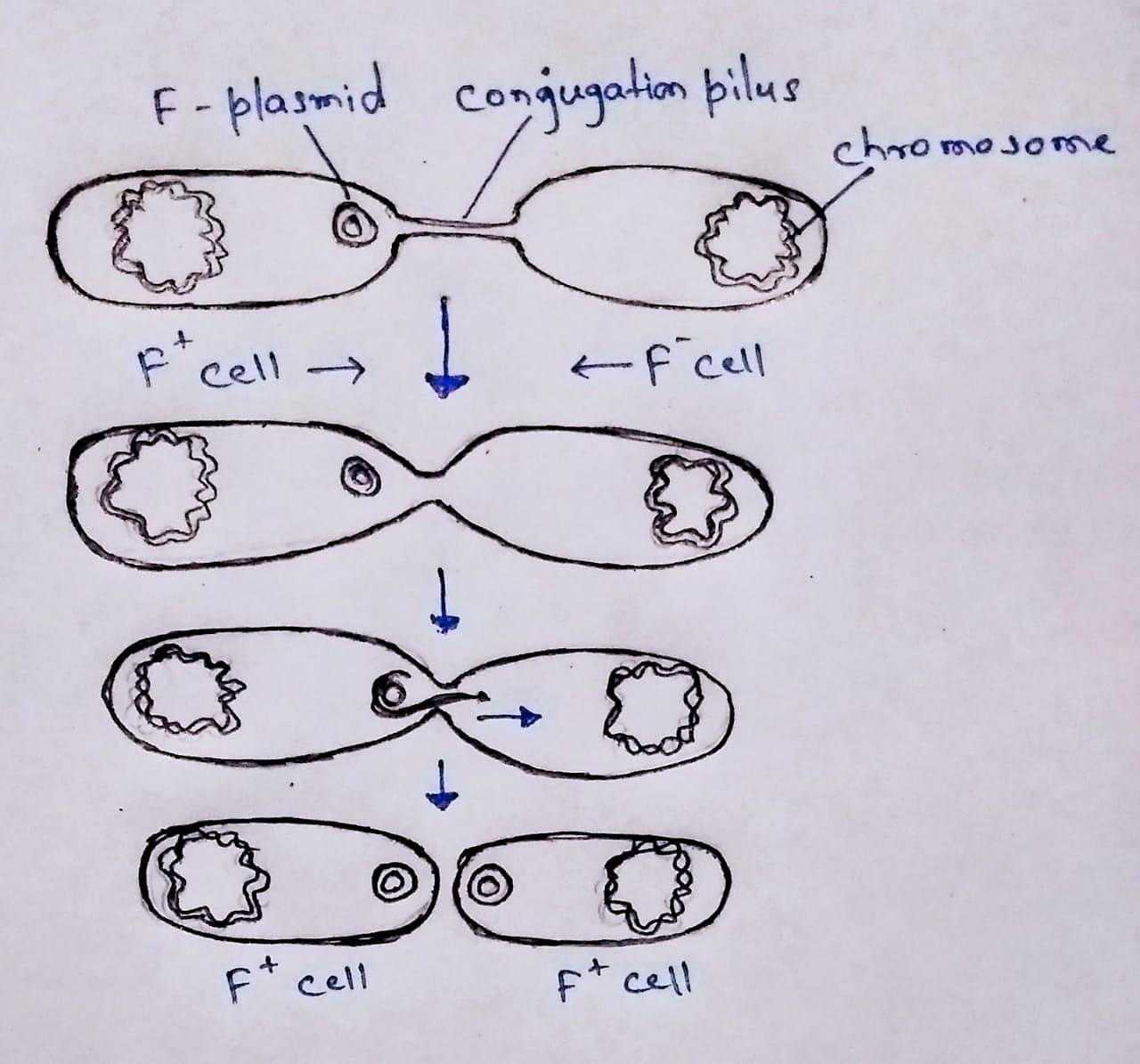
- Bacteria that conjugate are dimorphic, which means they have two kinds of cells, one male (F+) or donor cell and one female (F-) or receiver cell.
- The male or donor cell has 1 to 4 sex pili on its surface as well as a fertility factor (transfer factor, sex factor) in its plasmid.
- It contains genes that produce sex pili as well as other characteristics required for gene transfer.
- Sex pili are slender protoplasmic outgrowths that range in size from one to four.
- The sex pili and the fertility factor are not present in female or recipient cells.
- If these two types of cells come into contact, a male cell's pilus forms a protoplasmic bridge or conjugation tube with the female cell.
- The process takes 6-8 minutes to finish.
- These are the three methods of sexual reproduction in bacteria, and they introduce genetic variety in a bacterial species, which is vital for any species' survival and allows groups to adapt to environmental changes.
Things to Remember
- Binary fission is one of the methods used by bacteria to reproduce.
- The bacteria, which is a single cell, divides into two identical daughter cells during this procedure.
- Lederberg and Tatum (1946) demonstrated that bacteria can reproduce sexually.
- There are two strains of gramme negative bacteria: F+ (with fertility factor and sex pili) and F– (without fertility factor and sex pili) (without fertility factor and sex pili).
- The process by which a single cell divides into two genetically identical cells is known as binary fission.
- Bacterial cells exist in 3 shapes: rod-shaped, spherical, and spiral.
- A cell wall, a cellular membrane, the cytoplasm, flagella, a nucleoid region, plasmids, and ribosomes are all common bacterial cell components.
- Recombination, which includes the transfer of genes across cells, can help bacteria grow more genetically diverse because binary fission creates identical cells.
Sample Questions
Ques. What exactly are Transposable Elements? (3 Marks)
Ans. Transposable elements play a significant role in bacterial genetics as well. These are sections of DNA that "jump" from one location to another inside a genome, cutting and pasting themselves or inserting copies of themselves in new locations. Transposable elements in bacteria can sometimes carry genes for antibiotic resistance and pathogenicity (genes that cause bacteria disease). If one of these elements "jumps" from the chromosome into a plasmid, the genes are easily transferred to other bacteria via conjugation or transformation. This means that the genes can fast propagate across the population.
Ques. What is reproduction in microbiology? (2 Marks)
Ans. Reproduction is a biological process that an organism uses to ensure the survival of its species. There are two types of reproduction: sexual reproduction and asexual reproduction. Both are found in microorganisms. Reproduction is a biological process that an organism uses to ensure the survival of its species.
Ques. What is bacteria? (1 Mark)
Ans. Bacteria are single-celled creatures that are small in size. Bacteria can be found everywhere on the earth and are essential to the planet's ecosystems.
Ques. Are Bacteria Sexual or Asexual Reproducers? (2 Marks)
Ans. Bacteria can reproduce both sexually and asexually. Sexual reproduction occurs via the following mechanisms:
- Conjugation
- Transformation
- Transduction
They bring new features into the new daughter cell through genetic recombination or the exchange of genetic material. As a result, genetic variety exists within the species.
Bacteria reproduce asexually via
- Budding
- Fragmentation.
- Binary Fission
- Formation of a cyst
- Formation of endospores
They aid a bacterial cell's fast proliferation as well as survival in adverse environmental conditions.
Ques. What are the several bacteria types? (1 Mark)
Ans. Bacteria are classified into several groups depending on their form, cell wall composition, mode of respiration, and mode of nourishment.
Ques. What exactly is a bacteria? What do you mean when you say bacteria? (2 Marks)
Ans. Bacteria are unicellular prokaryotic creatures. In comparison to eukaryotic cells, they have a comparatively basic cell structure. They don't have any membrane-bound organelles, such as a nucleus, either. They, however, have genetic material (DNA or RNA) in the nucleoid, the intracellular space.
Ques. What is the process through which bacteria reproduce? (2 Marks)
Ans. Bacteria reproduce using a method known as binary fission. A single bacterium divides into two daughter cells during this process. These offspring cells are identical to each other and to the parent cell.
Ques. In bacteria, what form of cell division can be seen? (3 Marks)
Ans. Bacteria are unicellular prokaryotic creatures. Cell division in bacteria is amitotic. Mitosis and meiosis are the other two forms of cell division. Amitosis is a process that primarily involves lesser organisms. The chromatin fibres do not condense in amitosis. Cell division is accomplished by cleaving the nucleus and dividing the cytoplasm without the creation of spindles. As a result, the right response is 'Amitotic.'
Ques. Define Binary fission reproduction in bacteria. (2 Marks)
Ans. Binary fission is asexual reproduction in which the body is split into two new bodies. Binary fission occurs when an organism copies its genetic material, or deoxyribonucleic acid (DNA), and then divides into two halves (cytokinesis), each obtaining one copy of DNA. Binary fission is the most common way for bacterial organisms to reproduce.
Ques. What are the 3 types of reproduction in bacteria? (2 Marks)
Ans. Bacteria reproduce vegetatively, sexually, and asexually. Budding, fragmentation, and binary fission are examples of vegetative methods. In budding, the bud develops from the end of the cell.
For Latest Updates on Upcoming Board Exams, Click Here: https://t.me/class_10_12_board_updates
Also Read:



Comments