



Education Journalist | Study Abroad Lead
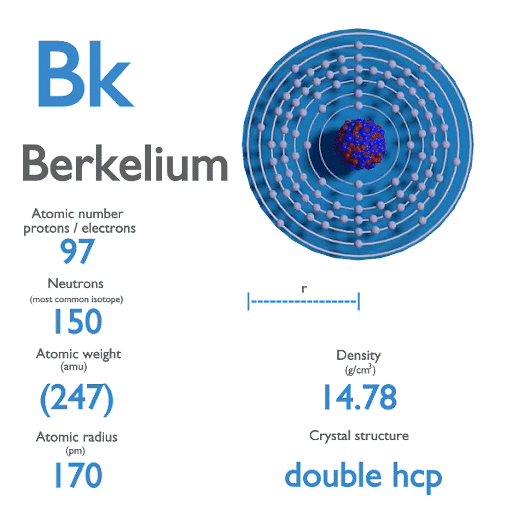
Berkelium is a radioactive element having atomic number 97 and has the symbol Bk. This element is a member of the actinide and transuranium element series in the periodic table. It was discovered in December 1949 and it became the fifth transuranium element after neptunium, plutonium, curium, americium. Berkelium belongs to the period 7th and F-block of the periodic table and it remains in the solid-state at standard temperature and pressure. The atomic mass of Bk is 247 and the electronic configuration is 5f97s2. The major isotope of Bk is 249Bk is synthesized in small quantities in dedicated high flux nuclear reactors.
| Table of Content |
Key Terms: Berkelium, Occurrence of Berkelium, Radioactive Elements, Transuranium Element, Temperature, Pressure, Atomic Number, Atomic Mass, Actinoids, Electronic Configuration
What is Berkelium?
[Click Here for Sample Questions]
Berkelium is one of the elements in the periodic table that has the atomic number 97. Its atomic symbol is “Bk”. It is a transuranic element and it belongs to the actinoid series. The other transuranic elements are neptunium, plutonium, curium, americium. It belongs to period 7 and is an F-block element in the periodic table. This element remains solid at room temperature and standard pressure. The atomic mass for this element is calculated to be 247 and has an electronic configuration 5f97s2.

Berkelium
Here are some important details about Berkelium:
| Element Name | Berkelium |
| Symbol | Bk |
| Atomic Number | 97 |
| Group | Actinoids |
| Period | 7 |
| Block | F |
| Atomic Mass | 247 |
| Configuration | 5f97s2 |
| Physical State | Solid |
Discovery of Berkelium
[Click Here for Sample Questions]
Berkelium is named after the city Berkeley in California. It was discovered in the Lawrence Berkeley national laboratory in December 1949. This element is currently synthesized in a dedicated high flux nuclear reactor in Oak ridge national laboratory in Tennessee, USA. Glenn T. Seaborg, Kenneth Street, Jr., Stanley G Thompson, and Albert Ghiorso were the first to produce this radioactive metal.
Read More: Electronic Configuration of First 30 Elements
Occurrence of Berkelium
[Click Here for Sample Questions]
As we know that Bk is a radioactive element, therefore the half-lives of this element is very less. So no primordial Berkelium metal could have survived since the formation of the Earth. Bk is only found in those areas where nuclear incidents take place. The place where the nuclear weapons were tested between 1945 to 1980 should contain this element. When the USA was testing its first hydrogen bomb, it remains consisted of many actinoids including berkelium. This element can also be found in nuclear reactors during the chemical reaction process.
Properties of Berkelium
[Click Here for Sample Questions]
Berkelium is a very soft, silvery-white-coloured radioactive metal. The berkelium 249 isotope is found to emit low energy electrons from it and thus it makes it safe to handle. Because this is a radioactive metal, it has a half-life of 330 days when it decays to form californium 249. Californium 249 is found to emit strong ionized alpha particles. In the periodic table, it is located to the right of actinide curium, to the left of actinide californium. It is situated below the lanthanide terbium with which it shares many characteristics.
- The density of this element is 14.78g/cm3 whose value lies between that of curium and californium.
- The melting point of the metal is 986o C which is less than californium and more than curium.
- The bulk modulus of berkelium is calculated to be 20Gpa which is very low compared to all the actinoids.
- It is found to behave as paramagnetic material between 70K and room temperature.
- Bk dissolves in many inorganic acids similar to actinoids and evolves the hydrogen gas.
- The most stable oxidation state for this metal is found to be +3 (trivalent), which is mostly found in aqueous solutions. The other oxidation states are +2 (divalent) and +4 (tetravalent) .
Properties of Berkelium
Isotopes of Berkelium
[Click Here for Sample Questions]
Till now there are about 20 isotopes of Bk are found by scientists. The mass number of these isotopes vary between 233 to 253 where six of them are found to be nuclear isotopes. All of the known isotopes of berkelium are radioactive in nature. Therefore they have half-lives of microseconds to a few days. 247Bk is found to have the longest half-life of about 1380 years. The half-life of 248Bk is around 300 years and 249Bk is around 330 years.
249 Bk is one of the most easy-to-synthesised isotopes. This element emits particles, which are very low on energy that making them difficult to detect. It also emits alpha particles which are also very low energetic.
Read More: Atomic Number and Mass Number
Things to Remember
- Berkelium is a radioactive element having atomic number 97 and has the symbol “Bk”.
- Berkelium belongs to period 7 and is an F-block element in the periodic table.
- Berkelium remains solid at room temperature and standard pressure.
- 249Bk has a half-life of 330 days when it decays to form californium 249.
- There are about 20 isotopes of Bk that are found by scientists.
- Six of the isotopes of berkelium are nuclear isotopes.
- 247Bk is found to have the longest half-life of about 1380 years.
- The density of this element is 14.78g/cm3 whose value lies between that of curium and californium.
Sample Questions
Ques. What are the uses of berkelium? (3 Marks)
Ans. The synthesis of berkelium is a very expensive process and limited too. Till now no real-life use of berkelium is found. Scientists synthesize this element and its isotopes to study its properties and to learn more about radioactivity. This element is also used to synthesize more transuranic elements from the actinoid series. It is an essential source for the production of californium-249, which is used by scientists for research. Bk element does not exist in nature, therefore it is produced by scientists in the laboratory.
Ques. What health issues can berkelium cause? (3 Marks)
Ans. Producing berkelium is a very expensive process, therefore scientists are not able to produce Bk in significant amounts. Hence, the effect of this metal inside the human body is not much clear. According to the study isotope, 249Bk is not much harmful to humans as it emits electrons of very low energy. However, after some time it will be converted into californium-249 which is extremely dangerous. The intake of Bk by rats are found to cause cancer in various organs in the body. The radiation after the ingestion can also cause a major effect on red blood cells in the body.
Ques. Write some physical properties of berkelium. (3 Marks)
Ans. Some of the physical properties of Berkelium are
- The density of berkelium is 14.78g/cm3.
- A neutral atom of Bk has an ionization potential of around 6.2 eV.
- Berkelium has hexagonal symmetry, the crystal structure changes with pressure and temperature.
- Berkelium is soft relative to the other elements and has the lowest bulk moduli among the actinides, at about 20 GPa.
Ques. How do we separate berkelium from its compounds? (3 Marks)
Ans. It is known that berkelium normally found is in a +4 oxidation state and is generally stable in liquids greatly assisting in the separation of berkelium from many other actinides. These are produced in huge amounts during nuclear reactions and generally favours +3 state. Berkelium(+4) is extracted with ion exchange, extraction chromatography, and many other complex methods. Lithium chloride agent is normally used in the separation of berkelium (+4) state.
Ques. How berkelium was prepared in the laboratory? (3 Marks)
Ans. At the laboratory, a 60-inch cyclotron was used for this purpose. First, an ammonium nitrate solution was coated on aluminium foil. Then, it was evaporated to convert the residue to americium dioxide by annealing. Finally, the scientists irradiated the target with alpha particles for as long as six hours. This experiment leads to the production of Berkelium-243 isotope along with two free neutrons
Ques. Comment on the oxidation states of berkelium. (3 Marks)
Ans. Berkelium doesn't react with oxygen at room temperature because it forms a protective oxide layer surface. But Bk can react with molten metals, halogen, chalcogen and hydrogen to form many binary compounds. In acids, Bk+3 is found to be in green colour. In sulphuric acid, the colour of Bk+4 atoms is orange-yellow whereas it is yellow in hydrochloric acid.
Ques. Write a short note on the discovery of berkelium. (3 Marks)
Ans. Berkelium was the fifth transuranic element that was discovered in the actinoid series. It was prepared in California, USA by three scientists namely Stanley Thompson, Gleann Seaborg, and Albert Ghiorso. They bombarded seven milligrams of americium -241 with alpha particles in a cyclotron. Berkelium was isolated in greater quantities by Burris Cunningham and Stanley Thompson in 1958. The element was named after the city of Berkeley, California where it was first prepared.



Comments