



Content Curator
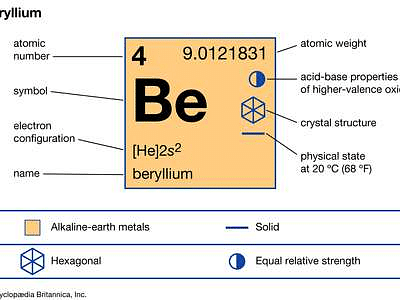
Beryllium is a chemical element. found in the Modern Periodic table’s 2nd group’s 2nd period. It is represented by the symbol Be and its atomic number is 4. Its physical properties include having a steel-grey colour and being lightweight, brittle and strong. It is an alkaline earth metal.
| Table of Content |
Read More: Fehling Test
Beryllium Definition
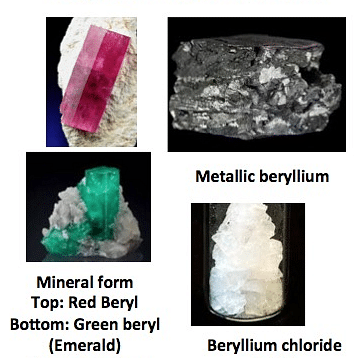
Beryllium is available in nature in the form of minerals as it is a divalent element that combines with other elements. Some of the gemstones containing beryllium include Aquamarine beryl, Emerald beryl and chrysoberyl. It usually occurs when large atomic nuclei that have collided with cosmic rays have spallation, so it is very rare. Beryllium is available on the earth’s crust for about 0.0004 per cent by its mass.
Beryllium is used for making parts for missiles, spacecraft, aircraft and satellites as it has thermal stability, high rigidity, low density and thermal conductivity. Beryllium is almost transparent to ionizing rays such as X-rays as it has low atomic mass and density.
Also Read:
Physical Properties of Beryllium
- Beryllium is a hard metal and steel grey, and it is brittle at room temperature. Its Structure is of a close-packed hexagonal crystal.
- It has great stiffness and has a melting point of 1287 Celsius.
- Beryllium’s modulus of elasticity is almost 50% greater than that of steel.
- It has a fast sound conduction speed of about 12.9 km/s.
- It has thermal conductivity (216 W·m−1·K−1) and high specific heat (1925 J·kg−1·K−1).
- It has a low linear thermal expansion’s coefficient (11.4×10⁻⁶ K−1).
Chemical Properties of Beryllium
- Beryllium electronic configuration - [He] 2s2.
- The oxidation state of beryllium is +2.
- Beryllium has a small atom and ionic radii.
- It has high ionization potentials and strong polarization when it is bonded to other atoms and that is the reason for its compound being covalent. It has a diagonal relationship with Aluminium.

- Beryllium prevents reaction with air by forming a 1−10 nm-thick oxide passivation layer on the surface.
- Beryllium burns brilliantly when it is heated in the air at around 2500 °C and forms a mixture of beryllium nitride and beryllium oxide.
- Beryllium dissolves in non-oxidizing acids, such as dilute H2SO4, and HCl. It also dissolves in alkali solutions.
Also Read:
Production of Beryllium
- Beryllium is typically extracted from the mineral beryl, that's either sintered by the use of an extraction agent or melted right into a soluble mixture.
- The sintering technique entails mixing beryl with sodium fluorosilicate and soda at 770 °C (1,420 °F) to form sodium fluoroberyllate, aluminium oxide and silicon dioxide.
- Beryllium hydroxide is triggered from an answer of sodium fluoroberyllate and sodium hydroxide in water.
- Extraction of beryllium The usage of the soften method includes grinding beryl into a powder and heating it to at least one,650 °C (3,000 °F).
- The soften is fast cooled with water and then reheated 250 to 300 °C (482 to 572 °F) in concentrated sulfuric acid, generally yielding beryllium sulfate and aluminium sulfate.

- Aqueous ammonia is then used to dispose of the aluminium and sulfur, leaving beryllium hydroxide.
- Beryllium hydroxide created by the usage of both the sinter or melt method is then transformed into beryllium fluoride or beryllium chloride.
- To shape the fluoride, aqueous ammonium hydrogen fluoride is delivered to beryllium hydroxide to yield a precipitate of ammonium tetrafluoroberyllate, which is heated to 1,000 °C (1,830 °F) to shape beryllium fluoride.
- Heating the fluoride to 900 °C (1,650 °F) with magnesium paperwork finely divided beryllium, and extra heating to at least one, three hundred °C (2,370 °F) creates the compact metallic.
- Heating beryllium hydroxide bureaucracy the oxide, which becomes beryllium chloride whilst blended with carbon and chlorine.
- Electrolysis of molten beryllium chloride is then used to obtain the metallic.
Read More: Gay-Lussac’s Law
Applications of Beryllium
There are various applications of Beryllium, such as:
- Radiation windows
- Mechanical Appliances
- Mirrors
- Magnetic Applications
- Nuclear Applications
- Acoustics
- Electronic
- Healthcare
Read More: Systematic Analysis of Cation
Things to Remember
- Beryllium is a chemical element. You can find it in the Modern Periodic table’s 2nd group’s 2nd period. It has the symbol Be and its atomic number is 4. Its physical properties include having a steel-grey colour and being lightweight, brittle and strong. It is an alkaline earth metal. It is available in nature in the form of minerals as it is a divalent element that combines with other elements.
- Beryllium is used for making parts for missiles, spacecraft, aircraft and satellites as it has thermal stability, high rigidity, low density and thermal conductivity. Beryllium is almost transparent to ionizing rays such as X-rays as it has low atomic mass and density. Beryllium’s physical properties are improved upon mixing it with alloying elements such as copper, aluminium, nickel or iron.
- Beryllium is a hard metal and steel grey, and it is brittle at room temperature. Its Structure is of a close-packed hexagonal crystal. It has great stiffness and has a melting point of 1287 Celsius. Beryllium’s modulus of elasticity is almost 50% greater than that of steel.
- Beryllium fulfils the first criterion however no longer the second, on the grounds that its oxides and hydroxides show amphoteric behaviour, in preference to alkaline.
Read More: Combined Gas Law
Sample Questions
Ques: Is beryllium hydride ionic or covalent? (3 marks)
Ans: It is covalent. According to Fajan’s Rule, a Covalent man or woman typically comes from having a cation that is very small reacting with an especially big anion. When you have got a small pretty charged cation you can say that the ion has “polarizing power”. Polarizing energy comes from the ratio among the dimensions of charge and radius being accurate. If a cation has an excessive polarizing power it “pulls” the large electron clouds from the anion forming a bond that is as a minimum in part covalent.
Ques: What charge does a beryllium ion have? (3 marks)
Ans: Since beryllium ions are few and are a long way between, I suspect you'll be asking approximately the oxidation kingdom of beryllium. The oxidation state is an assigned number and isn't always necessarily the actual price of an atom. Since beryllium is found in organization 2, in conjunction with the opposite alkaline earth metals, it has an oxidation state of +2.
Beryllium forms the Be2+ ion in acidic answers similarly to being hydrated, forming Be(OH)xy- ions and Be(OH)2 strong.
Ques: What is beryllium? (2 marks)
Ans: Beryllium is a chemical detail with the symbol Be and atomic number 4. It is a rare detail in the universe typically taking place as fabricated from larger atomic nuclei that have collided with cosmic rays. As an unfastened detail, it's far a steel-grey, sturdy, lightweight and brittle alkaline earth metal.
Read More: VSEPR Theory
Ques: Why is beryllium chloride solid despite the fact that beryllium includes an incomplete octet in beryllium chloride?(3 marks)
Ans: It is a series of Be atoms with bridging Cl atoms. Each Be has four Be-Cl bonds. Two of these Be-Cl bonds are covalent, with Be and Cl each contributing 1 electron. The different 2 are coordinate bonds with each electron coming from a Cl lone pair. So we could do a tally of the electrons inside the bonds: 2 from Be, 2 from 2 Cl’s in covalent bonds, 4 from 2 Cl’s in coordinate bonds. Total 8.
Ques: Why is beryllium now not considered as alkaline earth metallic? (3marks)
Ans: These factors are called Alkaline Earth metals due to reasons:
Their oxides exist in the earth’s crust and are very solid to warmth. ( That’s why the word “Earth” is used)
Their oxides and hydroxides display simple (alkaline) natures.
Beryllium fulfils the first criterion however no longer the second, on the grounds that its oxides and hydroxides show amphoteric behaviour, in preference to alkaline.
So, it is not taken into consideration an alkaline earth metallic inside the proper feel, although it does resemble them in various different residences.
Ques: Why is not Beryllium a more commonplace element? (2 marks)
Ans: Taken together with the reality that beryllium is quite poisonous, it's far most effectively utilized in positive really special contexts. But one (in which toxicity should not be plenty of a problem) is that it's miles one of the factors in emerald gems.
Ques: Why does beryllium have better ionization enthalpy than boron? (2 marks)
Ans: In case of Be electron is removed from absolutely crammed s orbital, while in case of boron electron is removed from p orbital, on account that s is extra near nucleus as compared to p, due to its excessive penetrating electricity, so extra energy is needed to cast off an electron from s as examine to p, this is why ionisation enthalpy of Be is higher than boron.
Ques: How dangerous is beryllium? (3 marks)
Ans: Beryllium is a totally interesting and perilous element. Very hard, very high melting, very low density. Very poisonous. The latter point is the one that issues you. Beryllium is a regarded carcinogen, this is, it causes cancer. It causes pulmonary disease on inhalation of the metallic or its compounds. Skin contact can reason five one-of-a-kind types of reactions. Some of the reactions are instant, some behind schedule and a few persistent. It has to be referred to that even machining this cloth calls for special precautions.
Also Read:



Comments