



Education Journalist | Study Abroad Lead
Hofmann elimination reaction is a kind of β elimination reaction and an important method in organic chemistry for the synthesis of an alkene from an amine. The Hofmann elimination reaction does this by eliminating the β hydrogen from the amine. A W Hofmann, a German chemist invented this process. The general products of this reaction mechanism are alkenes with one or two substituents.
Read More: Atoms & Molecules
| Table of Content |
Keyterms: Elimination reaction, Organic chemistry, Alkene, Amine, Hydrogen, Alkylation, Synthesis rule, Ammonium salt, Zaitsev’s rule
What is Hofmann Elimination?
[Click Here for Sample Questions]
The Hofmann Elimination reaction follows the Hofmann alkene synthesis rule. Usual elimination reactions follow Zaitsev’s rule but for bulky leaving groups like -N(CH3)3+, Hofmann alkene synthesis rule is applied and E2 elimination gives the least substituted alkene as the major product. The amines (10, 20, 30 ) undergo exhaustive alkylation to form quaternary ammonium salt.

Hofmann Elimination Reaction
The next step is treatment with silver oxide and water to give quaternary ammonium hydroxide. When this salt undergoes thermal decomposition, the Hofmann product is majorly produced due to the steric hindrance of the leaving group.

Hofmann Elimination reaction mechanism
Read More: Classification of Organic Compounds
Hofmann Rule
[Click Here for Sample Questions]
The Hofmann elimination follows the Hofmann rule or Hofmann alkene synthesis rule.This rule states that,
‘Alkylamines on treatment with alkyl halides ( eg. methyl iodide) undergoes exhaustive alkylation to give alkylammonium salts which are again reacted with an excess of silver oxide ( a strong base used for neutralising the effects of the acid formed in situ) to form alkenes.’
In the case of asymmetrical amines, the preferred product is the least substituted alkene.
In usual elimination reactions, Zaitsev’s product(the most stable and the most substituted alkene) is preferentially formed. But in the case of the bulkier -N(CH3)3+ leaving group, the Zaitsev’s product has more steric hindrance than the Hofmann product. So the major product is the Hofmann product.

Formation of Hofmann Product
Hofmann Elimination Mechanism
[Click Here for Sample Questions]
Step 1: The amine is treated with methyl iodide ( exhaustive methylation ) to form the quaternary ammonium iodide salt.

Formation of quaternary ammonium iodide salt
Step 2: Now the iodide is treated with excess silver oxide to form silver iodide, silver oxide ion, and silver hydroxide (by deprotonation of water)

Treatment with excess silver oxide
Step 3: Elimination of β hydrogen from the quaternary ammonium by the hydroxide after pyrolysis to form the final alkene.

Elimination of β hydrogen
Read More: Preparation of Diazonium Salts
Hofmann Elimination Example
[Click Here for Sample Questions]
The following reaction mechanisms illustrate Hofmann elimination reaction:
- Preparation of Propene from Propylamine:

- Preparation of trans-cyclooctene: Here the less stable trans-cyclooctene is the major product due to the Hofmann rule.

Things to Remember
- The Hofmann elimination is basically the E-2 elimination mechanism of quaternary ammonium salts.
- E-2 elimination requires the elimination of β hydrogen from the alkyl substituent of amine.
- Usual elimination processes follow Zaitsev’s rule. According to Zaitsev’s rule, the most substituted alkenes(most stable) are the major product.
- The Hofmann synthesis rule applies to the bulky leaving groups. The resultant major product is the least substituted alkene.
- Hofmann elimination is also called β elimination since it involves the elimination of β hydrogen.
- Amines - primary, secondary or tertiary can be taken as the starting material.
- Treatment of amines with excess alkyl groups is called exhaustive alkylation.If the alkyl group is a methyl group (eg. methyl iodide) then the process is called exhaustive methylation.
- Steric hindrance due to bulky leaving groups is a major factor deciding in the formation of the least substituted alkene as the preferred product.
Also Read:
Sample Questions
Ques. State Hofmann Rule. (2 marks)
Ans. The Hofmann elimination follows the Hofmann rule or Hofmann alkene synthesis rule.This rule states that,
‘Alkylamines on treatment with alkyl halides ( eg. methyl iodide) undergoes exhaustive alkylation to give alkylammonium salts which are again reacted with an excess of silver oxide ( a strong base used for neutralising the effects of the acid formed in situ) to form alkenes.’
In the case of asymmetrical amines, the preferred product is the least substituted alkene.
Ques. Explain the mechanism of Hofmann Elimination. (5 marks)
Ans. Primary and secondary amines react with alkyl halides to form tertiary amines. The primary or secondary amine acts as a nucleophile and performs nucleophilic substitution at an alkyl halide. On removal of HX, the secondary or tertiary amine is generated respectively. The secondary amine is a more powerful nucleophile that again reacts similarly with another alkyl halide forming tertiary amine. Finally, the tertiary amine reacts with an alkyl halide to form quaternary ammonium salts. The overall process is termed exhaustive alkylation.

The tetramethylammonium salt or quaternary ammonium halide on reaction with moist silver oxide form tetramethylammonium hydroxide and silver halide gets precipitated.

This heating gives tertiary amine, the least substituted alkene and water.

Ques. What is Exhaustive methylation? Why is the Hofmann product preferred over the usual more stable alkene in case of bulky leaving groups? (3 marks)
Ans. The process of converting an amine (primary, secondary or tertiary ) into its quaternary ammonium salt by treating it with excess methyl halide group is called exhaustive methylation.

In usual elimination reactions, Zaitsev’s product or the more stable and more substituted alkene is majorly formed. But in the case of bulky leaving groups, the Hofmann product or the least stable and least substituted alkene is majorly formed. This is because of steric hindrance.
Ques. Give the elimination mechanism for the formation of a cycloalkene. Why is the trans-isomer formed as the major product? (2 marks)
Ans. The following is the mechanism is for β elimination forming trans-cyclo-octene.
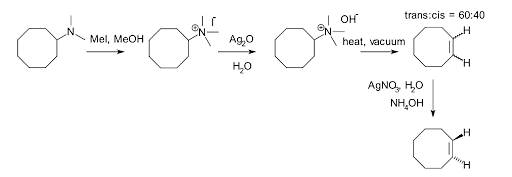
The above elimination reaction follows the Hofmann rule and due to bulky leaving groups on Nitrogen. Hence the less stable trans-cyclo-octene is the major product.
Ques. How does Zaitsev's rule differ from the Hofmann rule? Can cyclic amines undergo Hofmann Elimination? (2 marks)
Ans. Unlike the Hofmann rule, Zaitsev’s rule follows the principle that the major product is the most substituted and hence the most stable alkene. Only in cases where bulky leaving groups are attached to nitrogen, the Hofmann rule is applied and the least stable alkene is majorly formed.
Cyclic amines like pyrrolidines and piperidines which have β hydrogen can undergo Hofmann Elimination.
Ques. Distinguish between primary, secondary and tertiary amines. (5 marks)
Ans. The following tests act as distinguishing parameters for the different classes of amines:
- Carbylamine test: Both aromatic and aliphatic primary amines on heating with chloroform in the presence of alcoholic KOH forms carbylamines or isocyanides having an extremely unpleasant smell. This test is called the carbylamine test and is used to distinguish the primary amines from secondary and tertiary amines.
- Reaction with nitrous acid: All three types of amines react differently with nitrous acid. Primary amines react rapidly with nitrous acid to form aliphatic diazonium salt, which is unstable and decomposes to give alcohol and evolve nitrogen. Secondary aliphatic and aromatic amines react slowly with nitrous acid to form yellow coloured nitroso amines.
- Hinsberg’s test for amines: This test is also used to distinguish primary, secondary and tertiary amines. In this test the amine is heated with benzene sulphonyl chloride (C6H5SO2Cl) also known as Hinsberg’s reagent in the presence of excess alkali- Primary amines give a clear solution which on acidification yields an insoluble material. Secondary amines yield an insoluble substance that remains unaffected by the addition of acid. Tertiary amines do not react and remain insoluble in alkali and can be dissolved in acids.
- Azo-dye test: Aromatic amines can be distinguished from aliphatic primary amines by this test. Only primary amines react in this case.
Ques. Explain the reaction of primary and secondary amines with the Grignard reagent. (3 marks)
Ans. As a result of the reaction between primary amines and Grignard reagent (eg.MgBr) alkanes are formed. Secondary amines also react in the same way.
For example:

Methyl magnesium bromide is the Grignard reagent in the above reaction. Tertiary aliphatic amines do not react with the Grignard reagent because they do not have hydrogen attached to the nitrogen atom.
Ques. Explain the process of preparation of diazonium salts. (3 marks)
Ans. Aromatic diazonium salts are prepared by heating an ice-cold solution of an aromatic primary amine in excess of mineral acid like HCl or H2SO4 with an ice-cold solution of sodium nitrite dissolved in water. The temperature is maintained between 273K to 278 K because most of the diazonium salts decompose at higher temperatures.
The diazonium salts formed remain in the solution. Since the diazonium salts are unstable and explosive substances, they are not isolated in solid form but are used directly in the solution. This process of converting aromatic amine into diazonium salt is called diazotization.
Ques. State physical properties of diazonium salts. Why is it important to keep the temperature very low during the formation of Diazonium salts? (3 marks)
Ans. Following are some of the important physical properties of Diazonium salts:
- Diazonium salts are colourless, crystalline solids.
- Diazonium salts are readily soluble in water. Upon application of a little heat, they react with water.
- They are unstable and explosive in a dry state. Hence generally used in the solution state.
- Their aqueous solutions are neutral to the litmus test and conduct electricity due to the presence of ions.
- Aromatic diazonium salts are formed only in ice-cold solutions (273-278K ) . However, if the temperature is more than 278 K amines form phenol with the evolution of N2 gas.
Ques. Why do amines act as nucleophiles? Explain why the presence of a base is required in the ammonolysis of all alkyl halides. (2 marks)
Ans. Amines have a lone pair of Nitrogen atoms and therefore act as nucleophiles.
The ammonolysis of alkyl halides gives quaternary ammonium salts. The free amine can be obtained from the ammonium salt by using a strong base.
RNH3+X- + NaOH → RNH2 + H2O + Na+X-
For Latest Updates on Upcoming Board Exams, Click Here: https://t.me/class_10_12_board_updates
Check-Out:



Comments