



Education Journalist | Study Abroad Lead
CalciumIodide (CaI2) is a colourless solid inorganic compound similar to salts and is formed by treating any of the calcium salts like calcium carbonate, calcium oxide or calcium hydroxide with hydrochloric acid(HCl). On the other hand, iodine is one of the elements of halogens and a member of group no. 7th & period no. 5th. Both the elements calcium and iodine are naturally present in the body.
Read More: Chemistry Concepts
Key Terms: Calcium Iodide, Iodine, Chemical Formula, Iodide
Chemical Structure of Calcium Iodide
[Click Here for Sample Questions]
Calcium Iodide is an ionic compound and the ionic bond is formed between calcium and iodine when calcium loses its two valence electrons in order to become Ca2+, this turns calcium more positive now in order to make the bond iodine gain one electron to form I−. Since the formula for calcium iodide is CaI2 therefore by looking at the formula we can conclude that two atoms of iodine are needed in order to gain two electrons lost by a single atom of calcium. On the other hand, we can also say the formation of calcium iodide is the product of a redox reaction between calcium and iodine in which calcium is oxidised to Ca2+ and iodine (I) is reduced to iodide(I−).
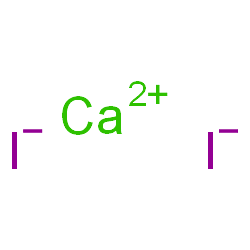
Structural Formula of Calcium Iodide
Reactions of Calcium Iodide
[Click Here for Sample Questions]
Henri Moissan first isolated pure calcium in 1898 by reducing calcium iodide with pure sodium metal:
CaI2 + 2 Na → 2 NaI + Ca
Calcium iodide can be formed by treating calcium carbonate, calcium oxide, or calcium hydroxide with hydroiodic acid:
CaCO3 + 2 HI → CaI2 + H2O + CO2
Calcium iodide slowly reacts with oxygen and carbon dioxide in the air, liberating iodine, which is responsible for the faint yellow colour of impure samples.
2 CaI2 + 2 CO2 + O2 → 2 CaCO3 + 2 I2
Properties of Calcium Iodide
[Click Here for Sample Questions]
General properties of calcium iodide is represented below:
| Melting point | 779 degrees Celsius |
| Boiling point | 1100 |
| Name | Calcium iodide |
| Molecular Formula | CaI2 |
| Molar Mass | 293.88 g/mol |
| Density | 3.956 g/cm |
| Solubility | 66/100 mol |
| Appearance | White |
| Physical form | powder |
| Crystalline Structure | Rhombohedral |

Structure (CaI)
Read More: NCERT Solutions Class 11
Application of Calcium Iodide
[Click Here for Sample Questions]
Calcium Iodide is used in the manufacturing of the following products or industries:
- Pyrotechnics & fireworks
- Cat food
- Medicines & pharmaceutical companies
- Photography & lithography
Read More: Chemical Reactions and Equations Important Questions
Things to Remember
- The chemical formula for calcium iodide is CaI2
- It is an ionic compound.
- It is formed by treating any of the salts like calcium oxide, calcium hydroxide & calcium carbonate with hydrochloric acid.
- CaI2 is highly soluble in water.
Sample Questions
Ques: What is iodide? (2 Marks)
Ans. Iodine is the element from the halogen group. Due to the vacancy of one electron in its valence shell, it accepts one electron from the donor atom and becomes I-. This ionic form is known as iodide, having chemical formula i- which is sometimes loosely called iodine itself. It has an enormous application in the pharmaceutical and food industries.
Ques: What is the difference between iodine and iodide? (2 Marks)
Ans. Iodine is the element depicted in the periodic table but this form of iodine does not actually is naturally present in nature. Iodide on the contrary is a grain of salt & ionic form of iodine after gaining one electron in its valence shell.
Ques: Describe the Physical properties of iodide? (3 Marks)
Ans. General properties of calcium iodide is represented below:
| Melting Point | 113.7 |
| Boiling Point | 184.31 |
| Solubility | 128g/100ml |
| electronegativity | 2.5 |
| colour | Lustrous Violet black |
| density | 3.13g/cm3 |
| odour | Harsh & strong |
| Crystalline structure | rhombohedral |
| Molar Mass | 126.904g/mol |
| Specific Heat | 0.214 |
Ques: Describe any four characteristics of iodide. (3 Marks)
Ans. i) When iodine is kept in an open vessel it sublimates and releases violate vapour.
ii) It changes to violet-black colour on heating.
iii) Iodide is usually colourless but sometimes it may get oxidised into iodine on reaction with atmospheric oxygen it might develop brown colour.
iv) The colour of iodine depends on the type of metal it combines with to form a salt.
Ques: Explain the formation of calcium iodide and its draw lewis dot structure? (3 Marks)
Ans. Calcium Iodide is an ionic compound and the ionic bond is formed between calcium and iodine when calcium loses its two valence electrons in order to become Ca+2, this turns calcium more positive now in order to make the bond iodine gain one electron to form I2- . since the formula for calcium iodide is CaI2 therefore by looking at the formula we can conclude that two atoms of iodine are needed in order to gain two electrons lost by a single atom of calcium.
Ques: Describe the characteristics of calcium iodide? (5 Marks)
Ans.CalciumIodide (CaI2) is a colourless solid inorganic compound similar to salts and is formed by treating any of the calcium salts like calcium carbonate, calcium oxide or calcium hydroxide with hydrochloric acid(HCl). It is highly soluble in water and is made up of two elements calcium and iodine, in which calcium is one of the elements of alkali earth metals and the member of group no. 2nd and period no. 4th. On the other hand, iodine is one of the elements of halogens and a member of group no. 7th & period no. 5th.Both the elements calcium and iodine are naturally present in the body.
Ques: Write the chemical equation for the formation of calcium and calcium iodide? (5 Marks)
Ans. Formation reaction for calcium
CaI2 + 2Na → 2NaI + Ca
Henri Moison first isolated elemental calcium using this reaction.
Formation reaction for calcium iodide
CaCO3 + 2HI → CaI2 + H2O + CO2
2HI(aq) + Ca(OH)2→ CaI2(aq) + 2H2O(aq)
Ques:Transfer of two valence electrons takes place in the formation of a calcium iodide compound. Explain? (5 Marks)
Ans.
i) Ca: atomic no - 20
Group no- 2
Period no- 4
electronic configuration- 2, 8, 8, 2
Total no. of Valence electrons - 2
ii) I: atomic no- 53
Group no- 17
Period no- 5
Electronic configuration- 2, 8, 18, 18, 7
Total no. of balanced electrons- 7
Since there are only two electrons present in the valence shell of calcium as per the octet rule. Hence calcium loses two electrons in order to become Ca2+.
Read More:



Comments