



Education Journalist | Study Abroad Lead
Air refers to the constant pressure that we can't see but that always exists around us which is responsible for the winds blowing and the swaying of trees. We all human beings can feel the air and depend on it for breathing purposes and thus for our survival. Air consists of a mixture of various gases such as nitrogen, carbon dioxide, and oxygen that exist in high proportions and water vapor, argon, and various other gases that exist in smaller proportions comparatively. When air flows at a higher velocity and pressure, we refer to it as a breeze. Our very existence on Earth is made possible due to the presence of air. Two gases that mainly ensure our sustainability is Oxygen and Nitrogen whose mixture majorly forms air. In this article, we will explore the importance of air for breathing purposes to the existence of plants and the occurrence of various processes.
| Table of Content |
Read Also: Role of Atmosphere
Air
Air is a kind of mixture of various gases. It neither has a smell nor a taste. As it is a matter, it has a certain weight and mass. This weight of air is responsible for creating atmospheric pressure. We inhale the oxygen from the air while breathing and release the carbon dioxide. This released carbon dioxide in the atmosphere is used by plants for the process of photosynthesis.
Components of Air
As air is a mixture of gases, it is comprised of:
- 78% of Nitrogen
- 21% of Oxygen
- 0.9% of Argon
- 0.04% of Carbon Dioxide
- Small amounts of water vapor and other gases
As can be seen, the air is majorly comprised of Oxygen and Nitrogen gases.

Composition of Air
Importance of Air
Air is an abundant element that exists in nature. It is an essential resource that is responsible for supporting our very life on this planet. Just like water, the air is also an important element for our survival. There is a major importance of air and it has multiple applications which are as follows:
- Sustaining growth and survival of life on Earth
- Supplying energy
- Maintaining the temperature in the atmosphere
- Photosynthesis
- Combustion
Survival of life on Earth
We need oxygen for the basic purpose of breathing and respiration. Even in aquatic habitats, organisms need air for survival and hence the air is important. Species of organisms living inside soil also breathe through the oxygen that is present in the air. Plants also need carbon dioxide and nitrogen for their survival and growth.

We intake oxygen from the atmosphere for breathing and release carbon dioxide gas
Combustion
Air also helps in supporting the burning also known as combustion. The oxygen gas in the air helps the burning of various fuels which helps us in carrying out our various routine activities such as cooking our food, running vehicles and industries, generating electricity and heat.

When we cut off the supply of air in a glass in which a candle is burning, the candle blows off
Maintaining the temperature in the atmosphere
Air helps in keeping a check on the temperature of the atmosphere by acting as a conductor of heat. It controls the temperature as air helps in the circulation of hot and cool winds. The water cycle which also helps in regulating the climate is also dependent on air.

Air helps in movement of winds that further helps in regulation of the atmosphere and helps in climate control
Photosynthesis
Organisms breathe oxygen all the time yet the gas is abundantly present in the atmosphere. This is because plants and trees help in restoring the oxygen in the environment. The plants and animals in the ecosystem are interdependent on each other. The carbon dioxide released by living beings is used by plants during the photosynthesis process. The plants release water vapor and oxygen as a by-product of the process.
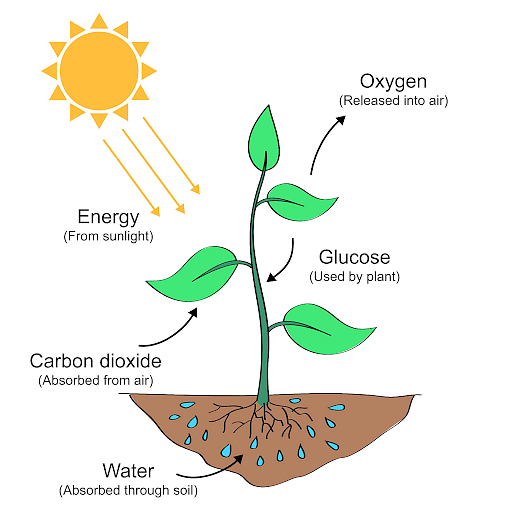
Photosynthesis
In the process of photosynthesis, the plants absorb the carbon dioxide from the atmosphere through chlorophyll in their leaves and release oxygen gas in the atmosphere.
The nitrogen from the air is used in the formation of ammonia.
Supplier of Energy
Air acts as one of the major suppliers of energy. Cells join together to make up human beings. These cells are then responsible for extracting oxygen present in the blood to produce energy in the form of Adenosine triphosphate, also known as ATP, which is an organic compound that is also known as the primary carrier of energy in the cells. This generated ATP is biochemical in nature. It is necessary to sustain life on Earth.
Generation of Power
Air plays a vital role in the process of electric power generation. Windmills are dependent on air in order to generate electricity. In many sensitive mechanical drive systems, a controlled pressure of air is used in order to move the various parts of machinery.

Generation of Power
The role of air in the process of generation of power through windmills and sensitive mechanical drive systems.
Air Pollution
Air pollution refers to the contamination of our environment through the use of any biological, chemical, or physical component that alters the natural characteristics of air and hampers them. Human activities have now led to air pollution which has given rise to multiple respiratory problems and is very harmful to humans as well as our atmosphere. Air pollution is caused by many activities such as deforestation, the release of industrial discharge, and various other chemical components in the air.
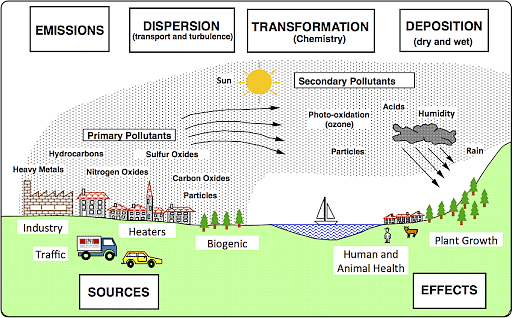
The release of harmful pollutants in the atmosphere leads to air pollution that has many disastrous effects on humans
In the absence of air, the plants would not have been able to conduct the process of photosynthesis, without which the animals dependent on plants for their survival would have perished. The plants would not have been able to cross-fertilize and we would have no food or harvest. The sound would not have been able to travel without air and we would exist in a soundless vacuum. In the absence of air, we would not have been able to survive and populate the Earth. In the absence of air, our Earth would have been just like any other lifeless planet existing in our solar system. Hence, we can see that air is a vital component of our very existence.
Things to Remember
- Air consists of a mixture of various gases such as nitrogen, carbon dioxide, and oxygen that exist in high proportions and water vapor, argon, and various other gases that exist in smaller proportions comparatively.
- Our very existence on Earth is made possible due to the presence of air.
- We need oxygen for the basic purpose of breathing and respiration.
- The oxygen gas in the air helps the burning of various fuels which helps us in carrying out our various routine activities
- Two gases that mainly ensure our sustainability is Oxygen and Nitrogen whose mixture majorly forms air.
- The carbon dioxide released by living beings is used by plants during the photosynthesis process.
- Windmills are dependent on air in order to generate electricity.
- Air pollution refers to the contamination of our environment through the use of any biological, chemical, or physical component that alters the natural characteristics of air and hampers them.
- Air pollution is caused by many activities such as deforestation, the release of industrial discharge, and various other chemical components in the air
Read Also: Effects of Air Pollution on Environment
Sample Questions
Ques. Why do we experience high pressure at sea levels and low pressure on hilly areas?(3 marks)
Ans. Though air appears to be light, it roughly pushes itself down on the surface of the Earth. This pressure is known as air pressure.
- As we reach sea level, the entire atmosphere forces down on you, and hence we experience high pressure.
- In the hilly areas, there is a lesser amount of atmospheric force being pushed down on you, as a result of which the air pressure is exhausted and we experience low air pressure.
Ques. How are water bubbles influenced by air?(3 marks)
Ans. Water bubbles are formed as a result of small concentrations of air getting trapped in the bubbles. If we add water to dry soil, we would observe water bubbles on the surface of the soil which in turn indicates the presence of air molecules as water displaces them. Therefore, the species living inside the soil breathe through the air present in the various holes they make inside the soil. Therefore, during rainy seasons the water replaces the air in the soil and hence the organisms such as earthworms come up in order to breathe the air.
Ques. What is the composition of air?(3 marks)
Ans. Air consists of a mixture of various gases such as nitrogen, carbon dioxide, and oxygen that exist in high proportions and water vapor, argon, and various other gases that exist in smaller proportions comparatively. The composition of air is as follows:
- 78% of Nitrogen
- 21% of Oxygen
- 0.9% of Argon
- 0.04% of Carbon Dioxide
- Small amounts of water vapor and other gases
Ques. Explain how air is important for us and the ecosystem?(5 marks)
Ans. Air refers to the constant pressure that we can't see but that always exists around us which is responsible for the winds blowing and the swaying of trees. We all human beings can feel the air and depend on it for our survival. Air is a vital component of our ecosystem as:
- Air consists of Oxygen which we breathe and which makes our survival and growth possible on this planet.
- The carbon dioxide in the air helps in the process of photosynthesis.
- It helps in controlling or maintaining the temperature.
- It helps to regulate the water cycle.
- Air helps in the burning of fuels or the combustion process.
- Air is an important resource of energy.
Ques. How can the ozone layer absorb the Ultraviolet light coming from the sun? (3 marks)
Ans. Ozone decomposes at approximately 573 K of temperature as it is unstable in nature. The molecules of ozone in the ozone layer absorb the ultraviolet radiations reaching them to decompose to yield an oxygen atom. An ozone molecule decomposes into a stable oxygen molecule (O2) and an unstable oxygen atom. Hence, the energy of the UV radiation is absorbed by the ozone layer preventing this energy from reaching the Earth's atmosphere thereby protecting us from its multiple harmful effects.
Ques. What is air pollution? How can we control the same?(5 marks)
Ans. Air pollution refers to the contamination of our environment through the use of any biological, chemical, or physical component that alters the natural characteristics of air and hampers them.
We can control air pollution by
- Conserving energy and energy resources as many fossil fuels are burnt in order to generate energy which releases many harmful toxins in the atmosphere, therefore, polluting the air.
- Planting more and more trees because they help in absorbing and removing the harmful pollutants from the air.
- Keeping a check on the emissions of the industries and using machinery that reduces the levels of pollutants released.
- Reducing burning and the use of fire products as they pollute the air.
- Try walking as much as you can and avoiding the use of vehicles as they emit pollutants in the air.
Ques. What are the harmful effects of pollution in the air?(5 marks)
Ans. Air pollution is harmful to us and the environment in multiple ways which are:
- Air pollution leads to a number of respiratory diseases and difficulty in breathing.
- Air pollution can hamper the regulation of temperature and hence can lead to global warming.
- The release of harmful gases and pollutants in the air through industry emissions or the burning of fossil fuels leads to acid rain as these pollutants mix with the rain.
- The release of harmful contaminants such as chlorofluorocarbons through air conditioners and refrigerators is already causing depletion of the ozone layer that can expose us to the harmful ultraviolet radiations of the sun.



Comments