



Education Content Expert
Gas is one of the three predominant states of matter, namely Solids, liquid, and gas.
- Gases have mass, but it has no definite shape and no definite volume.
- Gas, thus, takes the shape of the vessel it is stored in.
- It is the most abundantly found state of matter.
- It forms 99 per cent of the atmosphere.
- There are various types of gases that exist around us and serve us in millions of different aspects of our lives.
- Examples of Gases include Hydrogen, Nitrogen, Oxygen, Carbon Dioxide, Carbon Monoxide, Helium, etc.
- The gaseous state of matter is highly important in the study of the matter as gases show even minute and significant changes in the state of matter with the change of temperature and pressure.
Key Terms: Gases, Matter, Fluids, Temperature, Troposphere, Pressure, Elemental Gases, Chlorofluorocarbons
What are Gases?
[Click Here for Sample Questions]
Gas is a state of matter that has no definite volume and no specific shape but has a definite mass.
- Gases have the least intermolecular attraction between their molecules, hence they are very loosely packed.
- The molecules of gases also have a high velocity which is why gases can flow into a container and take its shape by evenly distributing themselves.
- Gases are highly compressible and can be indefinitely expandable.
- Gases have no molecular arrangements, consequently, the space between gas molecules keeps increasing and decreasing depending on physical and chemical factors.
- Due to this movement, they possess Kinetic Energy.
- Gases are sometimes also referred to as “fluids” as they can easily flow from one direction to another.
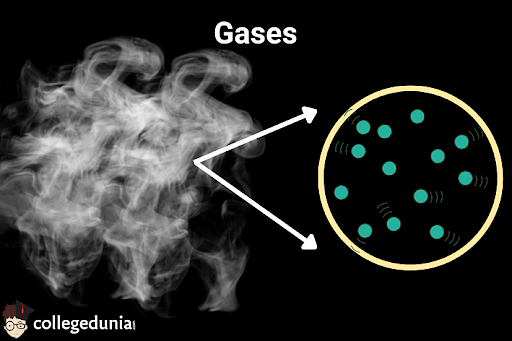
Gaseous State of Matter
Properties of Gases
[Click Here for Sample Questions]
Gases have distinct features which make them different from other states of matter like solid and liquid. The properties of gases are:
- Gases have the least intermolecular distances between.
- Gases are highly compressible. Due to the least intermolecular attraction, they are loosely packed hence the property.
- Gas molecules are at constant random movement and collide with themselves to produce kinetic energy.
- Gases exert equal pressure on the walls of the vessel containing them.
- Gases have no definite shape or a definite volume.
- Gases have less density when compared to solid and liquid states of matter.
- Gases combine easily and evenly( mostly with each other) to form a homogeneous mixture.
Read More:
Examples of Gases
[Click Here for Sample Questions]
Air is the most common example of gases around us. It is in abundance and it surrounds the earth in the form of its atmosphere. The troposphere is the nearest envelope of the atmosphere that sustains human life. It is a mixture of various common gases like oxygen, nitrogen, carbon dioxide, etc.
Examples of a few of these gases are:
- Hydrogen
- Nitrogen
- Oxygen
- Helium
- Neon
- Argon
- Carbon Dioxide
- Carbon Monoxide
- Water Vapour
- Ozone
- Acetylene
- Propane
- Butane
- Various Chlorofluorocarbons
Types of Gases
[Click Here for Sample Questions]
Gases can be categorized as:
Elemental Gases
The monatomic noble gases and diatomic homonuclear gases combine to form the category of “elemental gases.” Elemental gases are also called “molecular gases”.
- The monatomic gases are stable at standard temperature and pressure such as noble gases namely helium, argon, krypton, xenon, and radon.
- Diatomic homonuclear gases are such as hydrogen, nitrogen, oxygen, fluorine, Chlorine gases.
Triatomic Gases
The gases whose molecules have three atoms and have an atomicity of three are called triatomic gases. Examples of triatomic gases are carbon dioxide, water vapor, nitrous oxide, ozone, etc.
Mixed Gases
In nature, gases often occur in the form of mixtures as they flow and combine with each other very easily. These mixtures of gases are simply referred to as “mixed gases” and are Heterogeneous in nature.
Toxic Gases
The gases which are harmful to us are called toxic gases. Examples of toxic gases are as following hydrogen sulphide, ammonia, (NH3), phosgene (COCl2), oxides of nitrogen, Formaldehyde (CH2O), Arsenic (As), Carbon Monoxide (CO), sulphur dioxide ((SO2), etc.
Behavior of Gases
[Click Here for Sample Questions]
The behavior of gases is governed by four factors:
- Temperature
- Pressure
- Volume
- Quantity
| Temperature | Pressure | Volume | Observation |
|---|---|---|---|
| Increase | - | Increase | Gases Expand |
| Decrease | - | Decrease | Gases Contract |
| Increase | Increase | - | Gases Expand |
| Decrease | Decrease | - | Gases Contract |
Also,
- When the temperature of the gas is highly reduced or its pressure is highly increased gas is converted to either liquid or solid.
- With a decrease in quantity, the gas pressure is decreased and with an increase in gas pressure, there is an increase in pressure.
- Low volume and quantity of gas results in low pressure in gas, and;
- Increased volume and quantity of gas gives high pressure.
Read Also:
Applications of Gases
[Click Here for Sample Questions]
Gases are used in almost every periphery and aspect of our daily lives. Some of its applications are:
- Oxygen has very important medical uses and both oxygen and acetylene are used in welding.
- Propane is used as fuel to burn.
- Butane is used in torches and lighters.
- Freon and chlorofluorocarbons (CFC) are used as cooling agents in air conditioners and refrigerators.
- Nitrous Oxide is used as anesthesia.
- Gases also have industrial and manufacturing units like steel manufacturing, oil refining, fertilizers, and semiconductors.
- The ozone layer helps protect the earth from direct ultraviolet lights.
Things to Remember
- Gases are states of matter with the least intermolecular attraction.
- Molecules of Gases are loosely packed and have kinetic energy.
- Gases have no definite shape and volume.
- Behaviour of gases depends on different factors like pressure, temperature, volume, and quantity.
- Examples of important gases are oxygen, nitrogen, carbon dioxide, carbon monoxide, helium, hydrogen, argon, neon, etc.
- Gases can be monatomic, diatomic, homogenous, heterogeneous, pure, mixed, and toxic in nature.
- Ideal gases obey gas laws at all temperatures and pressures and real gases obey gas laws at low pressure and high temperature.
Sample Questions
Ques. What are the three States of Matter? (3 Marks)
Ans. The three states of matter are solid, liquid, and gas. Solid is a state of matter that has a definite shape and fixed volume and mass. It has the strongest intermolecular force of attraction. Examples of solid states of matter are wood, sand, paper, rock, metal, etc,
Liquid is the state of matter which has a definite volume and definite mass but no definite shape. It flows and takes the shape of the vessel it is stored in. The intermolecular attraction in liquid is less than that of solid hence the fluid nature. Examples of liquids are water, milk, ink, etc.
Gaseous state of matter has neither definite volume nor definite shape. It has the least intermolecular force of attraction hence it is highly compressible and highly expandable in nature. Examples are air, noble gases, ozone, etc.
Ques. Give some examples of gases with their usages. (5 Marks)
Ans. Gases have several usages in our daily lives as well as industrial and medical purposes
- Oxygen is present in the air we breathe. It is also used in welding and artificially provided to humans who have difficulty in breathing.
- Helium is used in rocket propulsion, welding of aluminum, scuba gear, and as cryogenic coolant.
- Hydrogen is often used as fuel in rockets. It is mixed with oxygen to make a hydro-oxygen flame used in welding. Hydrogen is used in the Haber process to make industrial-grade ammonia.
- Nitrogen is in the production of fertilizers, dyes, nitric acids, and explosives. Nitrogen is also used by plants to produce amino acids.
- Carbon dioxide is used as a greenhouse gas. It is used in carbonated beverages, refrigerators, fire extinguishers, etc.
Ques. What is the Composition of Air? (2 Marks)
Ans. Several gases combine to make the composition of air. They are nitrogen, oxygen, carbon dioxide, and various other gases. Nitrogen is in abundance at 78.09%, oxygen at 20.95%, argon at 0.93%, carbon dioxide at 0.04%, and other gases in trace amounts.
Ques. What are Real Gases? (2 Marks)
Ans. Gases that obey all gas laws at only low pressure and high temperature are called real gases. Unlike ideal gases, the volume of gas molecules in real gas is not negligible to the entire volume of gases. Real gases obey the Van der Waals gas equation.
Ques. Define Van der Waals Forces? (2 Marks)
Ans. Van der Waals forces are distance-dependent forces that act between uncharged atoms/ molecules. According to the Van der Waals equation, there are weak electrostatic forces that act as attractive forces between neutral atoms. It determines the different boiling and melting points of different elements. They are short-range forces.
Ques. What are the factors that determine the State of Matter? (1 Mark)
Ans. The factors that majorly determine the state of matter are pressure and temperature. Other factors include volume and quantity.
Ques. Define London Forces. (2 Marks)
Ans. The temporary attracting forces which occur due to dipoles present in non-polar molecules are referred to as London (dispersion) forces. In London forces, electrons of two neighboring atoms are displaced in a way that the atoms of these molecules get some temporary dipoles and attract each other.
Ques. Explain the Ideal Gas Equation. (3 Marks)
Ans. Ideal gas equation is an equation that determines the state of an ideal gas which is a hypothetical gas. It follows all gas laws Boyle’s Law, Charles’ Law, and Avogadro’s Law. It assumes that there are no intermolecular forces between the atoms of a molecule of an ideal gas. Ideal gas law is expressed as
pV = nRT
Where
- p = Pressure
- v = Volume
- n = Number of Molecules
- R= Ideal Gas Constant
- T = Temperature
Ques. What are the five Gas Laws? (5 Marks)
Ans. The five gas laws are as follows:
- Boyle's Law: Boyle’s Law depicts a relationship between the pressure and volume of a gas. It says that the pressure increases when the volume of a gas is reduced. It can be expressed as P α 1/V.
- Charles Law: Charles’ Law studies the effect of temperature on the volume of gas under pressure. It is represented by V∝T.
- Gay Lussac's Law: This law studies the relationship between the pressure and temperature of a gas. It says when the volume is constant, the change in temperature changes the pressure of the gas.
- Avogadro's Law: According to this law, under constant volume and pressure, the quantity of gas is directly proportional to the volume of the gas.
- Ideal Gas Law: Ideal gas law is the combination of all the aforementioned gas laws. It is represented by PV = nRT.
Ques. Name a few homonuclear Diatomic Gases. (1 Mark)
Ans. Few examples of homonuclear diatomic gases are hydrogen, nitrogen, oxygen, fluorine, and chlorine gases.
For Latest Updates on Upcoming Board Exams, Click Here: https://t.me/class_10_12_board_updates
Check-Out:



Comments