



Content Writer
Gas is the state of matter in which particles are widely spaced, fast moving and randomly organized.
- Among the three states of matter gasses are the substances that exist in a gaseous state.
- Gasses have extremely long intermolecular distances and are highly compressible.
- In contrast to liquids and solids, which have much stronger attractive interactions, gasses have far weaker attractions between their constituent particles.
- Gaseous state lacks definite shape or volume.
- They frequently take up the entire volume of the container they are placed in.
- Additionally, gasses impose a certain amount of finite pressure on the walls of their containers due to their great compressibility.
Key Terms: States of matter, Gas molecules, Kinetic energy, Ideal gas, Boyle’s law
Gaseous State
[Click Here for Sample Questions]
The word gas comes from the Greek word χάος, which translates to chaos. The states of matter, solid-liquid, and gas are the omnipresent elements that surround us. Everything we can touch or feel can be categorized under one of these categories. Gas is one of the three states of matter.
- It stands apart from liquid and solid because of its distinct chemical and physical properties.
- Gas is the most accessible state of matter present in the world. The air we breathe in and breathe out is gas.
- Although gasses are considered to be the simplest matter of all states, there are only 11 pure gasses also known as noble gasses which are: Helium, Xenon,Chlorine, Fluorine, Hydrogen, Nitrogen, Krypton, Argon, Neon, Radon, and Oxygen.
![Unorganized gas particles]()
Unorganized gas particles
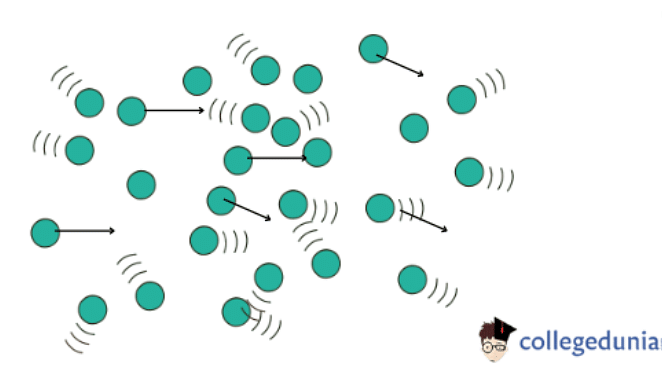
Read more: Noble gas properties
Pressure in Gas
[Click Here for Sample Questions]
The pressure of a gas is the addition of all components and their force exerted by the particles.The loosely placed particles of gas travel widely within the contained unit. The momentum of charge in a particle is the result of the force produced due to the constant collision of molecules.
The normal components in the velocity change during the collision, but the particles travelling in closer proximity to the wall do not change their momentum. Hence, build-up energy begins impacting the walls of the container.

Three states of matter
Read more:
Physical Properties of Gas
[Click Here for Sample Questions]
The physical properties of the gas are as follows:
- The physical properties of gasses can be defined under four different categories: pressure, temperature, number of particles, and volume.
- The gas particles travel wide distances and have weak bonds as compared to solids, or liquids.
- The intermolecular forces rise from electrostatic interactions between the gas particles.
- Gasses that have constantly charged ions are called plasmas.
Chemical Properties of Gas
[Click Here for Sample Questions]
The chemical properties of gas are as follows:
- Gasses are highly compressible.
- Gasses have a lower density than solids and liquids.
- Gas particles have kinetic energy because of the widened space between their molecules.
- Gas particles have no intermolecular forces between them.
- Gas particles are fast-moving and hit each other at a tremendous speed, which causes the gas to spread quickly — ultimately exerting pressure on the walls that confine them.
- Gasses take the volume and shape of the container they are in by spreading thin immediately.
Read more: Properties of gasses
Kinetic Molecular Theory of Gas
[Click Here for Sample Questions]
The kinetic molecular theory of gas is the model that offers us a deep understanding of the properties of gas, and our expectations of it.
- The theory states that the volume of gas depends upon the influence exerted by temperature.
- The molecules of the gas particles move in constant motion.
- This results in a collision that determines the magnitude of gas pressure exerted inside the container.
![Tiny particles spaced out in containers with constant motion.]()
Tiny particles spaced out in containers with constant motion.

Kinetic Energy
[Click Here for Sample Questions]
The kinetic energy is the measure of gas particles in constant motion.
Formula: KE = ½ mu2
- m = mass
- u = speed
The Gas Law
[Click Here for Sample Questions]
The gas law, also known as Boyle's Law, is the first reliable description of properties formulated by scientist Robert Boyle. Boyle's law states that the relationship between the expansion and compression of the gas at a constant temperature is empirical.
The temperature of gas directly impacts the movement of its speed particles.
Let's take a balloon for example. The volume of a balloon shrinks when the gas particles belong to a relatively colder gas like nitrogen. However, CO2-filled balloons expand the volume of the balloon, because of the increased temperature of the gas itself. The entire gas system is made up of motions of particles that are impacted by the temperature of their systems.

Volume of balloon during cold and hot gas.
The Ideal Gas Equation
[Click Here for Sample Questions]
The ideal gas is a hypothetical substance whose properties and behavior is independent of the repulsive and attractive forces. The behavior of an ideal gas can be described as the ideal gas law.
- There are no ideal gasses, but the ideal gas is a model that helps in deriving conclusions about the changing conditions of gasses.
- Most real gasses present themselves as being closer to the ideal gas.
- The ideal gas law's primary law is to predict the behavior of gasses under controlled conditions.
Difference between Solid, Liquid, and Gas
[Click Here for Sample Questions]
The central difference between gas and the other two states of matter is the separation of particles. Here are some other properties that make gas differ:
| Particulars | Solid | Liquid | Gas |
|---|---|---|---|
| Energy Level | Lowest energy | Medium Energy | Highest Energy |
| Compression | Harder to compress | Compressible with a push | Highly compressible |
| Volume & Shape | Fixed volume and shape | Fixed volume, but no fixed shape | No definite volume and shape |
| Molecular Arrangement | Closely and regularly arranged molecules | Loosely arranged molecules | Randomly and sparsely arranged molecules |
| Flow | No intermolecular flow | Intermolecular flow from high to low level | Intermolecular flow in all directions |
Things to Remember
- While gasses like oxygen have constituent molecules that are composed of multiple types of atoms, pure gasses like neon are made up of individual atoms.
- The main standard of difference between solids, liquids, and gas is the degree of separation among the gas particles.
- Gasses are colorless due to the vast distance between the particles, making them invisible to the naked eye.
- The temperature of the gas influences the movement of the particles.
- The intermolecular forces are due to the electrostatic force of attraction between the gas molecules.
Sample Questions
Ques: What will be the volume of a fixed amount of temperature and gas if the pressure comes at 2.500 atm and the sample gas in 18.10mL with 3.599 atm? (3 marks)
Ans: Given that the temperature and gas are fixed, we will apply Boyle's law of equations.
Boyle's formula states that Initial pressure X Initial volume = New pressure X New volume
P1V1 = P2V2
Hence, V2 = P1V1 / P2
Now, adding values:
V2 = (18.10 * 3.500atm)/2.500atm
V2 = 25.34 mL
Therefore, the new volume will be 25.34 mL.
Ques. What will be the new volume of a container with constant temperature and pressure, in which a 6.00 L of a gas is known to contain 0.975 mol, and the gas is increased to 1.90 mol? (3 marks)
Ans. Given that V1 is 6.00 L, n1 = 0.975, and n2 = 1.90 mol, as per Avogadro's law, the new volume can be calculated through the following formula:
V1/n1 = V2/n2
Therefore, V2 = V1n2/n1
V2 = (6 x 1.90)/ 0.975
Hence, the new volume will be 11.69 L.
Ques. What is an example of gaseous substances? (1 mark)
Ans. The most common example of gas is the air we inhale and exhale. Other common examples of gasses are nitrogen, helium, etc.
Ques. What are the main properties of gas? (1 mark)
Ans. The four basic properties of the gas are pressure, the number of particles, temperature, and volume.
Ques. What makes gas different from other states of matter? (1 mark)
Ans. The three most unique characteristics of gas are: A. They are easily compressible, B. They are expandable, C. They occupy as much space as they can, unlike solids, and liquids.
Ques. Is LPG liquid or gas? (1 mark)
Ans: LPG is both liquid and gas. It is a vapor with the container.
Ques. Given that 1 bar pressure occupies the balloon at 2.7 L, how much can a balloon expand if it is filled at room temperature, and burst pressure begins at 0.2 bar? (5 marks)
Ans. As per Boyle's Law,
p1V1 = p2V2
Therefore, if p1 = 1 bar, then V1 = 2.27 L
And, p2 = 0.2 bar
According to Boyle’s Law p1V1 = p2V2
If p1 is 1 bar, V1 will be 2.27 L
If p2 = 0.2 bar, then V2 = p1V1 / p2
Hence, V2 = 1 bar x 2.27 L / 0.2 bar = 11.35 L
Given that the balloon explodes at 0.2 bar pressure, the balloon's volume should be less than 11.35 L.
Ques. What gasses are present in the air? (2 marks)
Ans. The air we breathe is made up of a lot more than just oxygen! The oxygen content of air is only about 21%. The nitrogen gas makes up around 78% of the air you breathe. There are also minuscule amounts of other gasses like argon, carbon dioxide, and methane.
Ques. What are pure gasses? (1 mark)
Ans. The gasses made up of individual atoms are called as pure gas or noble gas
Ex: Argon(Ar), Neon (Ne), Helium (He)
Ques. The diagram demonstrates a graph of pressure versus volume for a real gas and an ideal gas. In accordance with the diagram, answer the following questions. (5 marks)
1. Interpret the behavior of real gas with respect to ideal gas at low pressure.
2.Interpret the behavior of real gas with respect to ideal gas at high pressure.
3. Mark the pressure and volume by drawing a line at the point where real gas behaves as an ideal gas.
Ans.

1. At low pressure, the real gas shows very small deviation from ideal behavior because the two curves almost coincide at low pressure.
2. At high pressure, the real gas shows large deviations from ideal behavior as the curves are far apart.
3. At point ‘A’, both the curves intersect each other. At this point real gas behaves as an ideal gas.P1 ⇋ V1 are the pressure and volume which corresponds to this point A.
Check out:



Comments