



Exams Prep Master
As we know that the Universe consists of matter and energy, where the motion of the molecules creates a form of energy called heat or thermal energy. Calorimetry is used to measure the amounts of heat transferred to or from a substance. In order to do so, the heat is exchanged with a calibrated object which is a calorimeter. Here, we will discuss the facts in depth.
| Table of Content |
Key Terms: Calorimetry Principles, Law of Conservation Energy, Heat, Temperature, Change of State, Thermal Energy
Define Calorimetry?
[Click Here for Sample Questions]
Just as our Universe comprises matter and energy, matter also comprises different particles like atoms and molecules, with the help of energy these particles can move invariably. So their motion is due to either colliding with each other or moving forward and backwards. The motion of these molecules and atoms makes a form of energy that is called thermal energy or heat. We all know that heat is present everywhere including the human body, volcanoes and even in the coolest places. It can be transferred from one body to another body. The flow of heat is measured by physical processes and chemical reactions. The procedure of measuring heat is defined as calorimetry.

In other words, Calorimetry can be defined as an act of qualifying change in the thermal energy of an object. The highlighting points related to calorimetry are mentioned below-
- The temperature of a body or an object helps to identify the amount of heat present in that particular body.
- Temperature and heat energy are directly proportionate with each other. In simple words, that means the more heat energy the more is the temperature of a body.
- To determine the loss and gain of heat energy, the temperature of an object is measured before and after the transfer of heat takes place. Although, the difference in temperature helps to find out the heat change of a body.
Read More: Coefficient of Linear Expansion
Example of a Calorimetry
[Click Here for Sample Questions]
Let’s understand this concept with an example.
Take a cup of coffee and a bowl of chilled ice cream to keep both of them at room temperature. After an hour or 1, you will notice that coffee cools down and ice cream melts. This happens because the coffee starts releasing heat energy due to a reduction in temperature while the ice cream starts melting due to a rise in temperature as it absorbs heat from the atmosphere.

It must be noted that the process of Calorimetry is possible only by using a calorimeter device. Calorimetry is the process of measuring the amount of heat transferred to or from a substance (how much amount of heat is absorbed or lost during the entire process). A calorimeter is a tool that can be used to measure the amount of heat involved in a chemical or physical process.
Read More: Latent Heat of Water
Principle of Calorimetry
[Click Here for Sample Questions]
When two bodies of different temperatures (a solid and a liquid) are kept in physical contact with each other, the process of heat transformation will start which means the body at higher temperature releases heat, while the body at a lower temperature consumes heat. This cycle goes on until it reaches thermal equilibrium. However, the principle of calorimetry determines the law of conservation energy that can be calculated by the total heat lost by the hot body is equal to the total heat gained by the cold body.
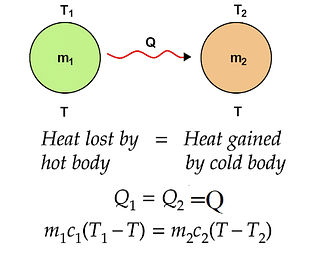
It can be written in the following manner in mathematical terms:-
Heat Lost = Heat Gained
The heat transfer in a system that can be calculated by using the below-mentioned formulae:
q=mcΔt
Whereas;
q is denoted as a measure of heat transfer;
m is denoted as the mass of the body;
c is denoted as the specific heat of the body;
Δt is denoted as a change in the temperature.
Read More: Thermal Stress
Things to Remember
- The principle of calorimetry: Heat lost = Heat gained.
- Heat transfer formula: q = mcΔt where,
q is denoted as a measure of heat transfer;
m is denoted as the mass of the body;
c is denoted as the specific heat of the body;
Δt is denoted as a change in the temperature.
- Calorimetry is used to measure amounts of heat transferred to or from a substance. To do so, the heat is exchanged with a calibrated object (calorimeter).
- Oxygen bomb calorimeters are useful in food testing laboratories to determine the amount of heat (calories) in food.
- Change in the heat capacity of the bonds within a molecule can be measured by differential scanning calorimetry and allows researchers to detect points of enthalpy and characterize and map the temperature-specific behavior of a drug product.
Read More: Impact of temperature
Sample Questions
Ques. If the specific heat of a substance is infinite that means
Heat is given out
no change in temperature takes place whether heat is taken in or out of it
Heat is taken in
none of these (1 mark)
Ans. The correct answer is b
Ques. To convert 1 gm of ice at 0 deg C into steam at 100 deg C then what amount of heat is required
100 cal
720 cal
80 cal
540 call (1 mark)
Ans. The correct answer is (b)
Explanation is mLfusion+mS(100)+mLvaporization
Ques. Calorimeter is made from which material
brass
aluminium
zinc
copper (1 mark)
Ans. The Correct option is (d)
Ques. The study of Calorimetry is based on which law?
Law of Kinetic Energy
Joule’s Law
Law of Conservation Energy
None of these (1 mark)
Ans. The correct option is c. Law of conservation energy.
Explanation: The principle of the calorimetry states that the heat lost by the hotter body = heat gained by the colder body. Thus in calorimetry, the total heat energy of the system remains, which is the law of conservation of energy.
Ques. What is the amount of heat required to change 1g of water by 40°C. The value of C water is mentioned at 4.2 J/gm K. (2 mark)
Ans. We have available values that are as follows:-
C= 4.2 J/gm K
m= 1g
ΔT= 40
We put the values according to the equation i.e., Q= mCΔT
Q= 1 X 4.2 X 40= 168 Joules
Ques. 1000 Joules of heat is applied to a mass of lead 0.5kg to change its temperature from 20°C to 40°C. Calculate its heat capacity. (2 mark)
Ans. We have available values that are as follows:-
Q= 1000J
m= 0.5kg
ΔT= (40-20)°C= 20°C
We put the values according to the equation i.e., Q= mCΔT
1000 = 0.5 x C x.20
C = 1000/0.5 x 20
C = 100 J/kg K.
Ques. 20g at 50°C and 8 g of ice at -20°C are mixed together in calorimetry. What is the final temperature of the mixture? (2 mark)
-5°C
5°C
20°C
28°C
Ans. The correct option is d. 28°C
Let the final temperature of the mixture be t°C
Heat lost by water in calories:
H1 = 20 x 1 x (50 - t) = 1000 - 20t
Heat from ice: H2 - msΔt + mL + mswt
= 8 x 0.5 x 20 + 8 x 80 + 8 x 1 x t
H2 = 720 + 8t = 1000 - 20t
Therefore, t = 28°C
Ques. State the principle of calorimetry. (3 mark)
Ans. When two bodies of different temperatures(a solid and a liquid) are kept in physical contact with each other, the process of heat transformation will start which means the body at higher temperature releases heat, while the body at a lower temperature consumes heat. This cycle goes on until it reaches thermal equilibrium.
However, the principle of calorimetry determines the law of conservation energy that can be calculated by the total heat lost by the hot body is equal to the total heat gained by the cold body. It can be written in the following manner in mathematical terms:-
Heat Lost = Heat Gained
Ques. 1 g of ice is mixed with 100 g of water at 50°C. Find the resulting temperature of the mixture. (2 mark)
Ans. Let the temperature of water = 1000 x 1 x (50 - θ)
Heat gained by ice = 10 x 80 + 10 x 1 x θ
Now, as per the principle of calorimetry we know that, heat lost = heat gained
5000 - 1000 = 800 + 100
4200 = 100 θ
Θ = 4200/110 = 38.2°C
Read More:



Comments