



Content Curator
Camouflage, also known as cryptic colouring, is a defence or strategy used by organisms to hide their appearance and merge in with their environment. Camouflage is a technique used by organisms to conceal their position, identity, and movement. This allows predators to read up on prey and prey to evade predators. The camouflage of a species is determined by several elements. The organism's physical qualities are crucial. Animals with fur, for example, use different camouflage techniques than those with feathers or scales. Feathers and scales could be removed and replaced regularly. Fur, on the other hand, may take weeks or months to fully develop. Seasonal camouflage is more common among furry animals.
Key Takeaways: Predators, Pigment, specimen, mimesis, disruptive, active, self-decoration, colouration, illumination.
Camouflage
[Click Here for Sample Questions]
Camouflage is the concealing of creatures or objects using any combination of materials, colours, or illumination, either by making them difficult to notice or by disguising them as something. The leopard's speckled coat, a modern soldier's battledress, and the leaf-mimic katydid's wings are all examples. A third technique, motion dazzle, deceive the observer with a prominent pattern, keeping the thing visible but temporarily more difficult to detect.
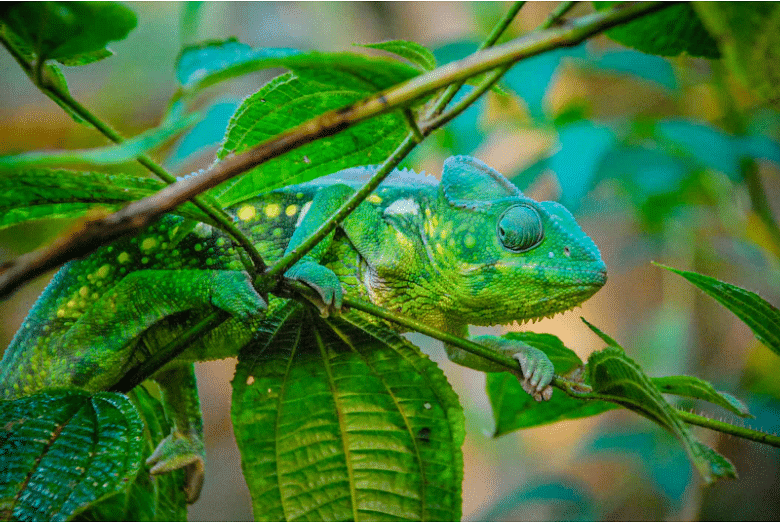
Camouflage of Chameleon
Several animals use camouflage to blend in with their surroundings. It imitates the colour of wood, leaf, or stone, for example, so that predators cannot discover them. To catch prey or flee from predators, the animals employ a variety of strategies. Camouflage is made up of two components: pigments and physical structure. For example, octopuses have pigments called biochromes that reflect light and affect the specimen's true colour.
Read More:
Types of Camouflage
[Click Here for Sample Questions]
Camouflage in animals comes in a variety of forms.
Mimesis Camouflage
This occurs when something looks to be something it is not. It begins to imitate its environment in order to attack prey or flee predators. It can, for example, imitate leaves, branches, and twigs. Leaf Tailed Gecko, Oakleaf Butterfly, Katydid, and Stick insects all have mimesis camouflage.

Gecko Camouflage
Read More: Catabolism and Anabolism
Active Camouflage
Only a few creatures alter their colour or pattern to fit into their surroundings. Octopus and Flounder fish, for example, may adapt to their surroundings. Octopus, Chameleons, Arctic Hare, Arctic Fox, and Peacock Flounders all have active camouflage.

Flounder Fish Camouflage
Read More: Difference between Warm blooded and Cold blooded animals
Self-decoration Camouflage
Some animals intentionally strive to hide by adorning themselves with items found in their environment, such as twigs, sand, or shell fragments, to break up their outlines, obscure their bodies' features, and blend in with their surroundings. A caddisfly larva, for example, constructs a decorated container and spends almost all of its time inside it; a decorator crab wraps its back with seaweed, sponges, and stones.

Decorator Crab
Disruptive Colouration Camouflage
Disruptive patterns, such as spots or stripes, are used to break up the contours of an animal or military vehicle, or to conceal telltale features, such as the eyes, as seen in the common frog. Disruptive patterns may employ multiple techniques to thwart visual systems such as edge detection. Disruptive camouflage is used by predators like the leopard to help them approach prey, while potential prey uses it to evade detection by predators.

Leopard Camouflage
Disruptive patterning is widely used in the military, both for uniforms and vehicles. Disruptive patterning, on the other hand, does not always achieve crypsis on its own, as elements such as shape, shine, and shadow can reveal an animal or a military target.
Read More:
Examples of Camouflage
[Click Here for Sample Questions]
Some of the animals which exhibit Camouflage are as follows:
Long-eared Owl
The long-eared owl, like nearly every other owl species, comes in a variety of colours, including brown, black, grey, and buff, to blend in with the woodlands where it dwells. It is difficult to spot even during the day because it is hidden in the crotch of a tree. This bird, which can be found in North America, Eurasia, Europe, and Asia, uses near-silent wingbeats to enhance its animal camouflage. As a result, the prey does not see or hear the approaching bird.

Long eared Owl
Read More:
Arctic Fox
The larger red fox, grizzly bears, wolverines, larger birds of prey, and wolves consume the Arctic fox, which is smaller than most other foxes. There are two types of Arctic foxes. The white-coated Arctic fox, like the Arctic hare, has a grey and brown coat during the summer, whereas the blue-coated Arctic fox has a blue coat. The white morph is found in almost all Arctic foxes.

Arctic Fox
Read More: Respiration and Combustion
Giraffe
Giraffe is recognised for its gorgeous patches and spots on its skin, in addition to its long neck. These patches, which are brown, orange, or black in colour and divided by cream-coloured or white pelage, provide excellent camouflage.

Giraffe Camouflage
Read More:
Cryptic Behaviour
[Click Here for Sample Questions]
Prey animals on the lookout for predators, as well as predators seeking for prey, are drawn to movement. Most crypsis methods also necessitate appropriate cryptic behaviour, such as lying down and remaining motionless to avoid detection, or, in the case of stalking predators like the tiger, moving with extreme stealth, both slowly and carefully, observing its prey for any signs of awareness of its presence. Young giraffes, for example, seek cover, lie down, and remain motionless for hours until their mothers return; their skin pattern mixes with the pattern of the vegetation, while the appropriate cover and lying position together disguise the animals' shadows.
Read Also:
Things to Remember
[Click Here for Sample Questions]
- Camouflage, also known as cryptic colouring, is a defence or strategy used by organisms to hide their appearance and merge in with their environment.
- Camouflage is a technique used by organisms to conceal their position, identity, and movement.
- Several animals use camouflage to blend in with their surroundings.
- Animals imitates the colour of wood, leaf, or stone, for example, so that predators cannot discover them.
Read More:
Sample Questions
Ques. What are distractive markings? (3 marks)
Ans: Distracting markings are used to disguise animals or military vehicles by diverting attention away from the object as a whole, such as observing its contour. This causes a lag in recognition. The markers must have a high contrast and hence stand out on their own. As a result, the method, like all camouflage, focuses on tricking the observer's mind rather than blending in with the background.
Ques. What is directional selection? (3 marks)
Ans: Directional selection is a negative natural selection mechanism in population genetics in which an extreme phenotypic is favoured over other phenotypes, leading allele frequency to move over time in the direction of that trait. As a result of disparities in survival and reproduction among distinct phenotypes, the beneficial allele accumulates under directional selection. The increases are independent of the allele's dominance, and even recessive alleles will eventually become fixed.
Ques. What is Counter-illumination? (3 marks)
Ans: Counter-illumination is a sort of active camouflage used by marine species like firefly squid and midshipman fish, as well as military prototypes, to produce light that matches the brightness and wavelength of their surroundings. When viewed from below, marine species in the mesopelagic (mid-water) zone seem black against the brilliant sea top. They can hide from predators and prey alike by creating lights with bioluminescent photophores along their down surfaces, which reduces the contrast between their silhouettes and the background.
Ques. What is countershading? (2 marks)
Ans: Countershading, often known as Thayer's law, is a camouflage technique in which an animal's colour is darker on top and lighter on the bottom. This pattern can be observed in several species of mammals, reptiles, birds, fish, and insects, including predators and prey, and dates back to the Cretaceous epoch, at least 145.5 million years ago.
Ques. What is a nymph? (3 marks)
Ans: A nymph is an immature form of several invertebrates, particularly insects, that goes through a progressive metamorphosis (hemimetabolism) before becoming an adult. Except for the lack of wings, a nymph's general morphology resembles that of an adult, unlike a typical larva (in winged species). Furthermore, a nymph rarely reaches the pupal stage while moulting. Instead, the adult insect emerges from the final moult. Nymphs go through several stages of development known as instars.
Ques. What is seasonal polyphenism? (3 marks)
Ans: Some far-northern animals, such as showshoe and Arctic hares, Arctic fox, stoat, and rock ptarmigan, change their coat colour from brown or grey summer camouflage to white in the winter (by moulting and growing new fur or feathers); the Arctic fox is the only dog family member to do so. Arctic hares, on the other hand, which reside in the extreme north of Canada, where summer is short, are white all year. The similarity of colour among these creatures in widely distant groups is attributable to convergent evolution, based on the assumption of natural selection favours a specific coloration in a specific environment.
Ques. What are Iridophores? (3 marks)
Ans: Iridophores, also referred also as guanophores, are chromatophores that use plates of crystalline chemochromes derived from guanine to reflect light. Because of constructive interference of light, they produce iridescent colours when lighted. Stacks of guanine plates separated with layers of cytoplasm generate minuscule, one-dimensional Bragg mirrors in fish iridophores. The character of the colour visible is determined by the chemochrome's orientation and optical thickness.
Ques. What is the importance of Camouflage? (3 marks)
Ans: Certain animals rely on camouflage to defend themselves from attackers or to attack their prey.
- It makes it easier to hide from predators.
- It will make escaping the predators impossible for the prey.
- It has the ability to blend in with the natural colour and pattern of the background.
Ques. What is bioluminescence? (3 marks)
Ans: A living entity produces and emits light, which is referred to as bioluminescence. It is a type of chemiluminescence. Bioluminescence is found in a variety of marine vertebrates and invertebrates, as well as fungus, microorganisms, including bioluminescent bacteria, and terrestrial arthropods like fireflies. The light is bacteriogenic in certain animals, created by symbiotic bacteria like those in the genus Vibrio, and autogenic in others.
Ques. What is variegation? (2 marks)
Ans: The emergence of different coloured zones in the leaves, stems, and fruit of plants is known as variegation. Variegated species can be found in the understory of tropical rainforests, so this environment is where a variety of variegated home plants come from. Color zonation in flowers, minerals, and animal skin, fur, feathers, or scales is also referred to by this word.
Read More:



Comments