



Education Content Expert
Environment is the surroundings in which all the living and non-living components live and interact with each other. The biotic factors (living) include animals, plants, forests, birds, etc. and abiotic factors (non-living) include water, land, sunlight, rocks, and air. The environment can be a social, natural or built environment.
There are majorly two types of environment namely Geographical Environment and Man-made Environment. Geographical Environment consists of all components provided by nature whereas a Man-made Environment is the one created by man to regulate specific environmental conditions.
Read More: Our Environment
Key Terms: Environment, Geographical Environment, Man-Made Environment, Biotic Factors, Abiotic Factors, Outer Environment, Inner Environment
What is Environment?
[Click Here for Sample Questions]
Environment refers to the surroundings or conditions in which living and non-living components co-exist with each other.
- Environment includes both biotic (living) and abiotic factors (non-living).
- It may be a natural, social, or built environment.
- Both individuals and the environment have an impact on each other and are complementary to each other.
- Environment influences an individual's behaviour and living conditions.
- Environment provides our surroundings with natural beauty and maintains life and all essential activities on the planet.
Types of Environment
[Click Here for Previous Years' Questions]
Environment is broadly divided into two categories
- Geographical Environment
- Man-made Environment
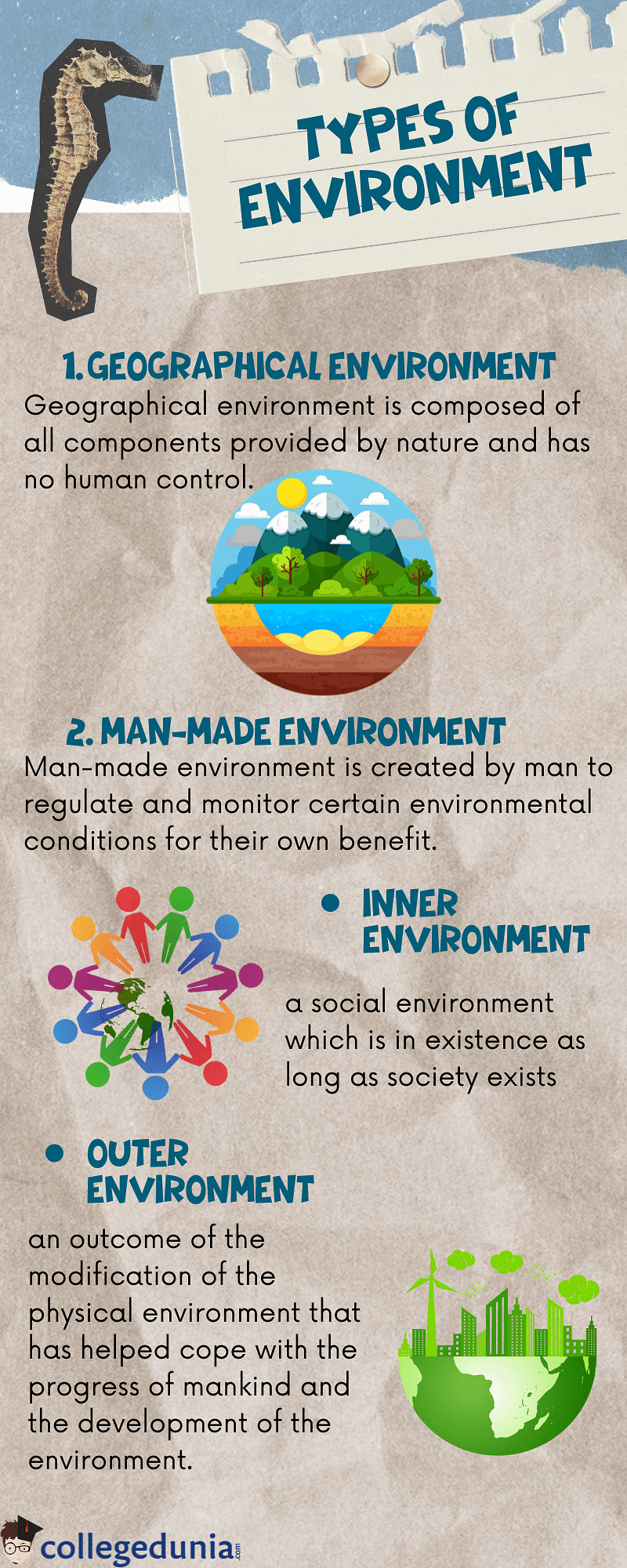
Geographical environment is composed of all components provided by nature and has no human control. Man-made environment is created by man to regulate and monitor certain environmental conditions for their own benefit.
Geographical Environment
[Click Here for Sample Questions]
Geographical environment, often referred to as a natural environment, is a terrestrial environment composed of complex natural and environmental conditions.
- It includes natural resources such as climate, earth’s surface, rivers, mountains, deserts, land, water, oceans, volcanoes, etc.
- Geographical environment is free of any human intervention. The geographical conditions are not dependent on the existence of humans.
- It is the complement of direct interaction between nature and humankind.
- The concept of geographical environment deals with various aspects of climatology, geology, and biogeography among others.
- The natural resources in the geographical environment contribute to the economy of a country.
Read More: Sustainability of Natural Resources
Man-Made Environment
[Click Here for Previous Years' Questions]
Man-made environment refers to the environment created by man in order to sustain and regulate the environmental conditions surrounding him. It is also referred to as the social environment.
There are two types of environments in the man-made environment:
- Inner Environment
- Outer Environment
Read More: Human Impact on the Environment
Inner Environment
- Inner environment is a social environment which is in existence as long as society exists.
- Inner environment depicts the customs, regulations, traditions, organizations and institutions in a society.
- It is also referred to as 'social heritage' as it plays an important role in humankind to exist and live.
- Inner environment directly affects the life of an individual and is essential for the social life of humans to flourish.
Outer Environment
- Outer environment is an outcome of the modification of the physical environment that has helped cope with the progress of mankind and the development of the environment.
- It is a physical environment created by man on his own with advancements in technology and science.
- It is composed of modern infrastructures, houses, communication and transport and various amenities at the social and individual levels.
- Outer environment evolves more rapidly than the inner environment because it is dependent on man and evolving technology.
| Chapter-Related Topics | ||
|---|---|---|
| Habitat | Importance of Ecosystem | Ecology and Environment |
| Terrestrial Ecosystem | Aquatic Ecosystem | Biomes |
Things to Remember
- Environment refers to anything that surrounds us.
- Living (biotic) and non-living (abiotic) components co-exist and interact with each other in the environment.
- Geographical environment and man-made environment are the two broad types of environment.
- Geographical environment is one that is composed of natural conditions and resources with no human control.
- Man-made environment is created by man to regulate and sustain environmental conditions.
- Man-made environment is further classified into Outer Environment and Inner Environment.
Previous Years’ Questions (PYQs)
- Biotic components of an ecosystem include…
- Co-existence of biotic and abiotic components of the environment…
- In a biotic community, the primary consumers are… (NEET 1995)
- Vertical distribution of different species occupying different… (NEET 2015)
- Trophic levels in ecosystem is formed by… (WBJEE 2009)
- What are the two most important climatic factors that…
- In a terrestrial ecosystem, detritus food chain…
- The Government of India has passed the environment (Protection) Act…
- India has a greater ecosystem diversity than a…
- An ecosystem which can be easily damaged but can… (NEET 2004)
Sample Questions
Ques. List the different types of environment. (3 Marks)
Ans. There are two major types of environment that exist:
- Geographical Environment: It is composed of natural components with no human control.
- Man-made Environment: It is created by man to adjust to the environmental conditions for their own benefit.
Ques. What are the components of the environment? (3 Marks)
Ans. There are two components of the environment namely:
- Biotic Factors: They include all the living things of the environment, like humans, microbe populations, plants, and animals.
- Abiotic Factors: They include all the non-living components such as temperature, light, rainfall, soil, and minerals.
Ques. What do you mean by microenvironments and macro environments? (2 Marks)
Ans. Microenvironment refers to the immediate local surroundings of an organism whereas macro environment of an organism refers to all the components including the biotic and abiotic factors.
Ques. State the difference between geographical and man-made environments. (3 Marks)
Ans. The geographical environment is the natural environment of an ecosystem which includes both abiotic and biotic factors. Some constituents of the geographical environment are mountains, rivers, terrain, etc.
A man-made environment is an environment that man has created to sustain and manage environmental circumstances. All the traditions, rules, institutions, and organizations are components of the man-made environment.
Ques. Elaborate on the environment in detail. (3 Marks)
Ans. Environment refers to the external surroundings that include all of the biotic and abiotic factors that surround and affect the survival and development of an individual or a society, It basically refers to the surrounding conditions and elements of an individual. The environment includes all the physicochemical and biological components of the ecosystem.
Ques. Mention the functions of the geographical environment. (5 Marks)
Ans. The major functions of the geographical environment are as follows:
- The geographical environment offers all the natural resources available in an ecosystem.
- It offers both renewable and non-renewable sources required to sustain life on the planet.
- All life-sustaining elements are provided by the geographical environment such as sunlight, water and air.
- It also assists in the assimilation of waste because of the various biogeochemical cycles that maintain the balance in the environment.
Ques. How can we clearly differentiate between man-made and geographical environments? (3 Marks)
Ans. In order to differentiate between man-made and geographical environments, we need to check the dependence of both of them.
- A manmade environment comprises all the material and non-material things created by man. This sort of environment will exist as long as human society exists.
- The geographical environment includes all those things that occur naturally and does not depend upon human existence.
Ques. What are the two types of the man-made environment? (3 Marks)
Ans. There are two types of man-made environment namely:
- Inner Environment
- Outer Environment
The inner environment is a social environment that exists as long as a particular society exists. The outer environment is a result of the modifications caused due to technology which includes modern infrastructure in cities, our homes and all associated elements.
Check-More:



Comments