



Education Journalist | Study Abroad Lead
Plastids are the largest cell organelle in plants. Plastids are double-membrane organelles that contain pigments that are helpful in the process of Photosynthesis and govern the change in the colours of the cells. Plastids also act as storage devices for starch and help in the synthesis of various molecules like fatty acids and terpene. They are found in plants and algae and are responsible for manufacturing and storing food. E. Haeckel was the first person to discover Plastids, however, its first clear definition was given by A. F. W. Schimper. Plastids in Plants can have varieties like chloroplasts, chromoplasts, leucoplasts, proplastids, etc. All kinds of green plastids are found to be surrounded by two membranes, these are inner and outer and are 7 nm thick membranes.
Table of Contents
| Table of Content |
Key Terms: Plastids, Photosynthesis, Colour, Plant, Cell, Organelle, Colourless, Pigment, Chloroplasts, Leucoplasts.
What are Plastids?
[Click Here for Sample Questions]
Plastids are organelle bounded with membranes that are found in algae cells, plants cells, and the cells of various eukaryotic organisms. The storage and manufacture of important compounds of chemicals that are used by autotrophic eukaryotes’ cells are done inside of Plastids. Plastids usually contain pigments inside them that are used in photosynthesis. The variety of a Plastid’s pigments determines the colour of the cell. Their origin is mutual and evolutionary. They possess a DNA molecule that is circular and is double-stranded, just like any other prokaryotic cell. Plastid is an important cell organelle that generates energy in plants only.
The name Plastids was coined by Shimper, it was actually for structures that are responsible for photosynthesis. However, photosynthesis is a process that transports chemical energy for all living organisms either directly or indirectly. Chloroplasts are organelles that capture, convert and conserve chemical energy that is actually solar energy. They are commonly seen in almost all the cells of a plant body. They are either found as coloured plastids, colourless plastids or proplastids.
Plastids
Plastids in Plants
[Click Here for Sample Questions]Plastids having chlorophylls are able to perform photosynthesis and hence are known as chloroplasts. They can also store starch and can manufacture terpenes and fatty acids, that is further used to produce energy, and these materials are also used as raw materials for other molecules’ synthesis. All plastids are made from proplastids. Proplastids exist in the plant’s meristematic regions. Proplastids along with younger chloroplasts divide with the help of binary fission but the same can be said for chloroplasts that are more mature.
Plastids can be differentiated into various forms, which depends on the purpose they serve inside the cell.
Identical proplastids can further develop in any of these variants:
- Chloroplasts: These are the plastids that are green in colour, for photosynthesis.
- Chromoplasts: The coloured plastids for pigment is synthesized and stored here.
- Gerontoplasts: It controls the dismantling of the photosynthetic during the senescence of the plant.
- Leucoplasts: These are the colourless plastids that are used for monoterpene combinations. They can differentiate further into more specialized plastids sometimes.
- Amyloplasts: They are used for storing starch, gravity awareness (geotropism).
- Elaioplasts: They are used for storing fat.
- Proteinoplasts: They store and alter protein.
- Tannosomes: They synthesize and create polyphenols tannins.

Types of Plastids
Plastids can differentiate between these forms depending upon their function and morphology.
A plastid makes several copies of a 75–250 kilobase plastome that is circular in shape. The genome that is copied per plastid has an inconstant number, that can become greater than a thousand by dividing cells quickly, which has a few plastids, ranging to a hundred or smaller in cells that are matured, where the separation of plastids has produced many plastids. The plastome has about a hundred genes that are encoded with transfer and ribosomal ribonucleic acids, with proteins that do photosynthesis and plastid gene translation and transcription. However, these proteins are only a small part of the total protein needed to produce and maintain the function and structure of a plastid’s particular type. Plant nuclear genes do the conversion of plastid proteins in huge bulks, and nuclear genes and plastid genes are co-controlled to help in coordinating the growth of the plastids properly with cell differentiation.
Plastids in Algae
[Click Here for Sample Questions]Leucoplast is the name used for all plastids that are unpigmented in Algaes. They help to differ from the plant’s leucoplasts. Amyloplasts, chromoplasts and Etioplasts are plant-specific. They don’t take place in algae. Plastids in hornworts and algae may be different from plastids in plants as they have pyrenoids.
Glaucophyte algae have Muroplasts that are similar to chloroplasts except that they contain a peptidoglycan cell wall, parallel to prokaryotes. Red algae have Rhodoplasts that are essentially red chloroplasts that help to photosynthesise up to 268 meters of depth. Floridean starch is stored and produced outside the cytosol’s plastids in the red algae.
Classification of Plastids
[Click Here for Sample Questions]Plastids can be classified on the basis of the absence or presence of pigments and their development phases. Plastids have been mainly classified into leucoplasts, chromoplasts and proplastids.
- Proplastids: They are Minor vesicular structures that are present in the meristematic cells. They have no colour and are immature. Proplastids can undergo changes and transform into either coloured chromoplasts with green chloroplasts or colourless leucoplasts. Proplastids constantly keep dividing and redividing and this helps the cells to undergo differentiation into different kinds.
- Leucoplasts: They are plastids without colours that are found in the in storage parenchyma along with other tissues that have no colour. They are usually found as storage organelles. They are divided further into amyloplasts depending on the type of chemicals they store. Such leucoplasts get altered into coloured plastids if they are exposed to sunlight, which means that these plastids have the required genetic potential to develop the tools and perform photosynthesis.
- Chromoplasts: Chormoplats have plastids containing coloured pigments together, and the green ones in them are known as chloroplasts. They are classified further depending upon their pigments. Rhodoplasts are rich in red pigment (phycoerythrin). Xanthoplasts and Phaeoplasts have yellow pigments (carotenoids, xanthophylls). Phycocyanin and other pigments are also a part of coloured plastids.
- Additional Plastids: These kinds of plastids except chloroplasts are found in some particular classes of plants and plant organs with parts that are floral. Floral parts produce different kinds of pigments in petals. Different plants make different petals with different colours however that is genetically encoded.

Structure of a Chloroplast
Structure of Plastids
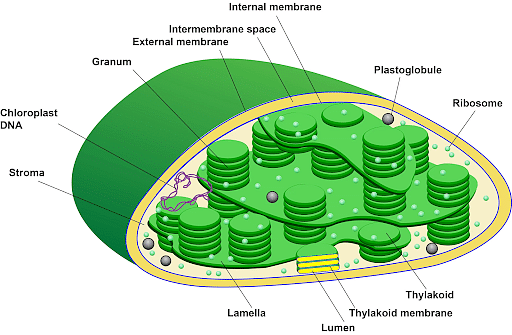
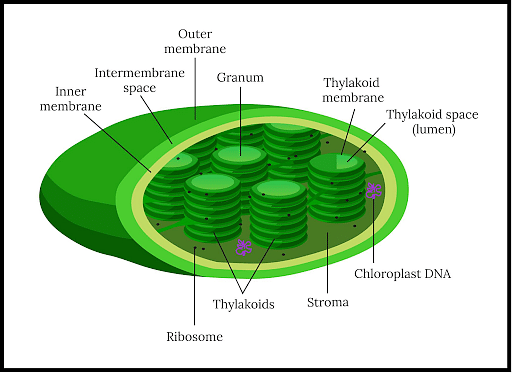
[Click Here for Sample Questions]All kinds of green plastids are found to be surrounded by two membranes, these are inner and outer and are 7 nm thick membranes. They are separated by an 8-10nm thick periplastid space. A fully developed plastid’s inner membranes do not have any inward foldings, unlike Mitochondria.
Structure of Plastids
Inheritance of Plastids
[Click Here for Sample Questions]Several plants are inherited from a single parent’s plastids. The female gamete helps to inherit angiosperms while the male pollen helps several gymnosperms to inherit plastids. Inheritance in Algae’s plastids is from a single parent only. The inheritance of the DNA of the plastids is completely uniparental. The inheritance of plastid is erratic in hybridisation.
Check More:
Things to Remember
- Plastids are organelle bounded with membranes that are found in algae cells, plants cells, and the cells of various eukaryotic organisms.
- E. Haeckel was the first person to discover Plastids, however, its first clear definition was given by A. F. W. Schimper.
- The storage and manufacture of important compounds of chemicals that are used by autotrophic eukaryotes’ cells are done inside of Plastids.
- Plastids usually contain pigments inside them that are used in photosynthesis.
- The variety of a Plastid’s pigments determines the colour of the cell.
- Their origin is mutual and evolutionary.
- They possess a DNA molecule that is circular and is double-stranded, just like any other prokaryotic cell.
- Plastid is an important cell organelle that generates energy in plants only.
- Plastids having chlorophylls are able to perform photosynthesis and hence are known as chloroplasts.
- They can also store starch and can manufacture terpenes and fatty acids that are further used to produce energy, and these materials are also used as raw materials for other molecules’ synthesis.
- All plastids are made from proplastids.
- Proplastids exist in the plant’s meristematic regions.
- Proplastids along with younger chloroplasts divide with the help of binary fission but the same can be said for chloroplasts that are more mature.
Sample Questions
Ques. What is the function of plastids? Name the various types of Plastids. (3 Marks)
Ans. The plastid is a first-rate double-membrane organelle that is found inside the cells of flowers and algae. Plastids manufacture and store vital chemical compounds which are utilized by the plant cells. They often contain pigments utilized in photosynthesis
In flora, plastids may differentiate into several types, relying upon which part they play in the cell. Plastids can be differentiated into various forms, which depends on the purpose they serve inside the cell. The various types of plastids found are Chloroplasts, Chromoplasts, Gerontoplasts, Leucoplasts, Amyloplasts, Proteinoplasts, and Elaioplasts.
Ques. What is the difference between mitochondria and plastid? (5 Marks)
Ans. Mitochondria and Plastid may be differentiated as the following:
- Definition
-
-
- Mitochondria: Mitochondria are a sort of organelles wherein the biochemical processes of respiratory and energy manufacturing occur.
- Plastids: Plastids are double-membrane organelles found most effective in flora and algae wherein the production and storage of chemical substances arise within the cell.
-
- Pigments
-
-
- Mitochondria: Mitochondria lack pigments.
- Plastids: Many plastids comprise pigments.
-
- Occurrence
-
-
- Mitochondria: Mitochondria is located in each plant and animal cell.
- Plastids: Plastids are best discovered in plant cells and algae.
-
- Inner Membrane
-
-
- Mitochondria: Inner mitochondrial membrane includes folds called cristae.
- Plastids: No folds are observed inside the inner membrane of plastids.
-
- Chambers
-
-
- Mitochondria: Completely separated chambers are discovered within the matrix.
- Plastids: Plastids are devoid of completely separated chambers inside the matrix.
-
- Function
-
-
- Mitochondria: Mitochondria produce energy in the cell.
- Plastids: Plastids are particularly involved within the food production and storage within the cell.
-
- Types
-
-
- Mitochondria: Mitochondrial type may vary based on the needs of the cell.
- Plastids: Leucoplasts, chromoplasts, and chloroplasts are the three forms of plastids.
-
- Organelle DNA
-
- Mitochondria: Mitochondria have their very own DNA inside the organelle.
- Plastids: Only chloroplasts have their personal DNA
Ques. Which plastids provide colour to the fruits in plants? (3 Marks)
Ans. Chromoplasts are the plastids that are responsible for providing colour to roots, leaves, flowers and ripe fruits. Chromoplasts contains carotenoids, the lipid-soluble pigments, that provide colour to different parts of plants and flowers.
Carotenoid pigments provide different colours like yellow, orange and red colour to different parts of fruits, flowers, old leaves, roots, etc. Also, Carotenoids are accumulated during the ripening of fruits and there is an extensive synthesis of carotenoids during the ripening of fruits.
Ques. How are Plastids inherited? (3 Marks)
Ans. Several plants are inherited from a single parent’s plastids. The female gamete helps to inherit angiosperms while the male pollen helps several gymnosperms to inherit plastids. Inheritance in Algae’s plastids is from a single parent only. The inheritance of the DNA of the plastids is completely uniparental. The inheritance of plastid is erratic in hybridisation.
Most of the plants inherit plastids from only one parent. Angiosperms inherit plastids from the female gamete, whereas various gymnosperms inherit plastids from the male pollen. Similarly, Algae also inherit plastids from a single parent only, thus, the plastid DNA of the other parent is completely lost.
Ques. Why don't animal cells have plastids? (5 Marks)
Ans. Animal cells are a sort of eukaryotic cells. Animal cells contain a nucleus, nucleolus, mitochondria, a nuclear envelope, ribosomes-unfastened and attached and clean endoplasmic reticulums, Golgi bodies, in addition to several different organelles. Those are just some of the foremost organelles. An animal cell has a cell membrane now not a cell wall. This is because those cells are included inside our body and they do now not need to maintain a sure structure. Animals cells also have a centriole. This organelle is most observed in animal cells now not plant cells. This organelle plays the first position in mitosis for the animal cells.
Plant cells however are quite comparable, however do have variations. Plant cells have each organelle that an animal cell has except for a centriole. On the contrary, there are organelles that plant cells have that animal cells do no longer; including plastids (leucoplasts, chromoplasts, and chloroplasts), an imperative vacuole, and a cell wall. A primary vacuole is wanted to save water for the plant to stay. Chloroplasts play a major position in photosynthesis; leucoplasts are starch that is stored in organelles; chromoplasts are plastids that include colourful pigments and they'll or may not take part in photosynthesis. A cellular wall is wanted for a plant cell to uphold its shape. This organelle maintains the plant cell from dying.
Ques. What are Leucoplasts? (3 Marks)
Ans. Leucoplasts are plastids without colours that are found in the in storage parenchyma along with other tissues that have no colour. Some of the important points about Leucoplasts are as follows:
- Leucoplasts are non-pigmented as compared to other plastids such as chloroplasts.
- They are found in the non-photosynthetic tissues of a plant such as roots, seeds, bulbs, etc.
- They are usually found as storage organelles. They are divided further into amyloplasts depending on the type of chemicals they store. Such leucoplasts get altered into coloured plastids if they are exposed to sunlight, which means that these plastids have the required genetic potential to develop the tools and perform photosynthesis.
Ques. What are Chromoplasts? (3 Marks)
Ans. Chormoplats have plastids containing coloured pigments together, and the green ones in them are known as chloroplasts.
- Chromoplasts are classified further depending upon their pigments. Rhodoplasts are rich in red pigment (phycoerythrin). Xanthoplasts and Phaeoplasts have yellow pigments (carotenoids, xanthophylls).
- Phycocyanin and other pigments are also a part of coloured plastids.
- Chromoplasts also vary in terms of their structure and appearance when observed under a microscope and can be classified into five types- globular, crystalline, fibrillar, tubular, and membranous.
Ques. Describe the additional plastids found in plants. (1 Mark)
Ans. The plastids except for chloroplasts that are found in some particular classes of plants and plant organs with parts that are floral are the additional plastids. Floral parts produce different kinds of pigments in petals. Different plants make different petals with different colours however that is genetically encoded.
Ques. What are Proplastids? (1 Mark)
Ans. Proplastids are Minor vesicular structures that are present in the meristematic cells. They have no colour and are immature. Proplastids can undergo changes and transform into either coloured chromoplasts with green chloroplasts or colourless leucoplasts. Proplastids constantly keep dividing and redividing and this helps the cells to undergo differentiation into different kinds.



Comments