



Education Journalist | Study Abroad Lead
Centrioles are paired barrel-shaped cell organelles found near the nuclear envelope in the cytoplasm of animal cells. Centrioles aid in the organisation of microtubules, which serve as the cell's skeletal system. They aid in the placement of the nucleus and other organelles within the cell. A centriole is a barrel-shaped organelle that normally resides within the centrosome. The centrosome is a cytoplasmic region. It is located near the nucleus and within the centrosome. There are two centrioles within that centrosome. Centrioles are essential for cell division. When the cell divides, those centrioles move to opposite ends of the nucleus. When the chromosomes condensate to undergo mitosis, the centrioles form the areas from which the mitotic spindle forms.
| Table of Content |
Key Terms: Centriole, Cell Organelles, Cytoplasm, Microtubules, Chromosomes, Centrosome, Nucleus, Eukaryotic Cells, Cilia, Flagella
What is Centriole?
[Click Here for Sample Questions]
Centrioles are cylindrical (tube-like) structures/organelles found in eukaryotic cells that are made up of microtubules. Centrioles in the cell facilitate chromosome separation, which aids in cell division. As a result, they are in close proximity to the nucleus.
Apart from cell division, centrioles help to form cilia and flagella, which aid in cell movement. Centrioles are found in eukaryotic cells but are absent in higher plants. Cells in these plants, therefore, do not divide using centrioles.

Centrioles
Read More: Difference between Cilia and Flagella
Structure of Centriole
[Click Here for Sample Questions]
A centriole is made up of short lengths of microtubules arranged in the shape of an open-ended cylinder 500nm long and 200nm wide. The microtubules that make up the cylinder's wall are organised into nine sets of three microtubule bundles each.
The wall and cavity architecture are slightly different in cilia and flagella, where centrioles are at the base of the structure and are referred to as basal bodies. In addition to cylinder walls made up of nine sets of three microtubule bundles, there are walls made up of nine sets of two bundles. Both types have a central matrix from which spokes radiate, similar to a cartwheel.
Centrioles in animal cells are usually found in pairs, with the cylindrical centrioles at right angles to each other.
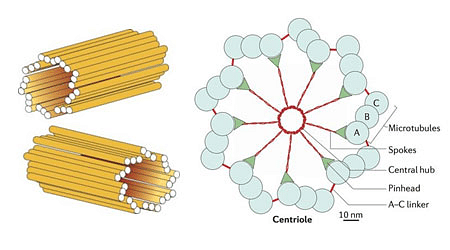
Structure of Centriole
Read More: Meiosis: Definition, Functions and Phases
Pairs of Centrioles
[Click Here for Sample Questions]
Mitotic cells have a centrosome with two pairs of centrioles and associated pericentriolar material (PCM). The centrosome divides into two parts during prophase, and a centriole pair migrates to each end or pole on the outside of the nuclear membrane or envelope. At this point, microtubules are formed at the pericentriolar material's outer edge and grow out in a radial pattern. Aster is a pair of centrioles and a PCM. Microtubules from one pole of the aster grow towards the opposite pole of the aster. Spindle fibres are the name given to these microtubules.
Functions of Centriole
[Click Here for Sample Questions]
- In most animal cells, centrioles function as a pair, but in cilia and flagella, they function as a single centriole or basal body.
- Centrioles are an essential component of centrosomes, which are responsible for organising microtubules in the cytoplasm. The position of the centriole determines the position of the nucleus and is important in cell spatial arrangement.
- Sperm centrioles are important for two reasons: forming the sperm flagellum and sperm movement, and embryo development after fertilisation. The sperm provides the centriole, which forms the zygote's centrosome and microtubule system.
- The position of the flagellum or cilium is determined by the mother centriole, which becomes the basal body in flagellates and ciliates. A number of genetic and developmental diseases have been linked to cells' inability to use centrioles to make functional flagella and cilia. Meckel–Gruber syndrome has recently been linked to the inability of centrioles to migrate properly prior to ciliary assembly.
Read More: Difference Between Cytosol and Cytoplasm
Things to Remember
- A centriole is a barrel-shaped organelle that is normally within the centrosome which is a cytoplasmic region. It is located near the nucleus and within the centrosome.
- A centriole is composed of short lengths of microtubules arranged in the shape of an open-ended cylinder 500nm long and 200nm wide.
- Mitotic cells have a centrosome with two pairs of centrioles and associated pericentriolar material (PCM).
- In cilia and flagella, the wall and cavity architecture are slightly different, where centrioles are at the base of the structure and are referred to as basal bodies.
- When the cell divides, those centrioles move to opposite ends of the nucleus.
- The centrosome divides into two parts during prophase, and a centriole pair migrates to each end or pole on the outside of the nuclear membrane or envelope.
Sample Questions
Ques. What does centriole do in our cells? (3 Marks)
Ans. Centrioles are paired barrel-shaped organelles found near the nuclear envelope in the cytoplasm of animal cells. Centrioles aid in the organisation of microtubules, which serve as the cell's skeletal system. They help to position the nucleus and other organelles within the cell.
Ques. How does centriole function? (3 Marks)
Ans. Centrioles are paired barrel-shaped organelles found in the cytoplasm of animal cells near the nuclear envelope. Centrioles help to organise microtubules, which serve as the cell's skeletal system. They help to keep the nucleus and other organelles in place within the cell.
Ques. Where is centriole produced? (3 Marks)
Ans. Centrioles are paired barrel-shaped organelles found near the nuclear envelope in the cytoplasm of animal cells. Centrioles aid in the organisation of microtubules, which serve as the cell's skeletal system. They are essential in the placement of the nucleus and other organelles within the cell.
Ques. Are centrioles present in plant cells? (3 Marks)
Ans. No, centrioles are absent in plant cells. They are present only in animal cells and in some lower plant cells. These paired organelles are only found in animal cells and are usually found together near the nucleus in the centrosome, a granular mass that serves as an organising centre for microtubules.
Ques. What happens if centriole is absent? (3 Marks)
Ans. Chromosomes would be unable to move during the formation of new cells if centrioles were not present. Centrioles aid in the organisation of microtubule assembly during cell division. To put it simply, during cell division, chromosomes use the centriole's microtubules as a highway.
Ques. What would happen if the centrioles stopped working? (3 Marks)
Ans. Without centrioles, organelles would not be able to stay in their proper positions, and microtubules would be unable to function properly, leaving cells unsupported and prone to losing shape. Apart from that, centrioles are essential for cell division, and if it stops working, it would be problematic for the cell.
Ques. In what type of cell is Centriole found? (3 Marks)
Ans. Centrioles are paired barrel-shaped organelles found near the nuclear envelope in the cytoplasm of animal cells. Centrioles help to organise microtubules, which act as the cell's skeletal system. They help to position the nucleus and other organelles within the cell.
Also Check:



Comments