



Education Journalist | Study Abroad Lead
Cyclostomata are group of parasitic vertebrates that includes the living jawless fish, morphologically similar to eels. They are popularly known as Agnatha, due to their jawless mouth. They belong to phylum chordata of kingdom Animalia. Cyclostomes are believed to have split off before the evolution of dentine and bone, hence making them jawless. However, many fossil agnathans, including conodonts found, possessed dentine and bones.
What are Cyclostomes?
[Click Here for Sample Questions]
Cyclostomes are the members of class Cyclostomata. The meaning of cyclostomata is derived from two Greek words-“cyklos which means circular and stoma meaning mouth”. Thus, Joan Crockford-Beattie came up with the name ‘Cyclostomata’ since the members of this group had a round mouth. It is a vertebrate group of animals which includes the living jawless fishes, lampreys and hagfishes.
- Such animals possess horny epidermal structures that act like teeth and branchial arches, positioned internally unlike related jaw fishes.
- Cyclostomes are warm blooded vertebrates found exclusively in marine environments.
- The members of phylum cyclostomata are marine vertebrates but for spawning, they migrate to freshwater.
- Spawning is the process of reproduction in cyclostomes through which they lay eggs to give rise to new organisms.
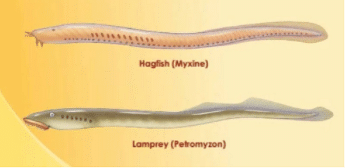
Cyclostomata
Origin of Cyclostomata
[Click Here for Sample Questions]
All living organisms are classified and identified based on the form and function of their bodies. The existence of cyclostomata first appeared in lower ordovician period. Some features are more prone than others to cause wide-ranging alterations in body design.
There is also a function of time in this. As a result, once a given body design is established, it will shape the impacts of all subsequent design alterations simply by existing. In other words, features that emerged earlier are more likely to be fundamental than characteristics that emerged later.
- Cyclostomata are living agnathans that are rudimentary in many ways but specialised in others.
- The suctorial mouth is ventral and circular, hence the name Cyclostomata.
- These are modified versions of the primitive vertebrates that are believed to have arisen in the Devonian period.
Characteristics of Cyclostomata
[Click Here for Sample Questions]
Cyclostomes are early vertebrates with no jaws. Hagfish and lampreys are among them. The body is eel-like in length with a compressed tail and trunk. Some of the notable characteristics of Cyclostomes are:
- Paired fins are lacking. The cartilaginous fin-rays support the median fin.
- The skin is soft and smooth with a slimy texture and less scaling.
- The trunk and tail include Z-shaped myomeres. The tongue is moved by the protractor and retractor muscles.
- The stomach is missing and the oesophagus connects to the intestine.
- There is an endoskeleton present.
- Skull is a primitive and simplistic design.
- The notochord is present throughout one's life.
- Around the notochord, neural arches represent the vertebrae.
- In sac-like pouches, there are five to sixteen pairs of gills.
- The heart is divided into two chambers. There is a sinus venous, but no conus arteriosus.
- Leukocytes and irregular nucleated erythrocytes are found in the blood.
- The brain is visible.
- There are ten pairs or fewer cranial nerves present.
- The nasal sac is solitary and located in the middle of the nose.
- There is a lateral line sense organ.
- A pair of mesonephric kidneys are part of the excretory system.
- The sexes are distinct.
- Gonad is without a gonoduct and is solitary.
- Direct development or a protracted larval stage are also possibilities.
Cyclostomata Resembling Amphioxus
[Click Here for Sample Questions]
Below mentioned are the characteristics of Cyclostomata resembling the characteristics of Amphioxus:
- There are no jaws, exoskeleton, or paired fins.
- Continuous notochord but with an added sheath.
- Presence of myotomy, that is segmental musculature, but with minimal variation from head to tail.
- Straight ciliated food tract with little regional specialisation.
- The number of gill-slits is relatively large.
- Lamprey larvae with endostyle.
- No products and gonads.
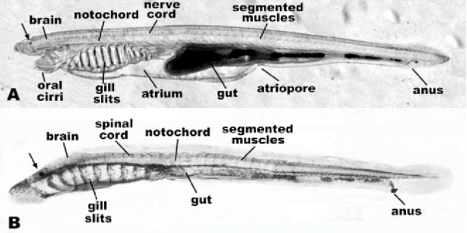
Amphioxus
Difference between Cyclostomata and Fish
[Click Here for Sample Questions]
Mentioned below are the notable differences between Cyclostomata and Fish:
| Cyclostomata | Fish |
|---|---|
| Cyclostomata has no biting jaws, hair, true teeth, true fin rays, girdles, ribs, stomach, spleen, or products. | Fish has well established, jaws, teeth, fins, girdles, stomach and spleen. |
| There is no break in the median dorsal fin. | Anatomy of fish has a break in the median dorsal fin. |
| Cyclostomata has no Diphysa Clic caudal fin | Fish has Diphysa Clic caudal fin |
| Cyclostomata has single nostrils in the middle | Fish has paired nostrils. |
| Cyclostomata has an incomplete cranium | Fish has a well-constructed cranium |
| It has weak or no vertebrae | It has a well-structured vertebrae |
| It has a rudimentary pancreas | It has a well evolved pancreas that carries out its functions. |
| It either has no spinal valve or has a week spinal valve in the gut. | Fish have spinal valve. |
| Cyclostomata has a tiny brain. | Fish have a well evolved brain. |
| Nerves are not medullated as ninth and tenth cranial nerves are not found. | Nerves are medullated. |
Classification of Cyclostomata
[Click Here for Sample Questions]
There are two orders in the Cyclostomata class, namely,
- Petromyzontida
- Myxinoidea
Petromyzontia
The characteristics of Petromyzontida are:
- Lampreys are included in this category.
- The buccal funnel has suctorial teeth and is suctorial.
- In the buccal funnel, the mouth is present.
- The nasal sac is located on the back of the nose. There is no link between it and the pharynx.
- The eyes are useful.
- There are seven pairs of gill slits.
- There is a well-developed dorsal fin.
- The branchial basket is finished.
- The brain has reached its full potential.
- The pineal eye has a good amount of development.
- The ear canals are semicircular.
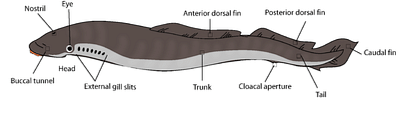
Lamprey
Myxinoidea
The characteristics of Myxinoidea are:
- Hag-fishes, sometimes known as slime eels, are among them.
- The buccal funnel is missing.
- A canal connects the nasal sac to the pharynx.
- Eyes are a relic of the past.
- The dorsal fin is either missing or very tiny.
- The branchial basket isn't as developed as it could be.
- The brain is a basic organ.
- The size of the pineal eye has shrunk.
- There is only one semicircular canal in the ear.
- All hag-fishes are found in the sea.
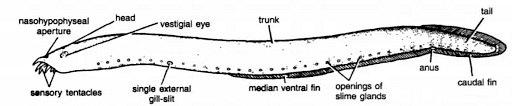
Myxinoidea
Things to Remember
[Click Here for Sample Questions]
- Cyclostomata are parasite fish that feed on them when they are adults. They have a morphology that is similar to that of eels.
- They are the only extant vertebrates lacking genuine jaws, which is why they are termed Agnatha. Hagfishes and lampreys are examples of Cyclostomata.
- The marine lamprey breeds in freshwater, which has been known for a long time. It does not, however, indiscriminately penetrate all streams within its range.
- Cyclostomata means ‘round mouths’ in Greek. They can't close their mouths because they don't have a jaw, so they have to constantly cycle water through it.
- Cyclostomes have a sucking and round mouth without the presence of a jaw.
Sample Questions
Ques. Define Vertebrata. (3 marks)
Ans. Vertebrates belong to phylum chordata of animal kingdom. They are symmetrical on both sides, triploblastic, coelomic and segmented, with sophisticated body tissue and organ differentiation. The following characteristics are shared by all chordates:
- Vertebrates possess a notochord.
- They have a dorsal nerve cord.
- They are triploblastic.
- They possess paired gill pouches.
- They are coelomates.
Vertebrates are classified into six groups, namely,
- Cyclostomata
- Pisces
- Amphibia
- Reptilia
- Aves
- Mammals
Ques. What is Ammocoete larva? (2 marks)
Ans. Ammocoete larvae are present in the larval stage of primitive jawless fish such as lamprey or Petromyzon. These young larvae remain burrowed in fine sediment in rivers for several years. They feed on detritus and microorganisms.
Ammocoete larvae possess several notable properties of ancient chordates as well as those of vertebrates, making them an important aspect in evolutionary studies. The larva possesses dorsal nerve cord, nervous system, gills, brain, eyes and notochord. The larva also goes under metamorphosis which is an essential step in the evolution of the petromyzon fish.
Ques. What is parasitism? Are Cyclostomes endoparasites? (2 marks)
Ans. Parasitism can be defined as a symbiotic relationship between host and parasite where the parasite is benefitted from the host body. In such a type of relationship, one organism, called a parasite, which is dependent on another organism, called as host, causes harm to the other organism by living in another's habitat.
Cyclostomes are endoparasites that live inside the host body. They mostly feed on fish in their adult stage.
Ques. What is the primary difference between Hagfishes and Lampreys? (2 marks)
Ans. Hagfish and Lamprey are two groups of Agnatha, ie, jawless fish that possess a morphology similar to that of an eel. Both Hagfish and Lamprey are boneless fish which lack scales and paired fins. The key difference between a hagfish and a lamprey is that the lamprey possesses a vertebra whereas the vertebra is lacking in hagfish. Moreover, lampreys belong to order Petromyzontida of class Cyclostomata whereas Lampreys belong to class Myxinoidea of class cyclostomata.
Ques. Differentiate between vertebrates and invertebrates. (4 marks)
Ans. Tabulated below are the key differences between vertebrates and invertebrates:
| Vertebrates | Invertebrates |
|---|---|
| Vertebrates possess a skeletal structure or a spinal cord. | Invertebrates do not possess a skeletal structure or a spinal cord |
| Not all vertebrates possess exoskeleton. | Invertebrates possess exoskeleton to maintain their structural support. |
| Vertebrates possess a bilateral symmetry. | Invertebrates either possess a bilateral symmetry or a radial symmetry. |
| Vertebrates possess an organised and comparatively complex nervous system. | Invertebrates possess an unorganised and simple nervous system. |
| Vertebrates are both cold blooded and warm blooded. | Invertebrates are cold blooded. |
| Sexual Reproduction is primary method of reproduction in vertebrates. | Asexual Reproduction is primary method of reproduction in invertebrates. |
Ques. Does Cyclostomata show metamorphosis? (2 marks)
Ans. Yes, cyclostomes show metamorphosis in their developmental stage. The larva present in cyclostomes is Ammocoete larva which undergoes metamorphosis in order to develop into an adult lamprey fish. Due to metamorphosis, below mentioned notable changes are observed in the developmental stage:
- The lamprey endostyle present develops into the thyroid gland.
- The nasal duct present undergoes modification and ends blindly in a pouch in lampreys whereas it opens into the pharynx in hagfishes.



Comments