



Exams Prep Master
Vertebrates form one of the most significant groups of the whole Animal Kingdom. The whole kingdom is divided into multiple groups with respect to the level of organization, symmetry, body cavity and Phylum. One such important criterion is the presence or absence of vertebras in the animals. Vertebrates and Invertebrates are classified based on the presence and absence of skeleton and backbone, respectively and have evolved from a common ancestor millions of years ago. Vertebrates are further subdivided into various classes like mammals, birds, amphibians, reptiles, fish etc. Let’s have a closer look at the topic and discuss some important questions.
| Table of Contents |
Key Terms: Vertebrates, Classification of Vertebrates, Evolution of Vertebrates, Vertebrates Characteristics, Mammals.
Vertebrates Meaning
[Click Here for Sample Questions]
Vertebrates are referred to the animals that possess a vertebral column or notochord at any point in their lives. Vertebrates and invertebrates evolved from a common ancestor that have lived around 600 million years ago.
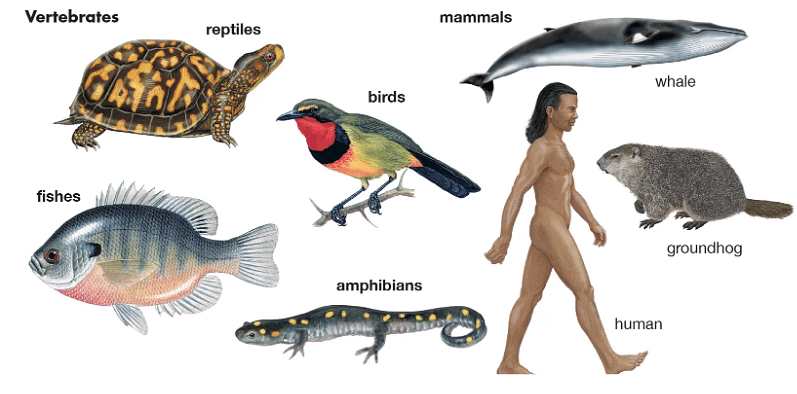
VERTEBRATES
Also read:
Evolution of Vertebrates
[Click Here for Previous Year Questions]
Animals that exhibit a cellular level of organization are grouped as cellular organisms, and the others where a group of cells arranged in a specific pattern to perform the same function is categorized under tissue level organism. Further, based on symmetry, they are divided into three categories- Asymmetrical (any plane that passes through the centre of the body does not divide them into equal halves), Radial (any plane passing through the central axis of the body divides the organism into two identical halves) and Bilateral (body can be divided into identical left and right halves in only one plane) organism.

Evolution of Vertebrates
Animals possessing coelom are called coelomates, and animals, where the body cavity is absent, are called acoelomates. Chordata is divided into Urochordata/ Tunicata, Cephalochordata, and Vertebrata. Urochordata and Cephalochordata are often referred to as protochordate and are exclusively marine.
Read more: Animal kingdom animalia subphylum
Characteristics of Vertebrates
[Click Here for Sample Questions]
The chief characteristics of vertebrates are as follows:
- Vertebrates possess a backbone through the length of the animal, either in the form of a vertebral column or a notochord. In the case of human beings, the notochord which is present during embryonic life develops into a vertebral column at a later stage.
- Another striking feature of vertebrates is the presence of the spinal cord and gastrointestinal tract.
- Within the vertebral column, there is a spinal cord through which groups of nerves arise, which expands to the brain and different parts of the body.
- The mouth is present at the anterior portion of the alimentary canal and ends at the anus that opens to the exterior. Most vertebrates have a tail at the end of the anus.
- Vertebrates also possess paired appendages in the form of fins or limbs.
- Vertebrates have a ventral muscular heart with either two or three, or four chambers.
Classification of Vertebrates
[Click Here for Previous Year Questions]
The vertebrates are broadly divided into seven groups based on their structure and functions.

Classification of Vertebrates
Mammals:
The chief highlights of the vertebrates of this class are:
- Found in a variety of habitats
- Four Chambered heart
- Warm-blooded
- Ability to regulate their body temperature and are called endothermic animals.
- Mammary glands are present to feed younger offspring.
- Presence of two pairs of limbs, external ears/ pinnae, teeth, Hairy skin
- Sexes are separate, and fertilization is internal. Generally, they give birth to offsprings, i.e. viviparous, with exceptions like Platypus.
Examples: Kangaroo, Lion, Tiger, Cat, Dog etc
Birds:
The chief highlights of the vertebrates of this class are:
- The presence of feathers and most of them can fly except a few like Ostrich
- Presence of toothless beaks
- Forelimbs are converted into wings
- Warm-blooded and sexes are separate (internal fertilization-oviparous)
- Presence of air cavities within bones
- Digestive system has two additional chambers
Examples: Crow, Pigeon, Parrot etc
Reptiles:
The chief highlights of the vertebrates of this class are:
- Creeping/ Crawling mode of locomotion
- No External ears and the tympanum represents the ear
- Three Chambered heart except for Crocodiles (Four Chambered)
- Body covered with scales/ dry skin
- Cold Blooded
- Separate sex and internal fertilization (oviparous)
- Called tetrapods
Examples: Snake, crocodile, tortoise etc
Amphibians:
The chief highlights of the vertebrates of this class are:
- Live in water and terrestrial habitat
- The body is divided into head and trunk
- Respiration is through the gills, lungs and skin
- The tympanum acts as ear and the skin is moist devoid of scales
- Heart is three-chambered and are cold-blooded animals
- Sexes are separate and fertilization is external (Oviparous)
- Digestive, Reproductive and Urinary tracts open to a common chamber
Examples: Toad, Frog etc
Bony Fishes:
The chief highlights of the vertebrates of this class are:
- Both marine and freshwater fishes with a bony skeleton
- Cold Blooded, Separate sex, External Fertilization(oviparous)
- Two chambered heart
- Presence of an air bladder & four pairs of gills
Examples: Sea Horse, Rohu, Catla etc
Cartilaginous Fishes:
The chief highlights of the vertebrates of this class are:
- Marine animals with a cartilaginous skeleton
- Powerful Jaws and mouth located ventrally
- Air bladder is absent
- Separate sex, Internal fertilization (viviparous)
- Cold-blooded and two-chambered heart
Examples: Dog fish, Sawfish, Stingray, Shark etc
Jawless Fishes:
The chief highlights of the vertebrates of this class are:
- Cartilaginous Vertebral Column and Cranium
- Migrate to freshwater to release eggs
- Feed on other fishes (ectoparasites)
- Jawless circular mouth
Examples: Hagfish
Fun facts about Vertebrates
[Click Here for Sample Questions]
- Vertebrates account for only 3% of all animals on Earth.
- Vertebrates are more intelligent than Invertebrates
- Vertebrates like frogs can breathe through the skin
- Antarctica is the only continent that doesn’t possess a habitat for reptiles.
Things to Remember
- Vertebrates are animals falling under the phylum chordate that possess a backbone or notochord.
- The vertebrates are subdivided into seven categories or classes- Mammals, Birds (Aves), Reptiles (Reptilia), Amphibians (Amphibia), Bony Fishes (Osteichthyes), Cartilaginous Fishes (Chondrichthyes), Jawless Fishes (Agnatha- Cyclostomata)
- All vertebrates are chordates but all chordates are not vertebrates.
Previous Year Questions
- In mammals, which blood vessel would normally carry... [NEET 2016]
- Blood pressure in the pulmonary artery is... [NEET 2016]
- Due to increasing air-borne allergens and pollutants.... [NEET 2019]
- Asthma may be attributed to... [NEET 2016]
- Identify the wrong statement with reference to... [NEET 2020]
- Star Fish belongs to...[NEET 1992]
- Eye of the molluscan group that resembles vertebrate eye is...[NEET 1992]
- Adult Culex and Anopheles can be distinguished with the help of...[NEET 1992]
- A chordate character is...[NEET 1989]
- Transfer of Taenia to secondary host occurs as….[NEET 1989]
- Jelly fish belongs to class…[NEET 1989]
- Fish which can be used in biological control of mosquitoes/Larvicidal fish is...[NEET 1989]
- Which one occurs in echinodermata?...[NEET 1991]
- An insect regarded as greatest mechanical carrier of diseases is…[NEET 1991]
- Metamorphosis of insects is regulated through hormone…[NEET 1991]
- Classification of Porifera is based on…[NEET 1991]
- The excretory structures of flatworms/ Taenia are.…[NEET 1991]
- Bladderworm/cysticercus is the larval stage of...[NEET 1991]
- In which of the following animals, haemocyanin pigment is found?… [NEET 2001]
- In which of the following animals post anal tail is found?...[NEET 2001]
Sample Questions
Ques: What are vertebrates? Give Examples. (2 marks)
Ans: Animals falling under the phylum chordate that possesses a backbone or notochord are called vertebrates. The members of Vertebrata possess notochord during the embryonic period. The notochord is replaced by a cartilaginous or bony vertebral column in the adult.
Examples include humans, reptiles, birds etc.
Ques: What are the various classes of vertebrates? (3 marks)
Ans: The vertebrates are subdivided into seven categories or classes:
- Mammals
- Birds (Aves)
- Reptiles (Reptilia)
- Amphibians (Amphibia)
- Bony Fishes (Osteichthyes)
- Cartilaginous Fishes (Chondrichthyes)
- Jawless Fishes (Agnatha- Cyclostomata)
Ques: What are the main features of Vertebrates? (4 marks)
Ans: The main striking features are as follows:
- Vertebrates possess a backbone through the length of the animal.
- Presence of the spinal cord and gastrointestinal tract with mouth and anus. Most vertebrates have a tail at the end of the anus.
- Vertebrates also possess paired appendages in the form of fins or limbs.
- Vertebrates have a ventral muscular heart.
- Vertebrates also possess kidneys for excretion and osmoregulation.
Ques: What is the most unique feature of the class Mammals under vertebrates? (2 marks)
Ans: The unique mammalian characteristic is the presence of milk-producing glands (mammary glands) by which the young ones are nourished.
Ques: Is this statement true or false- “All vertebrates are chordates but all chordates are not vertebrates”. (2 marks)
Ans: This statement is true. Chordata is divided into protochordate and vertebrates. Hence all vertebrates are chordates but chordates can be vertebrate or protochordate.
Ques: Which of the following does not fall under vertebra? (1 mark)
a) Birds
b) Reptiles
c) Jawless fishes
d) Leptocardii
Ans: Leptocardii belongs to cephalochordate
Ques: State few chief features of birds? (3 marks)
Ans: Presence of feathers and most of them can fly except a few like Ostrich
- Presence of toothless beaks
- Forelimbs are converted into wings and hindlimbs used for walking, running etc
- Warm-blooded and sexes are separate (oviparous)
- Presence of air cavities within bones
- Digestive system has two additional chambers
Ques: Which of the following classes of vertebrates undergo external fertilization? (1 mark)
a) Reptiles
b) Aves
c) Mammals
d) Amphibians
Ans: Amphibians- Fertilization is external in this class of vertebrates
Also check:



Comments