



Education Journalist | Study Abroad Lead
Electronegativity is the capacity of an atom to attract electrons from the outside, whereas electron affinity is the amount of energy released when an atom receives an electron. A subatomic particle of an atom is known as an electron. Since all matter is made up of atoms, electrons may be found everywhere. However, electrons are extremely significant in some chemical reactions since the sole difference between reactants and products in these processes is the exchange of electrons. Electronegativity and electron affinity are two words that describe how electrons affect an element's behaviour.
| Table of Content |
Key Terms: Electronegativity, Electron Affinity, Valency, Electrons, Protons, Neutrons, Atom, Charge
What is Electronegativity?
[Click Here for Sample Questions]
Electronegativity is the quality of drawing a shared pair of electrons towards itself. In basic terms, electronegativity is the attribute and capacity of an atom to acquire electrons. It is indicated by X and ranges from 0.79 to 3.98 on a scale. The electronegativity "e" is determined by the Pauling scale.
- The distance between the nucleus and the valence electron increases as the atomic number grows, and therefore the electronegativity rises as well.
- As a result, the electronegativity is determined by the atomic number and the distance of the electron from the nucleus, and these are the parameters that influence it. In addition, the tendency of electrons to attract rises as the amount of protons grows, which increases as the nuclear charge increases.
- When two electronegative atoms are put together, the polarity of the link between them rises as the difference between their electronegativity grows. The atom with the highest electronegativity gains a negative charge.
- When travelling through a group from up to down, the electronegativity normally increases throughout a period from left to right and declines.
- Chlorine becomes the most electronegative element, whereas Francium becomes the least electronegative element.

Electronegativity Trend Across Periodic Table
What is Electron Affinity?
[Click Here for Sample Questions]
The amount of energy released when an electron is added by an atom of a molecule to an individual neutral atom in a gaseous state that forms a negative ion after the gain of the electron is measured by electron affinity. This attribute is indicated by "Eea" and is measured in kilojoules per mole.
- The atomic size, nuclear charge, and electronic configuration of the molecules or atoms all influence the electron affinity of an atom on an element. The electron acceptor has a higher positive electron affinity value than the electron donor, which has a lower positive value.
- The electron affinity attribute is only applied to atoms and molecules that are present in a gaseous form. When molecules and atoms in a solid or liquid state come into touch with other atoms or molecules, they change.
- Robert S Mulliken developed the electronegativity scale using a number of electron affinities of elements. The idea of chemical hardness and chemical potential is likewise built on the theory of electron affinity.
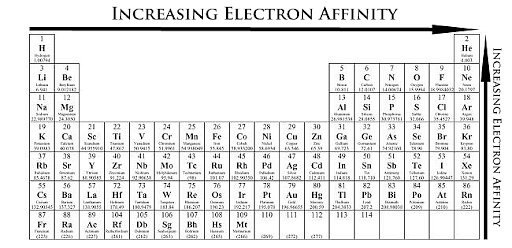
Electron Affinity Trend
Difference Between Electronegativity and Electron Affinity
[Click Here for Sample Questions]
The chemical qualities of electronegativity and electron affinity are two distinct chemical properties linked with elements. The main distinction between electronegativity and electron affinity is that electronegativity is a quality that refers to an electron's capacity to attract an atom.
- Electron affinity is linked to the release of energy whenever an electron prefers to be added to an atom.
- Although these two traits are frequently linked, they are not interchangeable. Both electronegativity and electron affinity are concerned with electron transport.
- Electronegativity, on the other hand, is the outcome of an attractive feature, whereas electron affinity is the result of a shift in energy.
The table below shows the specific differences between the two words.
| Electronegativity | Electron Affinity |
|---|---|
| Electronegativity is a qualitative measure of an atom's capacity to attract shared electrons to itself in a chemical combination. | The amount of energy released when a molecule or a neutral atom tries to acquire an electron from another element is referred to as electron affinity. |
| The Pauling unit is used to measure it. | It can be expressed in Kj/mol or eV. |
| The nature of this attribute is qualitative. | This feature, on the other hand, is quantitative. |
| It is a bonded atom with which it is related. | The atom is either connected to a molecule or is neutral in this case. |
| When the attracting energy is high, the maximum value is attained. | The maximum value is reached when the attracting energy is high. |
| Electronegativity is determined by the atomic number and the distance between the valence electrons and the charged nucleus. | Electron affinity is influenced by atomic size, nuclear charge, and atomic electronic configuration. |
| The most electronegative element is fluorine, whereas the least electronegative one is francium. | The highest electron affinity is found in chlorine, while the lowest is found in neon. |
Things to Remember
- Electron affinity and electronegativity are two properties that relate with the idea of electron gain.
- Electron affinity can be measured and defined precisely, while electronegativity cannot. As a result, the former works with chemically bound atoms whereas the latter deals with neutral atoms or atoms in a molecule.
- Electronegativity is the capacity of an atom to attract electrons from the outside.
- Electron affinity is the amount of energy released when an atom receives an electron.
- Electronegativity is the quality of drawing a shared pair of electrons towards itself.
- The distance between the nucleus and the valence electron increases as the atomic number grows.
- With increase in nuclear charge, tendency of electrons to attract rises as the amount of protons grows.
- The atomic size, nuclear charge, and electronic configuration of the molecules or atoms all influence the electron affinity.
Sample Questions
Ques. What does it mean to be electronegative? (3 marks)
Ans. The property of an atom of an element to attract electrons from other elements is referred to as electronegativity. Because each element does not tend to attract electrons with the same amount of force, electronegativity is not constant. Some elements would strongly attract electrons, whereas others would not.
As a result, various elements have varying electronegativities. A greater electronegativity indicates that an element has a stronger capacity to attract electrons, whereas a lower electronegativity indicates that an element has a weaker ability to attract electrons. As a result, the higher the electronegativity, the stronger the attraction of the electron to the atom.
Ques. What does the term "electron affinity" mean? (2 marks)
Ans. The shift in the energy of an atom is referred to as electron affinity. It is mainly created by the release of energy that occurs when an electron is added to it. In layman's terms, electron affinity refers to the amount of energy released when an atom gets an electron as a result of the production of a negative ion. Electron affinity is linked to exothermic processes, which means that every time an electron is added, it releases energy.
Ques. What are the important distinctions between electron affinity and electronegativity? (5 marks)
Ans. Some of the major distinctions between electronegativity and electron affinity are listed below.
- The electronegativity of an element is higher when that element has a better attracting ability. If the element's nuclear charge is larger, however, electron affinity is higher.
- Electronegativity is usually measured between 0.7 and 3.98. Electron affinity, on the other hand, is known to be fixed because when one electron is added to an atom, it releases almost the same amount of energy.
- Fluorine is the most electronegative element known, whereas chlorine has the greatest electron affinity.
- Electronegativity is the quality that causes the electron to be drawn to the atom. Electron affinity, on the other hand, is concerned with the energy released when an electron is added to an atom.
- Electronegativity is a qualitative characteristic, whereas electron affinity is a quantitative characteristic.
- Although electronegativity is a unitless quantity, it is defined in terms of Pauling. In contrast, electron affinity is measured in kJ/mol.
Ques. What exactly is an atom? (3 marks)
Ans. The atom is the smallest unit of matter that preserves an element's characteristics. An atom is made up of a nucleus and an electron cloud. The nucleus of an atom is made up of positively charged protons and electrically neutral neutrons, with negatively charged electrons surrounding the nucleus. Nucleons are made up of protons and neutrons.
Because they have an equal amount of electrons and protons, atoms are electrically neutral. An atom with an uneven amount of protons and electrons, on the other hand, has an electrical charge and forms ions. A positively charged ion is referred to as a cation because it contains more protons than electrons. An anion, on the other hand, is a negatively charged ion with more electrons than electrons.
Ques. Define Valency? (2 marks)
Ans. The combining power of an element is known as valency. The valency of elements in the same group of the periodic table is the same. The number of electrons in an element's outer shell determines the valency. Noble gases have a valency of 0 because they seldom mix with other elements. Valency can be determined from the respective atomic numbers of elements.
Ques. Define Atomic Number? (2 marks)
Ans. The atomic number is a unique identifier for each atom (symbol Z). The number of protons present in the nucleus is known as the atomic number. The atomic number of an atom with no charge is equal to the number of electrons. The number of electrons in ions, on the other hand, is the difference between the atomic number and the charge of the ions. There are fewer electrons than protons in cations, while there are more electrons than protons in anions.
Ques. How can you figure out the atomic number, mass, and charge of protons, neutrons, and electrons? (5 marks)
Ans. To find out the atomic number, mass charge of protons, neutrons and electrons below mentioned steps should be followed.
1) Select an element to work with. Let's pretend that it's a sodium atom (Na). There is no payment.
2) Find the mass number (M) and the atomic number (Z) (A). They have the same value as 11 and 23. C
3) Calculate the number of protons, neutrons, and electrons:
p = 11
n = 23 - 11 = 12
e = 11 - 0 = 11
4) You may also use the atomic number, atomic mass, and charge to determine the atomic number, atomic mass, and charge.
5) Decide on your element. Assume the sulphide anion is the culprit.
6) Determine the number of protons, neutrons, and electrons in the nucleus. They add out to 16, 16 and 18 points, respectively.
7) Determine the atomic number, mass, and charge.
Z = 16
A = 16 + 16 = 32
z = 16 - 18 = -2
Ques. What is the Mass Number? (2 marks)
Ans. The number of neutrons in a given element, however, can vary. Isotopes are versions of the same chemical element with differing numbers of neutrons. Protons and neutrons determine the mass of an atom. Mass number (A) is a sum of numbers of protons and neutrons. Like the atomic number of Lithium is 4 which is equal to the number of protons, the number of neutrons of magnesium is 4. The mass number is equal to 8(4+4)
Ques. What are isotopes? (2 marks)
Ans. Isotopes are members of an element's family that have the same number of protons but differ in the number of neutrons they have. The atomic number of an element from the Periodic Table is determined by the number of protons in its nucleus. For example, carbon with atomic number 6 has six protons. Carbon is found in three isotopes in nature: carbon 12, which has six neutrons (six protons plus six neutrons = 12), carbon 13, which has seven neutrons, and carbon 14, which has eight neutrons. The number of isotopes in each element varies.
Ques. What are isotones and isobars? (2 marks)
Ans. Isobars are nuclei that have the same number of nucleons but differing numbers of protons and neutrons. Isotones are nuclei that have the same amount of neutrons. Their atomic number (Z) is the same, yet they have the same mass number (A). Isobars exhibit a variety of physical and chemical characteristics. Physical and chemical features of isotones vary.
Read More:



Comments