



Education Journalist | Study Abroad Lead
Born-Haber Cycle is a method used for calculating energy in a chemical reaction. The cycle is primarily concerned with the production of ionic compounds from different elements and involves the formation of ionic compounds from metals (Group I or Group II) when they are reacted with a halogen or a non-metallic element such as oxygen. Born Haber cycle is mostly used to determine lattice energy. It also includes many phases or processes such as electron affinity, sublimation energy, ionization energy, formation heat, and dissociation energy.
| Table of Content |
Key Terms: Lattice Energy, Ionic Compound, Born-Haber Cycle Equation, Change of Enthalpy, Hess’s Law, Endothermic Process
NCERT Solutions of: Class 11 Physics Chapter 12 Thermodynamics
What is Born-Haber Cycle?
[Click Here for Sample Questions]
Born Haber cycle is a cycle of the process of change of enthalpy that forms a solid crystalline ionic compound from the elemental atoms in their standard state in a way that the net enthalpy is zero. The cycle is generally used to calculate lattice energy, which cannot otherwise be measured.

The enthalpy change involved in the production of ionic solids from gaseous ions, or the energy involved in breaking the ionic solids into gaseous ions, is referred to as the lattice energy. A Born-Haber cycle calculates the lattice energy using Hess' law by comparing the standard enthalpy change in the production of an ionic solid to the enthalpy required to produce gaseous ions from the elements. Born Haber cycle is used to determine the lattice energy, electron affinity, and crystal energy.
Read more: Internal Energy Formula
What is Lattice Energy?
[Click Here for Sample Questions]
Lattice Energy is a form of potential energy that is necessary to break apart an ionic solid and transform its component atoms into gaseous ions. As this is an endothermic process, the value for the lattice energy is always positive.
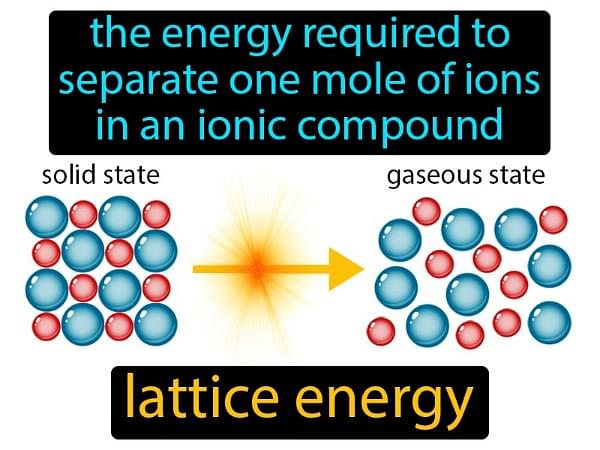
Lattice Energy
The other definition of lattice energy defines is as the energy produced when gaseous ions bond to create an ionic solid. Through this definition, the process will always be exothermic, and therefore the value for lattice energy will be negative. Its values are often given in kJ/mol units.
Also Read: Enthalpy and Entropy
Concept of Born Haber Cycle
[Click Here for Sample Questions]
Ionic solids are produced by the reaction of electropositive metals along with electronegative nonmetals. Alkali and alkaline earth metals react with the elements of the halogen family or chalcogen to form compounds that are crystalline ionic solids. Due to the stability of the electrostatic force of attraction between positive and negative charges, ionic compounds are expected to have identical physical properties. However, their physical properties such as water solubility and stability differ.

This difference is due to the difference in enthalpy known as ‘Lattice energy’, between the ionic solids. Lattice energy keeps together the anions and cations of the compound in fixed positions in a crystalline solid. It is defined as the energy released when gaseous ions are from a mole of a solid ionic compound or as the energy that is required to convert one mole of ionic solid into its gaseous ions. This lattice energy can only be approximately measured through Hess’s law.
What is Hess’s Law?
[Click Here for Sample Questions]
According to Hess's Law, the overall change in energy of a process may be calculated by breaking the process down into parts and then summing the energy changes of each phase. Hess' Law is effectively applied to an ionic solid in the Born Haber Cycle.
Before the Born-Haber Cycle can be used to calculate the lattice energy of ionic solid, some concepts mentioned below need to be understood:
- Ionisation Energy
- Electron Affinity
- Dissociation Energy
- Sublimation Energy
- Heat of Formation
Let us understand these concepts in more detail.
Ionization Energy
Ionization Energy is the amount of energy required to remove an electron from a neutral atom or ion. This process always needs an energy input and hence has a positive value.
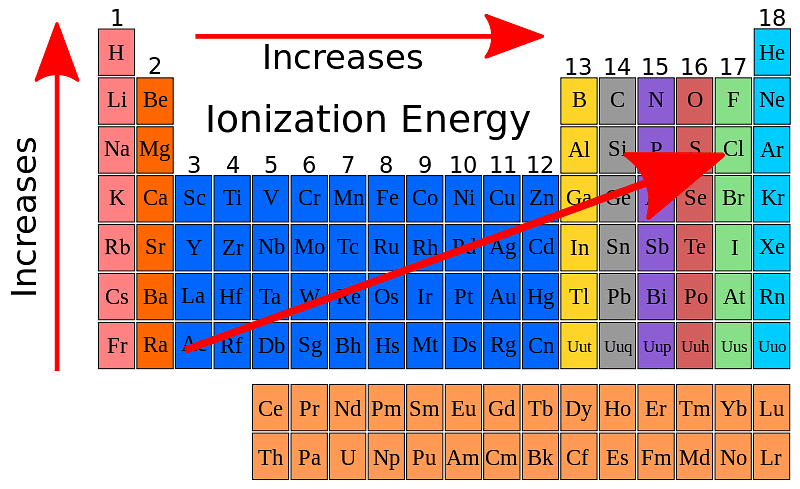
In general, ionisation energy increases from left to right throughout the periodic table and declines from top to bottom. There are several exceptions, which are generally related to the stability of half-filled and fully filled orbitals.
Electron Affinity
The energy produced when an electron is introduced to a neutral atom or an ion is known as electron affinity. Normally, the energy released has a negative value. However, according to the definition of electron affinity, it is expressed as a positive value in most tables.
As a result, while computing the lattice energy, we must remember to subtract the electron affinity rather than add it. Electron affinity rises from left to right across the periodic table and falls from top to bottom.
Dissociation Energy
The energy required to break apart a chemical is known as dissociation energy. A compound's dissociation is always an endothermic reaction, which means it always requires energy input.
As a result, every shift in energy is always good. The dissociation energy's size is determined by the electronegativity of the atoms involved.
Sublimation Energy
Sublimation energy is the amount of energy necessary to achieve a phase shift from solid to gas while avoiding the liquid phase. This is an energy input, thus it has a positive value. It is also known as the energy of atomization.
The heat of formation is the change in energy that occurs when a compound is formed from its constituent components. Depending on the atoms involved and how they interact, this might be positive or negative.

Also Read: Difference Between Electrophile and Nucleophile
Born Haber Cycle Example
[Click Here for Sample Questions]
An example of the Born Haber Cycle is given below:
| Example – Born Haber Cycle for NaCl (or any AB-type Mono-valent ionic solid) Solution: The heat of the formation of sodium chloride (NaCl) (ΔHf0) from the sodium metal and chlorine gas can be measured experimentally. For this, we can draw the Born Haber Cycle for the calculation of the lattice enthalpy of NaCl. Na(s) + ½ Cl2 (g) → NaCl(s); ΔHf0 = -411kJ/mol The formation of ionic solid sodium chloride from chlorine gas and solid sodium metal is not a single step process. The changes in the heat for all the processes except the lattice energy can be experimentally measured. The processes or steps in the formation of sodium chloride and Born Haber cycle for NaCl are- 1. Solid sodium atom sublimes to gaseous atom by absorbing heat energy (\(\triangle\)Hsub). Na (s) → Na (g) Sublimation energy ΔHsub = +107kJ/mol 2. A gaseous sodium atom absorbs the ionization energy to release one electron and form a gaseous sodium ion. Na(g) → Na+ (g) + 1e– Ionization energy \(\triangle\)HIE = + 502 kJ/mol 3. Diatomic chlorine breaks into two individual atoms as it absorbs bond energy. Each chlorine atom absorbs half the bond energy of the chlorine molecule. Cl2(g) → 2Cl(g) ½ Bond dissociation energy of chlorine = ½ \(\triangle\)Hdiss = ½ 242 = +121kJ/mol 4. The chlorine atom accepts an electron to form a chloride ion and releases energy that is equivalent to electron affinity. Cl (g) + 1e– → Cl– (g) Electron affinity = \(\triangle\)HEA = – 355kJ/mol 5. Gaseous sodium ion and gaseous chloride ion combine to form a solid sodium chloride molecule and release energy equivalent to lattice energy. Na+ (g) + Cl– (g) → Na+ Cl– (s) Lattice energy = \(\triangle\)HLE = U = ? Adding all the enthalpies from steps 1 to 5 in the Born Haber cycle for NaCl, we will get the net enthalpy of formation of sodium chloride from sodium and chlorine in their standard conditions. For this, we have to draw the Born-Haber cycle for the calculation of the lattice enthalpy of NaCl. The Born Haber Cycle for NaCl is represented as a cycle in the given figure.  So, ΔHf0 = ΔHsub + \(\triangle\)HIE + ½ \(\triangle\)Hdis + \(\triangle\)HEA + U or, ΔHf0 – (ΔHsub + \(\triangle\)HIE + \(\triangle\)Hdis + \(\triangle\)HEA + U) =0 411 + 107 + 502 +121 – 355 + U = 0 Here in the Born Haber cycle for NaCl, except for the lattice energy, all the other enthalpies can be measured experimentally. The lattice energy of the sodium chloride solid = U = ΔHf0 – (ΔHsub + \(\triangle\)HIE + ½ \(\triangle\)Hdis + \(\triangle\)HEA). = – 411 – 107 – 502 – 121 + 355 = – 786kJ/mol |
Born Haber Cycle Equation
[Click Here for Sample Questions]
The Born Haber cycle equation or Born Haber cycle formula can be summed up in one equation:
| Heat of formation = Heat of atomization of Dissociation energy + (sum of Ionization energies) + (sum of Electron affinities) + Lattice energy |
The electron affinity is included in this basic equation. When entering a number, however, consider whether the energy is released (exothermic reaction) or absorbed (endothermic reaction) for each electron affinity.
- If energy is discharged, the value should be negative.
- If energy is received, the number should be positive.
Rearranging the equation to solve for lattice energy yields the following:
| Lattice energy = Heat of formation- Heat of atomization- Dissociation energy- (Sum of Ionization energies)- (Sum of Electron Affinities) |

Equation of Born Haber Cycle
Also read: Electrophilic Aromatic Substitution
How to Apply Born Haber Cycle?
[Click Here for Sample Questions]
The Born Haber Cycle steps are as given below –
Step 1: Determine the energy of the metal and nonmetal (elemental forms). Subtract the heat of formation of the ionic solid, that will be formed by combining these elements in an appropriate ratio, from this. This gives us the energy of the ionic solid.
Step 2: The Born Haber Cycle requires the elements in the reaction to be in their gaseous forms. Add the enthalpy changes to turn an element into its gaseous state, and then do the same for the other element.
Step 3: Metals generally exist as single atoms in nature and therefore do not require dissociation energy. However, many non-metals such as chlorine exist as polyatomic species. The energy required to change Cl2 into 2Cl atoms must be added to the value that is obtained in Step 2.
Step 4: Both the metal and nonmetal are now changed in their ionic forms to exist in the ionic solid. For this, the ionization energy of the metal is added to the value obtained in Step 3. The electron affinity of a nonmetal is subtracted from the previous value as when an electron is added, energy is released.
Step 5: Now the metal and nonmetal both will be combined to form an ionic solid. This will cause a release of lattice energy. The value for the lattice energy can be calculated as the difference between the value from Step 1 and the value obtained from Step 4.
Also Read: Combined Gas Law
Things to Remember
[Click Here for Sample Questions]
- Ionic solids are long-lasting substances. The enthalpies necessary for ionic molecule synthesis do not account for stability alone.
- Ionic compounds are also more stable due to the lattice energy contained in their solid form.
- The amount of lattice energy present cannot be calculated. This is where the Born-Haber cycle comes into play.
- The Born Haber cycle allows us to calculate and comprehend the lattice energies of ionic solids.
- A Born Haber cycle is used to comprehend and calculate the concept of lattice energy.
- A significant negative value of lattice enthalpy suggests greater electrostatic forces in the lattice between oppositely charged ions.
- Covalent compounds cannot have lattice enthalpies because they are not made up of ions.
Important Questions on Born Haber Cycle
Ques: What type of enthalpy cycle is used to find out the solution for lattice energy? (1 Mark)
(a)Hess's Law
(b)Born-Haber cycle
(c)Haber process
(d)Contact process
Ans: (b) Born-Haber Cycle
Ques: What equation do I need to apply to solve lattice energy? (2 Marks)
Ans: The equation that you must apply to solve lattice energy is given below.
Lattice energy = Heat of formation- Heat of atomization- Dissociation energy- (sum of Ionization energies)- (sum of Electron Affinities)
Ques: What distinguishes Hess law from the Born Haber cycle? (3 Marks)
Ans: According to Hess's Law, the overall change in energy of a process may be calculated by breaking the process down into parts and then summing the energy changes of each phase. Hess' Law is effectively applied to an ionic solid in the Born-Haber Cycle. Born Haber cycle is used to determine the electron affinity, crystal energy, and lattice energy.
Ques: Write some examples of the Born Haber Cycle? (2 Marks)
Ans: Examples of the Born-Haber Cycle
- By absorbing heat energy (Hsub), a solid magnesium atom sublimes to a gaseous atom.
- Magnesium atoms in gaseous form release two electrons in two stages with matching ionisation energies.
Ques: What is the Born-Haber cycle's limitation? (3 Marks)
Ans: Born Haber cycle is used to determine the lattice energy, electron affinity, and crystal energy. However, only elements with relatively low ionisation energies may contribute as cations to ionic materials because elements with excessively high ionisation energies cannot be recovered from the resultant lattice energy.
Ques: How does the Born-Haber cycle explain ionic compound stability? (2 Marks)
Ans: This stability cannot be explained only by the enthalpies of the production of the ionic molecules. Because of the lattice energy of the solid structure, these molecules have increased stability. The Born-Haber cycle enables us to comprehend and calculate the lattice energies of ionic solids.
Ques: What exactly is NaCl lattice energy? (2 Marks)
Ans: For example, the lattice energy of NaCl is 787.3 kJ/mol, which is just slightly less than the energy released when natural gas burns. When ions with opposite charges are tiny, the connection between them is greatest.
Ques: What is BaO's lattice energy? (3 Marks)
Ans: Barium oxide (BaO), which has the same Madelung constant as sodium chloride (NaCl), has a bond radius of 275 picometers and lattice energy of -3054 kJ/mol, whereas sodium chloride (NaCl) has a bond radius of 283 picometers and lattice energy of -786 kJ/mol.
Ques: How to consider Lattice Energy? Is it positive or negative? (3 Marks)
Ans: To display the stability of ionic solid, Lattice Energy is used. In most cases, we can see its value of it as negative. But where gaseous ions bind is used to form atoms. Then the required energy is used for conversion and the value of this is defined as kJ/mol units.
Ques: What is the effect during the change of Enthalpy in an Ionic Solid Compound? (3 Marks)
Ans: A crystalline structure helps to let the ion interact with various ions (of opposite charge) that cause the change of favourable enthalpy in the system. In the time of interaction of the oppositely charged ions, a vast amount of energy is released. This indicates the ionic solids get high boiling and melting points.
Ques: What is Hess's law? Write its applications? (5 Marks)
Ans: According to Hess's law, if a process can be represented as the sum of two or more stages, the total enthalpy change equals the sum of the H values for each step. Second, if an equation is multiplied by a coefficient, the corresponding H value is multiplied by the same coefficient.
Hess’s Law is used to determine change in enthalpy that cannot be measured experimentally like:
- Enthalpy change during a physical change
- Enthalpy change during a chemical reaction
- Enthalpy of formation
- Bond energy
- Lattice energy
Related Articles:



Comments