



Content Curator
Isaac Newton introduced the term spectrum to optics in the 17th century, referring to the range of colors seen when white light is scattered via a prism. The phrase soon came to apply to a spectral density plot, which is a plot of light intensity or power as a function of frequency or wavelength.
| Table of Content |
Read More: Elastic Limit
What is Emission Spectra?
When an atom's electrons absorb energy, they migrate from lower energy levels to higher energy levels. To return to ground states from the excited state, which is unstable, these excited electrons must emit energy. The frequencies of the released light, compose the emission spectrum.
Read More: Intermolecular Forces
Emission Spectra include line spectrum and continuous spectrum.
Line Spectrum- When the radiation produced by the excitation of a substance is studied using a spectroscope; it produces a sequence of thin bright lines of specific colors. Between two successive lines, there is a black area. The term "line spectrum" or "atomic spectrum" refers to this type of spectrum.
Continuous Spectrum- When sunlight passes through a prism, it is scattered into a series of bands of various colors. When an incandescent object's light is resolved using a prism or spectroscope, it produces a continuous spectrum of colors.
Also Read:
What is Absorption Spectra?
When energy is absorbed by electrons in the ground state to reach higher energy levels, an absorption spectrum is formed by the frequencies of light transmitted with dark bands.

Difference between Absorption and Emission Spectra
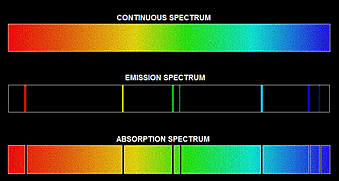
The difference between absorption and emission spectra are enlisted below-
| Absorption Spectra | Emission Spectra |
|---|---|
| When a substance absorbs radiation, it produces an absorption spectrum. | The emission spectrum is derived from the radiation emitted by the substances. |
| On a white background, black lines appear. | On a black background, white lines or colored lines appear. |
| When atoms or molecules are excited from a lower to a higher energy level, spectra are formed. | When atoms or molecules are de-excited from a higher to lower energy state, spectra are formed. |
| The ability of particular objects to hold heat and the quantity of absorption can be determined using absorption spectra. | The composition of a given substance can be determined using emission spectra. |
| For example, in a star's surface layers or a planet's atmosphere. In the spectra of the Sun and other stars, absorption lines can be seen. | For example, the sodium atoms emit an amber yellow color when the platinum wire is immersed in a sodium nitrate solution and then placed into a flame. Similarly, indium causes a flame to turn blue when it is introduced into it. The atomic emission spectrum can be used to identify elements because of these distinct properties. |
Things to Remember
- Isaac Newton introduced the term spectrum to optics in the 17th century, referring to the range of colors seen when white light is scattered via a prism.
- When an atom's electrons absorb energy, they migrate from lower energy levels to higher energy levels. To return to ground states from the excited state, which is unstable, these excited electrons must emit energy. The frequencies of the released light, compose the emission spectrum.
- When energy is absorbed by electrons in the ground state to reach higher energy levels, an absorption spectrum is formed by the frequencies of light transmitted with dark bands.
- The ability of particular objects to hold heat and the quantity of absorption can be determined using absorption spectra.
- When an incandescent object's light is resolved using a prism or spectroscope, it produces a continuous spectrum of colors.
Also Read:
Sample Questions
Ques: What are the differences between the continuous spectrum and the emission spectrum?
Ans: A continuous spectrum is one with no gaps in wavelengths over a wide range. Continuous spectra are produced by solids at high temperatures, such as the filament of electric light. In the emission spectrum, when an excited electron goes to a lower energy level, it emits a certain amount of energy in the form of photons. Because the energy levels are quantized, the spectrum for this transition is made up of lines. Colored lines appear against a black background in the emission.
Ques: How can the Bohr model of the atom explain the atomic spectra's fixed color lines?
Ans: He was sure that the atom could be visualized as a little positive nucleus surrounded by electrons. The electrons travel inset circular routes around the nucleus, known as energy levels or shells. Some energy is absorbed and some are ejected as an electron goes from a lower to a higher energy level. The energy change is calculated using the formula delta E=hc / wavelength.
Read More:
Ques: What is the difference between a continuous spectrum and a line spectrum?
Ans: A continuous spectrum is a record made by capturing all wavelengths of light flowing through space at the same time. Typically, the majority of the light will have come from the same source. Thermal radiation, such as that emitted by a black body, is commonly represented by continuous spectra.
A line spectrum is a recording of light emitted by excited atoms as their electrons return to lower energy levels. Because electron transitions can only occur at discrete energies predicted by quantum physics, you don't get photons of all wavelengths, only those with the specified frequency.
Ques: Why is the emission spectrum of each element different?
Ans: The electrons are contained in a series of ‘shells' in each element. All of these shells are about in the same location. When an electron goes from a higher to a lower orbital, it releases a quanta of energy, which is called the emission spectrum.
The energy for each transition varies depending on the attractive forces between the electron and the nucleus, despite the fact that the movement is essentially the same.
Read More:
Ques: What makes a molecular absorption spectrum different from an atomic absorption spectrum?
Ans: Only electron transitions are visible in atomic spectra.
In the case of molecular spectra, there are three types of transitions: 1) rotations in the radio wave range, 2) vibrations in the infrared range, and 3) electronic in the ultraviolet-visible region, in order of increasing energy. Because vibrations and rotations can occur at the same time, rovibrational spectra are made up of a large number of closely spaced absorptions. Electronic transitions will be divided into vibrational bands, which will be further divided into specific rotational lines.
Ques: In an absorption spectrum, what do the dark lines mean?
Ans: The wavelengths of light absorbed by the absorbing medium and hence not reaching the experimenter are represented by the black lines. All atoms and molecules have discrete characteristic energy levels, and they only absorb wavelengths whose energy corresponds to the difference between the different energy levels.
Read More:
Ques: A continuous spectrum is exemplified by a rainbow. Explain
Ans: A rainbow is considered to be one of the most stunning light displays ever seen on the planet. A rainbow is a colourful arc generated by water droplets striking light. Rainbows are created after the rain by the reflection, refraction, and dispersion of light in water droplets. In a rainbow, there are no obvious distinctions between colors. The term "continuous spectrum" refers to a spectrum with no abrupt boundaries between colors. As a result, a rainbow has a continuous spectrum.
Ques: What role does the electromagnetic spectrum have in our daily lives?
Ans: Electromagnetic waves are utilized in a wide range of applications in the electromagnetic spectrum:
Radio waves are easily transferred via the atmosphere. If they are absorbed by the human body, they do not cause harm. These characteristics make them perfect for radio and television transmission.
Microwaves are commonly utilized in food preparation applications. When high-frequency microwaves are absorbed by food molecules, their internal energy increases, resulting in warmth.
Cookers, electric heaters, and infrared cameras all use infrared radiation.
Fiber-optic communication uses visible light.
Also Read:



Comments