



Content Curator
Heat capacity is a physical property of matter defined as the amount of heat required to raise the temperature of the body by one degree. It is also known as Thermal capacity.
- The SI unit of heat capacity is joule per kelvin (J/K).
- Heat capacity is an extensive property i.e. its value depends on the amount of substance that was measured.
- By dividing the heat capacity of an object by its mass, we will get its Specific heat capacity.
- Specific heat capacity is an intensive property i.e. its value does not depends on the amount of substance that was measured.
Key Terms: Heat Capacity, Specific heat capacity, Molar Specific heat capacity, Heat energy, Mayor’s Formula, SI units, Temperature.
Heat Capacity
[Click Here for Sample Questions]
Heat capacity or thermal capacity is the amount of heat needed to increase the temperature of a body by one degree. The SI unit of heat capacity is joule per kelvin (J/K).
- Heat energy is defined as the total kinetic energy of the molecules of the substance. The SI unit of heat is joule (J).
- The temperature of a substance is a physical quantity that measures the degree of hotness and coldness of the substance. The SI unit of temperature is kelvin (K).
- The specific heat capacity of a substance can be obtained by dividing the heat capacity of that substance by its mass.
- By dividing the heat capacity of a substance by its mass in moles, we will get its molar heat capacity.
- The heat capacity per unit volume is known as Volumetric heat capacity.
- The heat capacity of a building is referred to as its thermal mass in architecture and civil engineering.
Also Read:
| Related Topics | |
|---|---|
| Joules Law of Heating | Difference Between Heat and Temperature |
Heat Capacity Formula
[Click Here for Sample Questions]
The heat capacity formula gives the amount of heat energy required to raise the temperature of the body by one degree. It is given by the ratio of the amount of heat energy that is given to the object for the resulting increase in the temperature.
It can be mathematically expressed as:
\(c={\Delta Q \over \Delta T}\)
Where,
- c = heat capacity
- ΔQ = Amount of heat energy given to the object
- ΔT = change in the temperature
Also Read: Heat Formula
Specific Heat Capacity
[Click Here for Sample Questions]
If an amount of heat (ΔQ) when given to a body its temperature increases by an amount ΔT. Heat gain or loss is directly proportional to the mass (m) of the body and changes in temperature (ΔT). i.e.
ΔQ ∝ m ΔT ⇒ ΔQ = m C ΔT
- Where C is a constant known as “specific heat capacity” or simply “specific heat” of the material of the body.
- Its value depends on the nature of the material of the body and its temperature range.
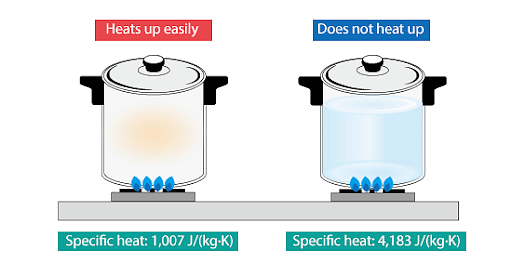
The specific heat capacity of the material of a substance is the amount of heat required to raise the temperature of the unit mass of the substance by one degree.
From the above formula, specific heat capacity can be given by
\(C={\Delta Q \over m\Delta T}\)
Where,
- m = mass of the substance
- ΔT = increase in temperature
- ΔQ = amount of transferred heat
Multiplying the above equation by the mass (m) of the substance, we get Heat capacity (C).
\(Heat\,capacity,\,c=mC=m({\Delta Q \over m\Delta T})\)
Hence, the product of the mass of the substance to the specific heat capacity gives the Heat capacity of that substance.
Specific Heat Capacity Video Explanation
The nature of the substance and its temperature affects the specific heat capacity of the substance.
Water is used as a coolant in automobile radiators and heaters because it has a high specific heat capacity which results in the slow heating up of the water than other substances.

For gases, there are two specific heat capacities:
- Specific heat capacity at constant pressure (CP).
- Specific heat capacity at constant volume (CV).
For an ideal gas,
CP – CV = R
Where
- R is the universal gas constant.
- Above relation is known as Meyer’s relation or Mayer’s Formula.
Units of Specific Heat Capacity
The units of specific heat capacity are given below:
- If m in gram (g), ΔT in oC, and ΔQ in calorie (cal), then the unit of specific heat capacity is (cal/goC).
- In SI unit of specific heat capacity is (J/kgK).
Molar Heat Capacity
[Click Here for Sample Questions]
Molar heat capacity or molar-specific heat is defined as the amount of heat required to raise the temperature of one mole of a substance by one degree. It is given by
\(Molar\,heat\,capacity\,,C_m={\Delta Q\over \mu \Delta T}\)
Where μ is the number of moles of the substance.
If m be the mass of the substance in gram, and M be the molar mass, then
\(m=\mu M \Rightarrow \mu ={m\over M}\)
Therefore, molar heat capacity can be given by
\(C_m=M{\Delta Q\over m\Delta T}\)
But, \({\Delta Q\over m\Delta T}=s,\) specific heat capacity
Hence,
Molar Heat Capacity, Cm = MC
Molar specific heat is equal to the product of the molar mass of the substance (in grams) and specific heat.
The SI unit of molar heat capacity is (J/mol K).
Formulae Related to Heat Capacity
[Click Here for Sample Questions]
The formulae related to Heat capacity are given below:
Heat capacity (c) = Δ Q/Δ T
Where
- ΔT = change in temperature
- ΔQ = amount of transferred heat
Heat capacity (c) = mC
Where
- m is the mass of the substance
- C is the specific heat capacity
Specific heat capacity (C) = ΔQ/mΔT
Where
- m= mass in grams
- ΔT = change in temperature
- ΔQ = amount of transferred heat
Molar specific heat capacity ( Cm ) = ΔQ/µΔT
Where
- µ = moles or the amount of substance
- ΔT = change in temperature
- ΔQ = amount of transferred heat
Relation between Celsius temperature (TC) and Fahrenheit temperature (TF)
TF = (9/5)TC + 32
The ideal gas equation
PV = µRT
Where
- µ = number of moles
- R = universal gas constant
Newton’s law of cooling is given by
dQ/dt = -k (T2 – T1)
Where
- T1 = Temperature of the surrounding medium
- T2 = temperature of the body
Also Read:
Things to Remember
- Heat Capacity is the amount of heat needed to increase the temperature of a body by one degree.
- The SI unit of heat capacity is joule per kelvin (J/K).
- The formula for heat capacity is given by the ratio of the amount of heat energy that is given to the object for the resulting increase in the temperature.
- The transfer of heat between two different bodies due to temperature is known as conduction.
- If the dimension of a body increases with temperature, it is known as thermal expansion.
- The calorimeter is the device used to measure heat.
- If there is a change in the mass of the substance while changing from one state to another then the quantity of heat (Q) = mL or L = Q/m. where L = latent heat.
- The electromagnetic radiation happening due to temperature is known as thermal radiation.
Sample Questions
Ques: Sample A of water uses 12600J heat to increase its temperature by 6oC. sample b of water uses 9450J heat to increase the temperature by 4.5 degrees. What is the relationship between the heat capacities of samples A and B under an ideal situation? (1 Mark)
Ans: The heat capacity of sample A will be equal to the heat capacity of sample B.
Ques: An iron rod of 10kg mass uses 3000 J of heat to increase the temperature from 20oC to 40oC. Determine the heat capacity. (2 Marks)
Ans: Given, m = 10kg
ΔT (temperature difference) = 20oC
ΔQ (heat lost) = 3000J
Q = mc ΔT
C= 300020
= 150J/oC
Ques: A Copper ball of mass 45g absorbs the heat of 15,245 J. Calculate the change in temperature if the specific heat of copper is 0.39 J/goC? (2 Marks)
Ans: Given, mass (m) = 45g
Specific heat of copper (c) = 0.39 J/goC
Q = 15245 J
Q = mc ΔT
Qmc = ΔT
ΔT = 15245J / (45g) (0.39J / goC)
ΔT = 868. 66oC
Ques: A foam cup contains 35.0g of water and 1.5g of NH4NO3. The temperature changes from 22.7 to 19.4c. Calculate the heat of dissolution of NH4NO3 in KJ mol-1 if the specific heat capacity of the solution is 4.18 JK -1 g-1. (2 Marks)
Ans: Total mass = 35 g + 1.5 g
Weight of the total solution = 36.5 g
Difference in temperature = -3.3 K
Therefore, energy = -4.18 JK-1 g-1 x 36.5g x -3.3K = +503 J
The value is positive because it represents the energy gained by the reaction
Ques: Calculate the energy in KJ required to boil 1.2l of water whose heat capacity is 4.18Jg-1K-1. Temperature starting from 25oC. (3 Marks)
Ans: Change in temperature (ΔT) = 75K
Mass of water = 1 g cm -1
Energy = 4.18 J g-1 k-1 x 1000g x 75k
= 313500J
= 313.5 KJ
Ques: The temperature of a hot pan decreases from 94oC to 86oC in 2 minutes at a room temperature of 20oC. calculate the time required to cool it from 71oC to 69oC. (3 Marks)
Ans: the average temperature = 90oC which is 70oCabove the room temperature
(dT2)/(T2 – T1) = Kms dt = -kdt = change in temperature time
8oC/ 2 mins = k (70oC)
70oC is the average is the average of 60oC and 71oC, which is 50oC above room temperature.
2oC time = k (50oC)
Dividing the two equations
(8c/2 min)/(2c/time) = k(70c)/k(50c)
Time = 0.7 min
= 42s
Ques: A foam cup calorimeter contains two different samples of water, 150ml and 50 ml with temperatures T1 = 25oC and T2 = 60oC respectively. In the equilibrium, what is the final temperature T0 in oC? (3 Marks)
Ans: average of the temperature = 150200 * 25 + 50200 * 60 = 33.75oC
the heat given out by 150 g of water at 25oC = 4.18 Jg-1 k-1 x 150g x 25k = 15.6 KJ
Heat given out by 50g of water at 60oC = 4.18Jg-1 k-1 x 50g x60k = 15.5KJ
Total available energy = 15.6 +12.5 = 28.1 KJ
150g+ 50g =200g
The final temperature of 200g water if 28.1KJ energy is given at 0oC
= 28215J / (200g x 4.18 JK-1 g-1)
= 33.75oC
For Latest Updates on Upcoming Board Exams, Click Here: https://t.me/class_10_12_board_updates
Do Check:



Comments