



Content Curator
Skeletons are found in every living thing. However, there are two sorts of skeletons: endoskeleton and exoskeleton. The endoskeleton is predominant in invertebrates, whereas the exoskeleton is predominant in arthropods. Based on location creatures are found, flexibility, growth, support, and blood supply are all factors that distinguish the endoskeleton and exoskeleton. A skeleton can be either inside (endoskeleton) or external (exoskeleton) (exoskeleton). Endoskeletons are found in some living species, while exoskeletons are found in others.
| Table of Content |
Key Takeaway: Locomotion, Vertebrates, Invertebrates, Arthropods, Bones
Endoskeleton
An internal skeleton, such as a bone or cartilaginous skeleton in vertebrates, is an internal skeleton existing inside the body of a living organism. An endoskeleton is found in all vertebrates, including birds, fish, reptiles, amphibians, and mammals. The endoskeleton is the internal framework that provides structure, protection and support to the internal organs while also helping in movement and locomotion. It also serves as a location for muscular attachment, allowing forces to be transmitted to the muscles.
Bones and cartilage make up the majority of the endoskeleton. It is constructed entirely of cartilage in some creatures, such as cartilaginous fishes. Bones are made up of osteoblasts, which produce joints that allow bones to articulate with one another. Ligaments provide connection between one bone to the other bones, while tendons help in connecting muscles to bones.
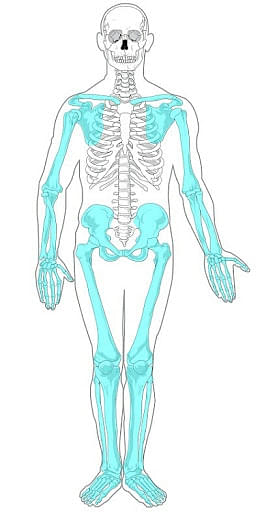
Endoskeleton
Functions of the Endoskeleton
Given below are the functions endoskeletons:
- The Endoskeleton’s primary and most important duty is to protect and support the body.
- The axial skeleton, which is made up of the skull, rib cage, and vertebral column, serves to protect the heart, liver, kidneys, and lungs, which are all delicate organs.
- The legs and feet, as well as the arm bones, pelvic girdle, and shoulder blades, make up the appendicular skeleton, which supports and protects the limbs.
Also Read:
Exoskeleton
The exoskeleton is the exterior skeleton that protects an organism from the elements. It is the body's hard exterior shell that gives support and protects the muscles, soft tissues, and organs. The animal is also protected from predators and the harsh environment. The ectoderm gives rise to the exoskeleton. Scales, calcified shells, and chitinous cuticles are all examples of exoskeletons.
Exoskeletons are found in most invertebrates and animals that lack a backbone, such as grasshoppers, cockroaches, and crustaceans like crabs and lobsters. Insects have the most exoskeletons in the animal kingdom, which are composed of a material called chitin. Their exoskeleton is linked to their wings via muscles. The exoskeleton does not expand and contract with the body. Molting is a process through which insects shed their skin multiple times during their life cycle.
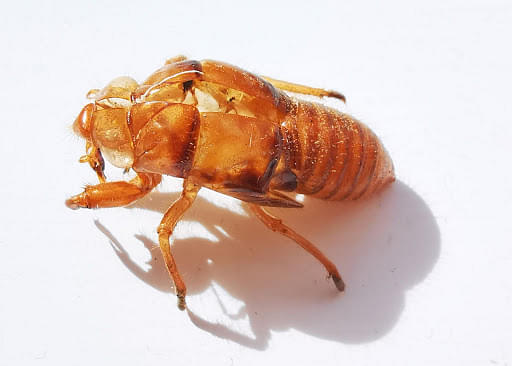
Exoskeleton
Functions of the Exoskeleton
Given below are the functions of exoskeleton:
- The tissues that make up an exoskeleton add to the exoskeleton's strength and rigidity.
- It defends the animals from attacks by invisible critters, preventing injury to their fragile organs.
- Chitin is the most crucial component of an insect's exoskeleton, which defends them from predators.
Difference Between Endoskeleton and Exoskeleton
The major differences between the endoskeleton and exoskeleton are mentioned below.
| Parameter of Comparison | Endoskeleton | Exoskeleton |
|---|---|---|
| Meaning | Internal Skeleton | External Skeleton |
| Location | Inside the Body | Outside of Body |
| Organism Found In | Vertebrates | Arthropods |
| Developed From | Endoderm | Ectoderm |
| Made up of | Phosphorus and calcium | Calcifies shells and scales |
| Growth | It develops with the body. Molting does not occur in animals with an endoskeleton. | It does not expand and contract with the body. Molting is a process through which insects shed their skin multiple times during their life cycle. |
| Flexibility | It provides flexibility to the body. | Flexibility is not provided by exoskeleton to the body. |
| Support | It supports a larger body | It does not support a larger body. |
| Blood Supply | Bones enable blood supply | No blood supply through bones. |
Things to Remember
- The endoskeleton is considered to be a living structure made up of an endoderm (the innermost layer of cells in an embryo during early development).
- Hard bones and pliable cartilage from the endoskeleton.
- Animals' endoskeletons develop in tandem with their bodies throughout their lives.
- The exoskeleton is a non-living structure made up of the ectoderm (the outermost layer of cells of an embryo during early development).
Also Read:
Sample Questions
Ques. What is an endoskeleton made of? (2 marks)
Ans. The endoskeleton of vertebrates is made up of two types of tissues (bone and cartilage). The endoskeleton is made up of notochord and cartilage during early embryonic development. In most vertebrates, the notochord is replaced by the vertebral column and cartilage by bone in most adults.
Ques. What is the importance of the endoskeleton? (3 marks)
Ans. The importances are:
- Endoskeletons support the body and protect the internal organs.
- They also help in movement through the contraction of skeleton-attached muscles.
- Endoskeletons examples: Human and horse skeletons.
Ques. How does the endoskeleton grow? ( 2 marks)
Ans. Endoskeletons offer an advantage over exoskeletons in that, as living tissue, they grow in lockstep with the rest of the body. Organisms with exoskeletons must shed or molt their outer skeletons to mature from infancy to adulthood, and then grow a new one.
Ques. What are the main parts of an endoskeleton? (2 marks)
Ans. In invertebrates, the endoskeleton is divided into two halves. The axial skeleton is the initial component. The skull, backbone, and rib cage make up this section, which protects organs including the brain and lungs. The appendicular skeleton, on the other hand, consists of the shoulder bones, arm and leg bones, and pelvic bones.
Ques. What are the functions of the exoskeleton? (3 marks)
Ans. The functions of exoskeleton are:
- The exoskeleton helps in protecting against predation, desiccation, or waterlogging present in arthropods and is necessary for small creatures.
- They have numerous muscle attachment sites (for flexibility).
- The exoskeleton, on the other hand, limits the size of arthropods.
Ques. What is the cell Endoskeleton? (2 marks)
Ans. The cell's endoskeleton is an organelle that provides structural support to the cell. The endoplasmic reticulum is the cell's endoskeleton. It is made up of membrane sheets and tubules that begin near the nucleus and spread across the cell, as the name suggests. The cell's boundary is formed by the cell wall.
Ques. What is the advantage of having an exoskeleton? (4 marks)
Ans. They advantages are:
- It keeps the creature from getting wet or drying out like wearing a portable raincoat.
- Exoskeleton is a great defense against predators as it forms a hard covering on the outside.
- It helps to support the body.
- Exoskeleton also protects the fragile interior organs and muscles of the animal from harm.
Ques. How big can an exoskeleton get? (2 marks)
Ans. With a span of nearly 12 feet, the Japanese spider crab is the largest known organism with an exoskeleton. Another size constraint is that the animal must lose its exterior exoskeleton to build a new one, which typically necessitates the replacement skeleton being soft to escape the hard exoskeleton.



Comments