



Content Writer
Key Highlights
- Open and Closed Circulatory Systems are two primary types of circulatory systems.
- These systems help circulate blood from one part of the body to another along with the required fluid.
- Circulatory systems carry oxygen & nutrients throughout the body.
- The primary difference between an open and closed circulatory system is the mixing of blood in the body.
- Human beings are composed of a closed circulatory system.
A circulatory system is a cardiovascular system that includes the blood, heart and blood vessels, which is circulated throughout the body of a human or other vertebrate.
- It is divided into an open and closed circulatory system.
- Along with each heartbeat, the heart sends blood throughout the body and carries oxygen and nutrients to each cell.
- The difference between an open and closed circulatory system is the mixing of blood and interstitial fluid in an organism's body.
Key Terms: Difference between Open and Closed Circulatory System, Open Circulatory System, Closed Circulatory System, Circulatory System, Heart, Blood Vessels, Blood
Open Circulatory System
[Click Here for Sample Questions]
An open circulatory system is a type of circulatory system in which blood is not enclosed in blood vessels. In this system, blood flows freely through the cavities and is pumped into an open cavity called a hemocoel.
- The arteries transport the blood away from the heart, whereas the veins carry the blood back to the heart.
- The responsibility of the circulatory system is to transport oxygen, nutrients, and hormones to the cells.
- The open circulatory system is also called hemolymph, as blood mixes with the interstitial fluid.
- The heart is used to pump hemolymph through arteries, where it exchanges substances with the surrounding cells.
- It is found in organisms such as insects, crabs, and molluscs such as octopuses, snails, and slugs.
Closed Circulatory System
[Click Here for Sample Questions]
The Closed Circulatory System is one of the complex circulatory systems in which blood remains within a network of interconnected vessels.
- It involves the pumping of blood into the vessels to reach the tissue and the organs.
- The interchange of gasses happens between the smaller vessels and tissues and takes place inside the bloodstream.
- A closed circulatory system creates pressure, causing the blood to travel farther and deliver more oxygen.
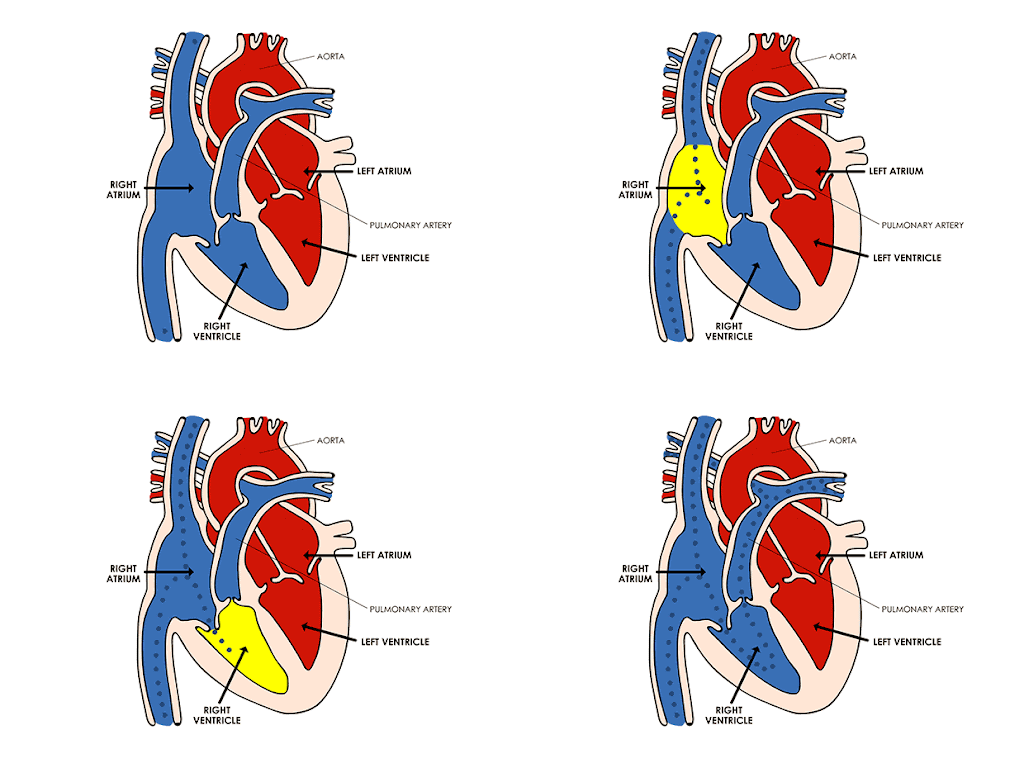
- The human body has a closed circulatory system, which implies that the blood is enclosed in the vessels and the heart during its circulation.
- It is found in invertebrates, such as octopuses and squids and vertebrates grasshoppers.
Difference between Open & Closed Circulatory System
[Click Here for Sample Questions]
The differences between Open and Closed Circulatory System have been mentioned in the table below:
| Open circulatory system | Closed circulatory system |
|---|---|
| Hemolymph directly washes the organs and tissues. | The blood flows inside the closed vessels. |
| The blood & the interstitial liquid can't be identified. | Blood & interstitial fluid are different. |
| Present in mollusks & arthropods. | Present in annelids & vertebrates. |
| Blood is pumped into the body cavity. | Blood is pumped through the vessels by the heart. |
| Dorsal blood vessels present. | Dorsal & ventral blood vessels are present. |
| Blood is in direct contact with the tissues. | Blood is not in direct contact with the tissues. |
| Nutrients are transferred directly among blood and tissues. | The nutrients are exchanged via tissue fluid. |
| No transportation of gases takes place. | Transportation of gases takes place. |
| The fluid that is circulating in the system is described as "hemolymph". | The Fluid which is circulating in this system is called blood. |
| No respiratory pigments are present. | Presence of Respiratory pigments. |
| The volume of blood cannot be managed. | Volume of blood can be controlled by compression and relaxation of blood vessels. |
| The flow of Blood is slow. | The Blood flow is fast. |
| The open sections are termed as sinuses and lacunae. | The closed spaces involve arteries and veins. |
| Examples: Snails, clams, cockroaches and spiders. | Examples: Humans, squids, Cats, earthworms. |

Difference between Open & Closed Circulatory System
Sample Questions
Ques: What are the basic function of the circulatory system? (3 marks)
Ans: The basic function of a circulatory system is to deliver O2 and nutrients to the cells and carry away all the waste extract. It is composed of blood vessels that carry the blood away & towards the heart. The circulatory system helps maintain a proper acid-base balance within the body by transporting chemicals that regulate blood pH. Nutrients like glucose (sugar), amino acids, and fats, obtained from digested food, are delivered to cells for various metabolic processes.
Ques: What are the main components of a circulatory system? (3 marks)
Ans: The major components of circulatory system are as follows:
- Heart: The heart acts as the muscular pump of the circulatory system. It's a tireless worker, continuously contracting and relaxing to propel blood throughout the body. The heart has four chambers: two upper chambers called atria (singular: atrium) that receive blood and two lower chambers called ventricles that pump blood out.
- Blood: Blood is a specialized fluid that circulates within the vessels of the circulatory system. It's a complex mixture of several components, including plasma, red blood cells, white blood cells and platelets.
- Blood Vessels: These are a network of tubes that form a closed circulatory loop, carrying blood throughout the body. There are three main types of blood vessels: veins, arteries, and capillaries.
Ques: What are the types of circulatory system? (4 marks)
Ans: Transportation of oxygen and nutrients throughout the body, every multicellular organism requires a circulatory system which are of two types namely Open circulatory system and Closed circulatory system.
- Closed Circulatory System: In a closed circulatory system, blood continuously circulates within a closed loop of vessels. The heart acts as a pump, forcing blood through this loop. Oxygenated and deoxygenated blood are always kept separate within this closed system.
- Open Circulatory System: This type of circulatory system is found in some invertebrates, like insects and molluscs. In an open system, blood isn't entirely confined to vessels. It flows through a combination of vessels and open spaces within the body cavity (hemocoel). The heart pumps blood into the hemocoel, which bathes the tissues directly and eventually re-enters the circulatory system. In open circulatory systems, oxygenated and deoxygenated blood may mix to some extent.
Ques: What are the advantages of a closed circulatory system? (3 marks)
Ans: There are a few benefits and limitations of a closed circulatory system. The advantages of it constitute:
- It is useful in carrying oxygen all through an organic entity.
- It contributes more energy in the form of pressure.
- It has a lymphatic framework that operates independently.
Ques: What is the human circulatory system? (4 marks)
Ans: Human beings comprise a closed circulatory framework which signifies that the blood is uniformly contained in vessels and the heart while circulating throughout the body. Going through arteries and veins, blood carries significant molecules all through the body and is constantly bound.
- The circulatory system helps maintain a proper acid-base balance within the body by transporting chemicals that regulate blood pH.
- It plays a crucial role in blood clotting, which helps prevent excessive bleeding after an injury.
- The human circulatory system has a double circulation system, meaning blood passes through the heart twice in one complete circuit.
Ques: What are the two differences between Open and Closed circulatory systems? (2 marks)
Ans: The blood & the interstitial liquid can't be identified in an open circulatory system but in a closed circulatory system, it can be identified. Blood & interstitial fluid are different. In the case of an open circulatory system, the Hemolymph directly washes the organs and tissues. Whereas, the blood flows inside the closed vessels in the closed circulatory system.
Ques: Where does the open circulation take place? (3 marks)
Ans: Open circulation is performed in the absence of vessels to carry the blood & it circulates freely through the cavities of the body. The hemolymph used performs the functions of blood, lymph, & intestinal fluid. Unlike complex and closed systems of veins and arteries, the organism having open circulatory systems has a central body cavity which is called “hemocoel”.It is found inside most invertebrate animals where both digestive and circulatory functions take place.
Ques. What is pulmonary circulation? (2 marks)
Ans. The pulmonary circulation is a small loop from the heart to the lungs and back again. It’s a big artery that originates from the heart. It splits into two sections and transports blood from the heart to the lungs. In the lungs, the blood picks up the O2 and drops off the carbon dioxide. It then passes the blood back to the heart through the pulmonary veins.
Ques. What is systematic circulation? (2 marks)
Ans. Systematic circulation transports the blood from the heart to all the other parts of the body and back again. Once the blood returns to the heart, it requires re-entering the pulmonary circulation and delivering to the lungs to drop off the CO2 and carry out more oxygen.
Ques. What are the advantages of open circulatory system? (4 marks)
Ans. The advantages of open circulatory system are as follows:
- Simpler Structure: An open circulatory system requires a less complex structure compared to a closed system. It doesn't require a network of extensive blood vessels.
- Nutrient Delivery to Tissues: In open circulatory systems, the hemolymph bathes the tissues directly within the hemocoel, which allows for a more direct and simpler delivery of nutrients to some body parts, especially in smaller organisms where diffusion distances are shorter.
- Faster Gas Exchange: In some cases, open circulatory systems might allow for a quicker exchange of respiratory gases (oxygen and carbon dioxide). The hemolymph's direct contact with tissues could facilitate faster gas diffusion than relying solely on closed system capillaries.
Ques. What is an example of open and closed circulatory system? (2 marks)
Ans. Some common examples of open circulatory system include snails, spiders, clams and cockroaches. On the other hand some common examples of closed circulatory system include humans, squids, octopuses, cats and earthworms.
Also Check:



Comments