



Content Curator
Closed circulatory system is different from the open circulatory system as it includes the blood vessels for blood transportation. The closed circulatory system is mostly found in invertebrates and annelids.
Also Read: Circulatory System
| Table of Contents |
Keywords: Circulatory system, Heart, Arteries, Veins, Blood, Oxygen, Capillaries, Vertebrates
What Is A Closed Circulatory System?
[Click Here for Sample Questions]
In a closed circulatory system, the heart pumps the blood directly into the blood vessels, where it flows through the closed vessels like veins and capillaries. The closed circulatory system does not feed the organs and the tissues directly with the blood but flows through a closed channel of blood vessels.
The exchange of gases is usually done by the capillaries between the blood and the tissues of the body. The common examples of the closed circulatory system are vertebrates including humans.
Humans have a developed cardiovascular system to circulate blood throughout their bodies, besides having a developed lymphatic system to circulate lymph through the body.
Components Of Closed Circulatory System
[Click Here for Sample Questions]
Components of a closed circulatory system are specified below:
- Heart: The heart is the main part of the circulatory system. It is a fleshy organ made up of special cardiac muscles and is around the size of a closed fist. It lies in the center of the chest, slightly left of the center. This organ is protected by the rib cage. The heart is the central part of the circulatory system in living organisms.
- Arteries: The heart pumps the purified oxygen-rich blood in the arteries that take the blood to the rest of the body.
- Veins: The deoxygenated blood from all over the body is taken to the heart by veins. This impure blood goes through the lungs to oxygenate itself.
- Blood: Blood is a fluid that carries all the material within it to transport it to the whole body. The material includes hormones, nutrients, and oxygen.
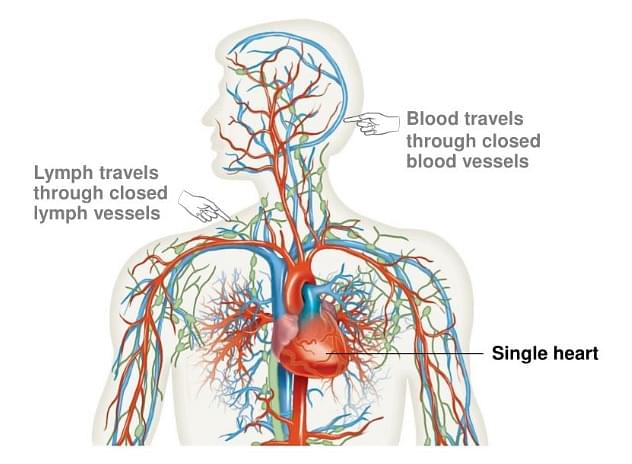
Closed Circulatory System
Exchange Of Gases In The Closed Circulatory System
[Click Here for Sample Questions]
The blood flows through the capillaries in the lungs where the oxygen gas diffuses into the bloodstream through the tiny membranes. The oxygenated blood is thus transported to the heart from where it gets away through arteries.
Meanwhile, the body uses oxygen in metabolism and creates carbon dioxide. The deoxygenated blood is taken back to the heart through veins where it goes through the same process again.
Things To Remember
- The blood circulatory system consists of the following essential components: Blood, Heart, and Blood Vessels
- The closed circulatory system is found in vertebrates including humans.
- Humans have a developed cardiovascular system to circulate blood throughout their bodies.
- Arteries are the major vessels that take blood from the heart to the other parts of the body.
- The exchange of gases in the closed circulatory system takes place in the bloodstream.
- The oxygenated blood is transported to the heart from where it gets away through Arteries.
Sample Questions
Ques. How does the closed circulation system help in respiration? (2 Marks)
Ans. The closed type of circulation in the human body is responsible for many metabolic activities including breathing. The inhaled air in the blood will be circulated to purify and then exhaled in this process of breathing.
Ques. What is the role of the circulatory system in the human body? (2 Marks)
Ans. The circulatory system plays a crucial role in transporting nutrients, essential gases like oxygen, and wastes like carbon dioxide throughout their bodies. There is a full-fledged transportation system of material in the bodies of multi-cellular organisms known as the circulatory system.
Ques. Discuss how the closed circulatory system functions in the bodies of living organisms. (5 Marks)
Ans. The closed circulatory system is different than that of the open circulatory system as it includes the blood vessels for blood transportation. In a closed circulatory system, the heart pumps the blood directly into the blood vessels where it flows through the closed vessels like veins and capillaries.
Unlike the open circulatory system, the closed circulatory system does not feed the organs and the tissues directly with the blood but flows through a closed channel of blood vessels to reach the cells and the organs of the body.
The exchange of gases is usually done by the capillaries between the blood and the tissues of the body. The blood and the interstitial fluid are distinguished in this type of circulatory system.
Ques. Define how the exchange of gases takes place in the closed circulatory system. (3 Marks)
Ans. The blood flows through the capillaries in the lungs where the oxygen gas diffuses into the bloodstream through the tiny membranes. The oxygenated blood is thus transported to the heart from where it gets away through Arteries.
Meanwhile, the body uses oxygen in metabolism and creates carbon dioxide. The deoxygenated blood is taken back to the heart through veins where it goes through the same process again.
Ques. Do humans have a closed or an open circulatory system? (1 Mark)
Ans. Humans have a closed circular system, which is different from that of many animals like fish, reptiles, birds, etc.
Ques. Which of the organisms are said to have a closed type of circulation? (2 Marks)
Ans. Many vertebrates and a few invertebrates are said to have this closed type of circulation. For instance, an annelid earthworm has this circulation in its body.
Ques. How does the open and closed circulation differ from each other? (1 Mark)
Ans. The distinction between both the open and closed circulation can be realized by the nature of blood flowing inside the body.
Ques. Discuss the major components involved in the closed circulatory system. (4 Marks)
Ans. The components involved in the closed circulatory system are:
- The heart is the central part of the circulatory system in living organisms.
- The arteries pump the purified oxygen-rich blood in the arteries that take the blood to the rest of the body.
- The deoxygenated blood from all over the body is taken to the heart by veins.
- Blood: Blood is a fluid that carries all the material within it to transport it to the whole body.
Ques. Explain the role of the heart in the closed circulatory system. (2 Marks)
Ans. The heart is the main part of the circulatory system. It is a fleshy organ made up of special cardiac muscles and is around the size of a closed fist. It lies in the center of the chest, slightly left of the center. This organ is protected by the rib cage. The heart is the central part of the circulatory system in living organisms.
Ques. What is the advantage of a closed circulatory system over an open system? (2 Marks)
Ans. An advantage of the closed circulatory system, the blood is transferred faster than in an open circulatory system.
Also check:



Comments