



Content Curator
Spinal cord belongs to the nervous system whereas the backbone belongs to the skeletal system. Spinal cord is long nerve shape whereas the backbone is composed to vertebrate. Spinal cord lies inside the backbone. On an average the human backbone is larger than the spinal cord. Backbone provides supports the body and protects the spinal cord. Spinal cord controls several activities throughout the body. In this lesson we will study the spinal cord and backbone in detail.
| Table of Content |
Key Takeaways: Spinal cord, Nervous system, Backbone, Skeletal system, Vertebrate.
Spinal Cord
[Click Here for Sample Questions]
Spinal cord is a cylindrical structure that runs through the center of the spine. It’s a structure that contains nerve bundles and cells that carry messages. Spinal cord is a band of tissues and cells. Spinal cord is the link or connection between the brain and the nerves in the rest of the body. It is divided into five different regions. In adults the spinal cord is about 18 inches long.
- Cervical – It has eight pairs of spinal nerves coming. The area covers the neck.
- Thoracic- It has 12 pairs of spinal nerves. It is presented at the center.
- Lumbar – It has five pairs of spinal nerves. It’s located at the lower back.
- Sacral nerves- It has also five pairs of spinal nerve
- Coccyx nerve- It contains only one pair of spinal nerves. It located at low back.

Spinal Cord
Also Read: Human body
Backbone
[Click Here for Sample Questions]
Backbone also called vertebral column. It is a flexible column extending from neck to tail. It is made up of a series of bones. The combination of the vertebral column and spinal cord is called spine. A protective layer of bone is called backbone or vertebral column. That covers and protects the spinal cord. The bones in the vertebral columns are called vertebrae. Between each pair of vertebrae, it is a spinal disk.
Spinal discs have a tough outer shell and gel-like interior. They act as a cushion for vertebrae and spinal cord. The function is to transmit body weight in walking and standing. It provides main support to the body. It supports head to the top. It is attached with shoulder bones, ribs, and musculature of the back.
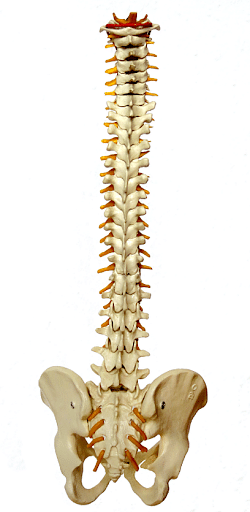
Backbone
Difference between Spinal Cord and Backbone
[Click Here for Sample Questions]
| Properties | Spinal cord | Backbone |
|---|---|---|
| Definition |
|
|
| Body System | It is a part of nervous system | It is a part of skeletal system |
| Function |
|
|
Things to Remember
- Spinal cord is related to nervous system
- In nervous system, central nervous system and peripheral nervous system
- Spinal cord is related to central nervous system
- In spinal cord, there are 31 pairs of spinal nerves
- The length of the spinal cord is 18 inches in adults.
- Backbone is a vertebral column which is hard and flexible
- Backbone is related to the skeletal system.
Also Read:
Sample Questions
Ques. What is the role of spinal cord in nervous system? (2 Marks)
Ans: In the nervous system there are two types, one is the central nervous system and one is peripheral nervous system. In the central nervous system, two major things are present: one is the brain and one is the spinal cord. The basic purpose of the nervous system is to coordinate all of the activity of the body.
Ques. What are the different regions of the spinal cord? (5 Marks)
Ans: The spinal cord is divided into five different regions
- Cervical – it has eight pairs of spinal nerves coming. The area covers the neck.
- Thoracic- it has 12 pairs of spinal nerves. It is presented at the center.
- Lumbar – it has five pairs of spinal nerves. It’s located at the lower back.
- Sacral nerves- it has also five pairs of spinal nerve
- Coccyx nerve- it contains only one pair of spinal nerves. It is located at the low back.
Ques. What is the function of the spinal cord? (3 Marks)
Ans: Functions of the spinal cord are:
- It carries signals from the brain.
- It receives the signal from the brain that controls movement and automatic functions.
- It is carrying information to the brain from the body. Such as sensations like touch, pain etc.
Ques. Write about spinal cord in brief (2 Marks)
Ans: Spinal cord is a cylindrical structure that runs through the center of the spine. It’s a structure that contains nerve bundles and cells that carry messages. Spinal cord is a band of tissues and cells. Spinal cord is the link between the brain and the nerves in the rest of the body.
It is divided into five different regions. The regions are cervical, thoracic, lumber, sacral nerve and coccyx nerve.
Ques. What is backbone? Explain (1 Mark)
Ans: Backbone also called vertebral column. It is a flexible column extending from neck to tail. It is made up of a series of bones. The combination of the vertebral column and spinal cord is called spine. A protective layer of bone is called backbone or vertebral column.
Ques. What is the relation between spinal cord and backbone? (2 Marks)
Ans: Spinal cord lies inside the backbone. Backbone covers and protects the spinal cord. The bones in the vertebral columns are called vertebrae. Between each pair of vertebrae, it has a spinal disk. Spinal discs have a tough outer shell and gel-like interior. They act as a cushion for vertebrae and spinal cord.
Ques. What is the importance of backbone? (2 Marks)
Ans: Backbone provides main support to the body. It supports head to the top. It is attached with shoulder bones, ribs, and musculature of the back. It increases the strength, maintains the balance, absorbs shock and protects it from breaks. It is a single concave curve. It serves as attachment sites for muscles and ligaments. It resists comprehensive forces.
Ques. What is the difference between spinal cord and backbone? (5 Marks)
Ans: The difference are:
| Spinal cord | Backbone |
|---|---|
| It is related to nervous system | It is related to skeletal system |
| The structure contains bundles of cells | The structure contains series of bones |
| Spinal cord is the link between the brain and the nerves in the body | Backbone is flexible column extending from neck to tail |
| It carries signals from the brain. | The function is to transmit body weight in walking and standing. |
| It is carrying information to the brain from the body | It serves as attachment sites for muscles and ligaments. |



Comments