



Content Writer
An earthworm can be referred to as a segmented worm that belongs to the phylum Annelida. The terrestrial invertebrates are usually found in moist soil and feed on organic matter.
- The farmer's companion, the earthworm, is an annelid that aids in soil fertility retention.
- This is an invertebrate animal that lives primarily in the soil's upper layer.
- Worm castings are the faecal deposits of the earthworm.
- If you see these worm castings in your garden soil, you can almost certainly find a few earthworms if you dig into them.
- Earthworms are classified as a genus by the scientific name Pheretima.
- Mouth, anus, pharynx, crop (which stores food), gizzard (filled with small stones) and intestine are important body parts of earthworms.
Key Terms: Earthworm, Earthworm Diagram, Anatomy of Earthworm, Morphology, Alimentary canal, Closed Circulatory System, Reproductive System
Earthworm Diagram
[Click Here for Sample Questions]
The earthworm diagram depicts the morphological features of the given species.
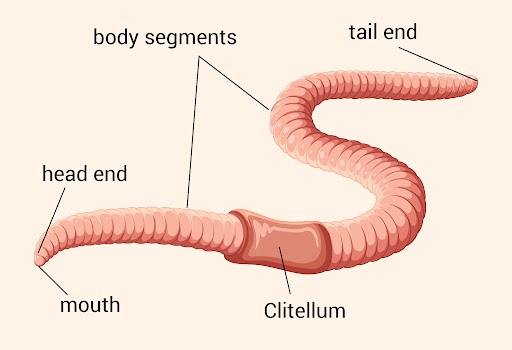
Earthworm Diagram
Also read:
Morphology of Earthworm
[Click Here for Sample Questions]
Earthworms are reddish-brown in colour and have a cylindrical body divided into segments called metamers. The body is also elongated and pointed in the anterior region, with a rounded posterior region.
- Earthworm's body is segmented, with approximately 100 to 120 metameres, or short segments.
- On the dorsal surface of the body, there is a dark median mid-dorsal blood vessel.
- Genital openings or pores can be found on the body's ventral surface.
- The peristomium is the first body segment with a mouth.
- The anus can be found in the final segment.
- The clitellum is a prominent dark band of glandular tissue located between segments 14 and 16.
- These are the segments that have been joined together.
- Four pairs of spermathecal apertures are located between the 5th, 6th, 7th, 8th, and 9th intersegments.
- A single female genital pore is present on the 14th segment, in the midventral line.
- On the 18th segment, there is a single pair of male genital pores.
- On the body's surface, there are numerous minute pores known as nephridiopores.
- Except for the first, last, and clitellum segments, all other segments have embedded S-shaped setae.
- These setae aid in locomotion.
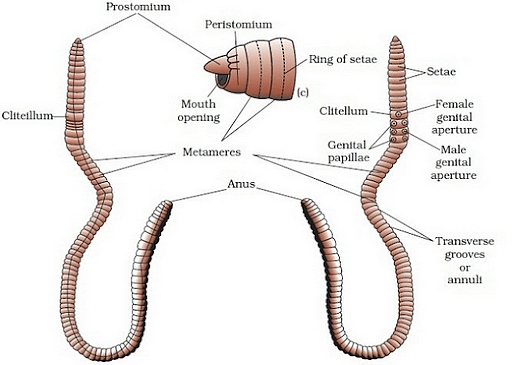
Anatomy of Earthworm
[Click Here for Sample Questions]
The earthworm's body is covered by a thin layer of non-cellular cuticle, two muscle layers, and the coelomic epithelium. Coelomic epithelium is the inner layer, which is sheathed above an epidermis layer and the cuticle on top. The epithelium is made up of glandular columnar that exists in a single layer.
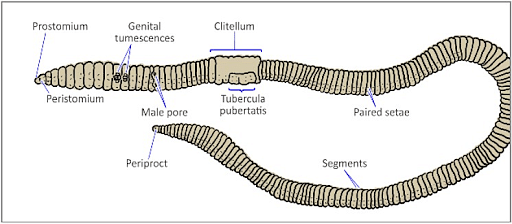
Reproductive System
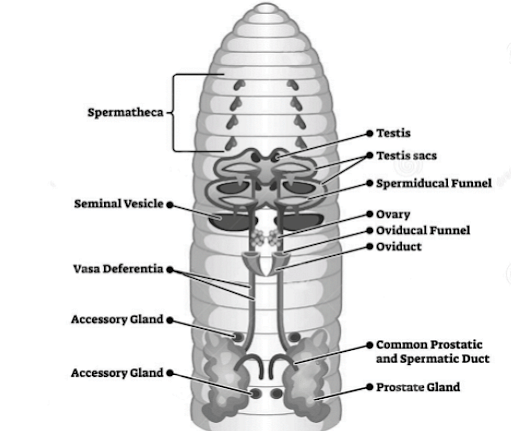
The reproductive system of an earthworm is monoecious or hermaphrodite, which means it has both male and female reproductive organs. However, self-fertilization does not occur because the male and female reproductive organs do not mature at the same time.
- Protandry is a condition in which the testes mature before the ovaries.
- As a result, cross-fertilization occurs, which is followed by cocoon formation.
Components of Male Reproductive System
The following are the components of the male reproductive system:
- Two pairs of the Testis: One pair of the testis is held in each of the tenth and eleventh segments.
- Vasa Deferentia: There are two pairs of vasa deferentia. Each side of vasa deferentia runs close to each other until the 18th segment. The 18th segment connects both vasa differentia from each side to the prostate duct coming from the prostate gland.
- Accessory Glands: Two pairs of accessory glands are located internally in the 17th and 19th segments. During copulation, the secretion of these glands aids in the retention of the two worms.
Components of Female Reproductive System
The female reproductive system consists of:
- One Ovary and one Oviduct: A pair of white minute ovary masses are present between the 12th and 13th segments to the posterior surface of the septum. Behind the ovaries, there are two short tubes, each of which lays eggs.
- Four pairs of Spermathecae: In the 6th and 9th segments, where the spermatozoa are stored.

Circulatory System
The earthworms have a closed blood vascular system, which means that blood is confined to the heart and blood vessels.
Heart
There are four pairs of tubular hearts in an earthworm. The 7th and 9th segments contain the lateral hearts, which are the two anterior pairs of hearts.
- They connect the dorsal and ventral blood vessels.
- The posterior two pairs of hearts, known as latero-oesophageal hearts, are present in the 12th and 13th segments.
Blood Vessels
There are two types of blood vessels found in earthworms namely Dorsal Blood Vessel and Ventral Blood Vessels. Dorsal Blood Vessel is the largest blood vessel in the body, running mid-dorsally above the alimentary canal.
- The valves in the vessel prevent blood from flowing backwards.
- Its function is to receive blood from various parts of the earthworm via the various connecting vessels.
- Ventral Blood Vessels do not include any valves.
- The blood flows from the front to the back of the body.
- Its primary function is to distribute blood.
Blood
The red colour of an earthworm's blood comes from a protein called haemoglobin, which is found in the plasma and aids in the transportation of oxygen for respiration.
- The blood is made up of two components: fluid plasma and colourless blood corpuscles.
- The only type of blood corpuscles found in the blood of an earthworm are leukocytes, which are phagocytic in nature and enter the body.
Blood Glands
From the fourth to sixth segments, small red-coloured follicular bodies are found, which are referred to as blood glands.

Respiratory System
Earthworms do not have a well-developed structure for respiration. The respiration is done through the moist skin by the process of diffusion.
Excretory System
The excretory system of earthworms consists of nephridium, which is a coiled tubule responsible for regulating the volume and composition of body fluids.
- Nephridia is arranged in three segments: septal, integumentary, and pharyngeal nephridia.
- Septal has 15-last segments, integumentary has 3-last segments, and pharyngeal nephridia has 4-6 segments.
- It is connected to a funnel for delivering wastes and excess fluid and is later excreted out via the digestive tube.
Nervous System
The nervous system of earthworms consists of sensory input and muscular responses. The muscular responses and sensory input are responsible for controlling ganglia, which are paired with the nerve cord to form the nervous system of earthworms.
Sensory System
The sensory system of earthworms is located in the anterior portion of the body. Though earthworms do not have eyes, they have specialized receptor cells that recognise changes taking place in the environment.
- The response to stimuli is controlled by specialised sensory organs and chemoreceptors.
Digestive System
Earthworms are soil-dwelling creatures whose alimentary canal is in the shape of a long tube running from the first to the last segment of the body. The food of earthworms is mixed with soil.
- The gastrointestinal tract is a straight tube that runs from the mouth to the anus.
- The peristomium, also known as the buccal segment, is the first body segment that includes the mouth.
- The pharynx is a pear-shaped chamber that starts from the 3rd segment and continues to the 4th segment.
- The gizzard acts as a grinder, thus helping earthworms in the grinding of soil particles combined with organic matter and other decaying materials.
| Parts of the Alimentary Canal | Number of the segments in Earthworm |
|---|---|
| Mouth | First segment |
| Buccal Cavity | 2nd to 3rd segment |
| Pharynx | 3rd to 4th segment |
| Esophagus | 5th to 7th segment |
| Gizzard | 8th to 9th segment |
| Stomach | 9th to 14th segment |
| Intestine | 15th to the last segment |
| Anus | Last or pygidial segment |
Also read:
Things to Remember
- An earthworms feed on organic matter and are common inhabitants of moist soil.
- The dorsal side is distinguished by a dark line of blood vessels, while genital openings distinguish the ventral side.
- The anterior end is distinguished by the mouth and the prostomium (an organ that aids in burrowing).
- The earthworm's body wall is covered by a thin, non-cellular cuticle.
- A layer of the epidermis is sheathed beneath the cuticle, followed by two muscle layers and coelomic epithelium (inner layer).
- A single layer of glandular columnar epithelium makes up the epithelium.
Sample Questions
Ques: What makes up an Earthworm's nervous system? (4 marks)
Ans: The activities of an earthworm are controlled by a well-developed and concentrated nervous system. It is segmented in the same way that the rest of its body is.
- A pair of cerebral ganglia located in the depression between the buccal cavity and the pharynx in the third segment.
- It elongates laterally, producing a pair of thick connectives that encircle the pharynx and meet ventrally to form a pair of ganglia.
- This completes the ring around the pharynx.
- From the ganglia to the posterior of the body, a nerve cord runs backwards in the midventral line.
- Each segment of the ventral nerve cord contains a ganglion.
- The segmental ganglia send nerve impulses to various parts of the body.
- Sensory information and messages are transmitted from various parts of the body to the nerve cord via these nerves, and vice versa.
Ques: Write a note on earthworm’s morphology. (4 marks)
Ans: Earthworms have a long cylindrical body. The body is divided into more than a hundred short segments which are similar (metameres about 100-120 in number).
- The dorsal surface of the body is marked by a dark median mid-dorsal line (dorsal blood vessel) along the longitudinal axis of the body.
- The ventral surface is distinguished by the presence of genital openings (pores).
- The anterior end consists of the mouth and the prostomium, a lobe that serves as a covering for the mouth and as a wedge to force open cracks in the soil into which the earthworm may crawl.
- The prostomium is sensory in function.
- The first body segment is called the peristomium (buccal segment) which contains the mouth In a mature worm, segments are covered by a prominent dark band of glandular tissue called clitellum.
- Thus the body is divisible into three prominent regions – preclitellar, clitellar and postclitellar segments.
Ques: Write a note on the reproductive system of an earthworm? (4 marks)
Ans: Earthworm is hermaphrodite (bisexual), i.e., testes and ovaries are present in the same individual (Figure 7.13). There are two pairs of testes present in the 10th and 11th segments.
- Their vasa deferentia run-up to the 18th segment where they join the prostatic duct.
- Two pairs of accessory glands are present one pair each in the 17th and 19th segments.
- The common prostate and spermatic duct (vasa deferentia) opens to the exterior by a pair of male genital pores on the ventrolateral side of the 18th segment. Four pairs of spermathecae are located in 6th-9th segments (one pair in each segment).
- They receive and store spermatozoa during copulation.
- One pair of ovaries is attached at the inter-segmental septum of the 12th and 13th segments.
- Ovarian funnels are present beneath the ovaries which continue into oviduct, join together and open on the ventral side as a single median female genital pore on the 14th segment.
Ques: How do earthworms reproduce? (3 marks)
Ans: A mutual exchange of sperm occurs between two worms during mating. One worm has to find another worm and they mate juxtaposing opposite gonadal openings exchanging packets of sperms called spermatophores.
- Mature sperm and egg cells and nutritive fluid are deposited in cocoons produced by the gland cells of the clitellum.
- Fertilisation and development occur within the cocoons which are deposited in the soil.
- The ova (eggs) are fertilised by the sperm cells within the cocoon which then slips off the worm and is deposited in or on the soil.
- The cocoon holds the worm embryos. After about 3 weeks, each cocoon produces two to twenty baby worms with an average of four.
- Development of earthworms is direct, i.e., there is no larva formed
Ques: Draw and label the Nephridial system in earthworm? (3 marks)
Ans: The labelled diagram is as follows:
Ques: Write a note on the excretory organ in the earthworm? (4 marks)
Ans: The excretory organs occur as segmentally arranged coiled tubules called nephridia (sing.: nephridium). They are of three types:
(i) Septal nephridia, present on both the sides of intersegmental septa of segment 15 to the last that open into intestine,
(ii) Integumentary nephridia, attached to the lining of the body wall of segment 3 to the last that open on the body surface
(iii) Pharyngeal nephridia, present as three paired tufts in the 4th, 5th and 6th segments.
- These different types of nephridia are basically similar in structure.
- Nephridia regulate the volume and composition of the body fluids.
- A nephridium starts out like a funnel that collects excess fluid from the coelomic chamber.
- The funnel connects with a tubular part of the nephridium which delivers the wastes through a pore to the surface in the body wall into the digestive tube.
Ques: What does the circulatory system of an earthworm comprise? (5 marks)
Ans: The earthworms have a closed blood vascular system, which means that blood is confined to the heart and blood vessels.
- Heart: In an earthworm, there are four pairs of tubular hearts. The 7th and 9th segments contain the lateral hearts, which are the two anterior pairs of hearts. They connect the dorsal and ventral blood vessels.
- Blood Vessels: The following are the types of blood vessels found in earthworms: Dorsal Blood Vessel: It is the largest blood vessel in the body, running mid-dorsally above the alimentary canal. Its function is to receive blood from various parts of the earthworm via the various connecting vessels.
- Ventral Blood Vessels: This does not include any valves. The blood flows from the front to the back of the body. Its primary function is to distribute blood.
- Blood: The red colour of an earthworm's blood comes from a protein called haemoglobin, which is found in the plasma and aids in the transportation of oxygen for respiration. The blood is made up of two components: fluid plasma and colourless blood corpuscles.
Ques: What are the characteristics of earthworm? (3 marks)
Ans: The characteristic of earthworms are as follows:
- The body of an earthworm is long, cylindrical, and segmented.
- Its sex organs are both male and female, making it a hermaphrodite.
- The skeleton of the species is hydrostatic.
- It possesses both a peripheral and central nervous system.
- The setae found in the epidermal pits facilitate movement.
Ques: Why does an earthworm have five hearts? (2 marks)
Ans: Earthworms have five pairs of hearts. Since they are worms, earthworms lack a true heart, but they do have aortic arches, which join the dorsal and ventral veins and pump blood. Since an earthworm is a terrestrial invertebrate, its circulatory system is open and it lacks a heart.
Ques: Explain the agricultural importance of earthworms? (2 marks)
Ans: Earthworms are called friends of farmers. They help increase the porosity of soil, which is used for aeration and water absorption. The faeces of earthworms contain different chemical compounds that are used for the growth and development of plants. They are also used for fishing game baits.
Ques: What is the biological classification of earthworm? (2 marks)
Ans: The biological classification of earthworm are as follows:
- Kingdom: Animalia
- Phylum: Annelida
- Class: Clitellata
- Order: Opisthopora
- Suborder: Lumbricina
Do Check Out:
| Class 11 Biology Study Guides | ||
|---|---|---|
| Biology MCQs | Biology Study Notes | Class 11 Notes |
| Comparison Topics in Biology | NCERT Solutions for Class 11 Biology | NCERT Class 11 Biology Book |



Comments