



Exams Prep Master
Glycine is the simplest amino acid that occurs in nature. An amino acid is the building block of a protein. They are molecules that combine together to form protein molecules in the body. These amino acids are leftover when proteins are digested or broken down. Our body uses amino acids to prepare proteins that help the body further in breaking down food. Glycine is the only amino acid that is not a stereoisomer. The structures of amino acids contain an -COOH and an - NH2 group and are, therefore, zwitter-ionic.
| Table of Content |
Key Takeaways: Glycine structure, glycine properties, amino acids, zwitter-ionic nature of glycine, glycine uses
Glycine Structure
[Click Here for Sample Questions]
Glycine is the simplest amino acid that occurs naturally. It is the only achiral amino acid and hence is not stereoisomeric. It can fit into hydrophilic or hydrophobic environments since it has only one hydrogen atom in its smaller side chain. Amino acids have a general structure that has an -R group where specific substituents are replaced to form a particular amino acid. There are 20 amino acids present in the human body. The simplest among all of them is glycine. It has the molecular formula C2H5NO2. The -R group in the general amino acid formula is substituted by a hydrogen atom in glycine.
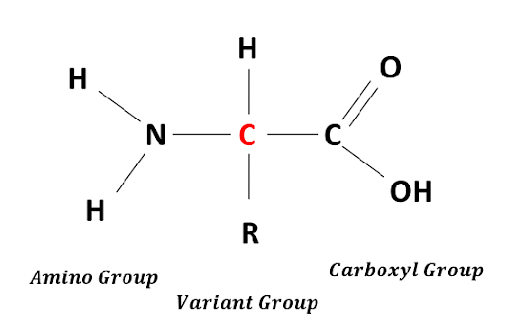
Structure of General amino acid
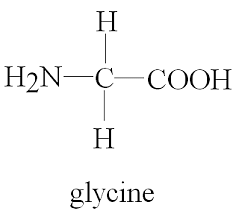
Structure of glycine
where R=H of an amino acid

Zwitter-ionic structure of glycine
Read more:
Formation of Glycine
[Click Here for Sample Questions]
Glycine can be formed using two synthetic processes. The two main processes are the following-
i) Amination of chloroacetic acid with ammonia, which gives the products glycine and ammonium chloride.
ii) The Strecker amino acid synthesis, which is the main synthetic method for the preparation of glycine. In this process, an aldehyde is treated with ammonia in the presence of potassium cyanide. The condensation reaction yields alpha-amino nitrile which on further hydrolysis gives the required amino acid, glycine in this case.

R=H, for glycine preparation
iii) Glycine is also a by product or an impurity in the synthesis of EDTA.
Read more:
Properties of Glycine
[Click Here for Sample Questions]
Glycine is a sweet-tasting amino acid that has some unusual properties. The properties of glycine are as follows-
- Glycine is a non-polar, non-essential amino acid.
- Glycine is a colourless crystalline solid.
- In an aqueous solution or at a pH nearly neutral, glycine is zwitterionic in nature.
- Glycine is hydrophilic in nature which is mostly due to the presence of one hydrogen atom.
- Glycine is highly soluble in water.
- Due to the acidic nature of glycine, at pH=6, glycine behaves as a buffer solution.
- It is one of the non-essential amino acids present in mammals.
Read more:
Uses of Glycine
[Click Here for Sample Questions]
Glycine is synthesized in the human liver and is very useful in various fields. The uses of glycine are as follows-
- Glycine aids in the formation of protein in the human body.
- When glycine is mixed with carbohydrates, the recovery rate becomes faster and provides lean growth.
- Glycine is used as a sweetener or as a taste enhancer in several food supplements and protein drinks.
- It helps in treating schizophrenia, stroke, and other metabolic disorders.
- Glycine acts as a buffer in cosmetics, antacids, toiletries, antacids, etc.
- Glycine is used in formulating certain drugs that improve gastric absorption.
Read more:
Things to Remember
- Glycine was first isolated in the year 1820 from a substance known as gelatin. Later, a French chemist and pharmacist named Henri Braconnot discovered it glycine by boiling the gelatinous material with sulphuric acid.
- An amino acid is the building block of a protein. They are molecules that combine together to form protein molecules in the body. These amino acids are leftover when proteins are digested or broken down.
- Glycine is formed by the reaction of chloroacetic acid and ammonia, which gives the products glycine and ammonium chloride.
- When glycine is mixed with carbohydrates, the recovery rate becomes faster and provides lean growth.
- Glycine can also be formed using aldehyde and ammonia in presence of potassium cyanide which on hydrolysis gives glycine. This method is known as the Strecker amino acid synthesis.
- Glycine has the molecular formula C2H5NO2 and its structure is-
Read more :
Sample Questions
Ques. All amino acids have optical activity except glycine. Why? [2 marks]
Ans. All amino acids are stereoisomeric except glycine. This is because the molecule is achiral. An achiral centre is one that does not have distinguished functional groups or atoms in all the bonds. Since glycine has two hydrogen atoms in the carbon centre the molecule becomes achiral and is not stereoisomeric. Therefore, glycine is not optically active.
Ques. Give the D and L form of glycine. [3 marks]
Ans. Glycine is the simplest stable amino acid with the formula NH2CH2COOH. The D form of glycine is

Ques. Fill in the following blank. [2 marks]
The simplest amino acid is _________ .
(a) Alanine
(b) Glycine
(c) Lysine
(d) Valine
Ans. b) Glycine
Glycine is the simplest amino acid that occurs in nature. An amino acid is the building block of a protein. Amino acids have a general structure that has an -R group where specific substituents are replaced to form a particular amino acid. The simplest among all of them is glycine since, the -R group in the general amino acid formula is substituted by a hydrogen atom in glycine. It has the molecular formula C2H5NO2 and the chemical formula NH2CH2COOH.
Ques. Which of the following is not an alpha-amino acid? [2 marks]
(a) Alanine
(b) Guanine
(c) Glycine
(d) Benzidine
Ans. d) Benzidine
Benzidine is not an alpha-amino acid. It is an aromatic primary amine with the molecular formula C12H12N2 and structure

Structure of benzidine
Ques. i) Which of the following is true about alpha-amino acids? [2 marks]
(a) If the amino group at the chiral carbon lies on the left hand side as in L (-) glyceride, the amino acid belongs to L-series.
(b) If the amino group at the chiral carbon lies on the right hand side as in D (+) glyceraldehyde, the amino acid belongs to D-series.
(c) Both of the above
(d) None of the above
ii) Name one of the essential alpha-amino acid.
(a) Lysine
(b) Glycine
(c) Serine
(d) Proline
Ans. i) c) Both of the above.
ii) a) Lysine.
Ques. Name a water soluble vitamin which is a powerful antioxidant. Give its one natural source. [2 marks]
Ans. A water soluble vitamin which is a powerful antioxidant is vitamin C.
One natural source of vitamin C is amla.
Ques. What is a glycosidic linkage? [2 marks]
Ans. The two monosaccharide units are joined together through an etheral or oxide linkage formed by the loss of a molecule of water. Such a linkage between two monosaccharide units through an oxygen atom is called glycosidic linkage.
Ques. Define the following as related to proteins: [3 marks]
(i) Peptide linkage
(ii) Primary structure
(iii) Denaturation
Ans. (i) Peptide linkage: A peptide linkage is a type of amide linkage formed between -COOH group of one alpha-amino acid and -NH2 group of another alpha-amino acid by loss of one molecule of water. The -CO-NH- bond formed is called peptide linkage.
(ii) Primary structure: Proteins usually have one or more polypeptide chains. Each polypeptide in a protein has several amino acids linked with each other and they are in a particular sequence and it is this sequence of amino acids that is known as the primary structure of that protein.
(iii) Denaturation: Due to the coagulation of globular protein under the influence of physical changes like change in temperature, change in pH and other factors, the original shape of the protein is destroyed and its biological activity is lost and the protein thus formed is called denaturated protein and the phenomenon is known as denaturation.
Ques. What happens when D-glucose is treated with the following reagents? [3 marks]
(i) HI
(ii) Bromine water
(iii) HNO3
Ans. (i) When D-glucose is treated with HI in presence of heat, n-hexane is formed.

(ii) When D-glucose is treated with bromine water, D- gluconic acid is formed.

(iii) On being treated with HNO3 , D-glucose is oxidised and forms saccharic acid.

Ques. Differentiate between globular and fibrous proteins. [3 marks]
Ans. The differences between globular and fibrous proteins are-
| Globular proteins | Fibrous proteins |
|---|---|
| These proteins are functional in nature which means they help in specific biological functions in a body. | These proteins are structural in nature which means they help in maintaining the shape of the cell. |
| These proteins are usually spherical in shape. | These proteins are usually long and narrow. |
| The sequence of the presence of amino acids is irregular. | The sequence of amino acid in these proteins are repetitive. |
| These proteins are soluble in water. | These proteins are insoluble in water. |
| These proteins are more sensitive to physical changes such as temperature and pH. | These proteins are less sensitive to changes in temperature and pH. |
Related links:



Comments