




GRE Subject Tests assess your in-depth knowledge of a specific academic discipline for graduate admissions. Unlike the GRE General Test, they focus on subject-specific knowledge in Mathematics, Physics, and Psychology. Whether you need a Subject Test depends on your target university and programme requirements.
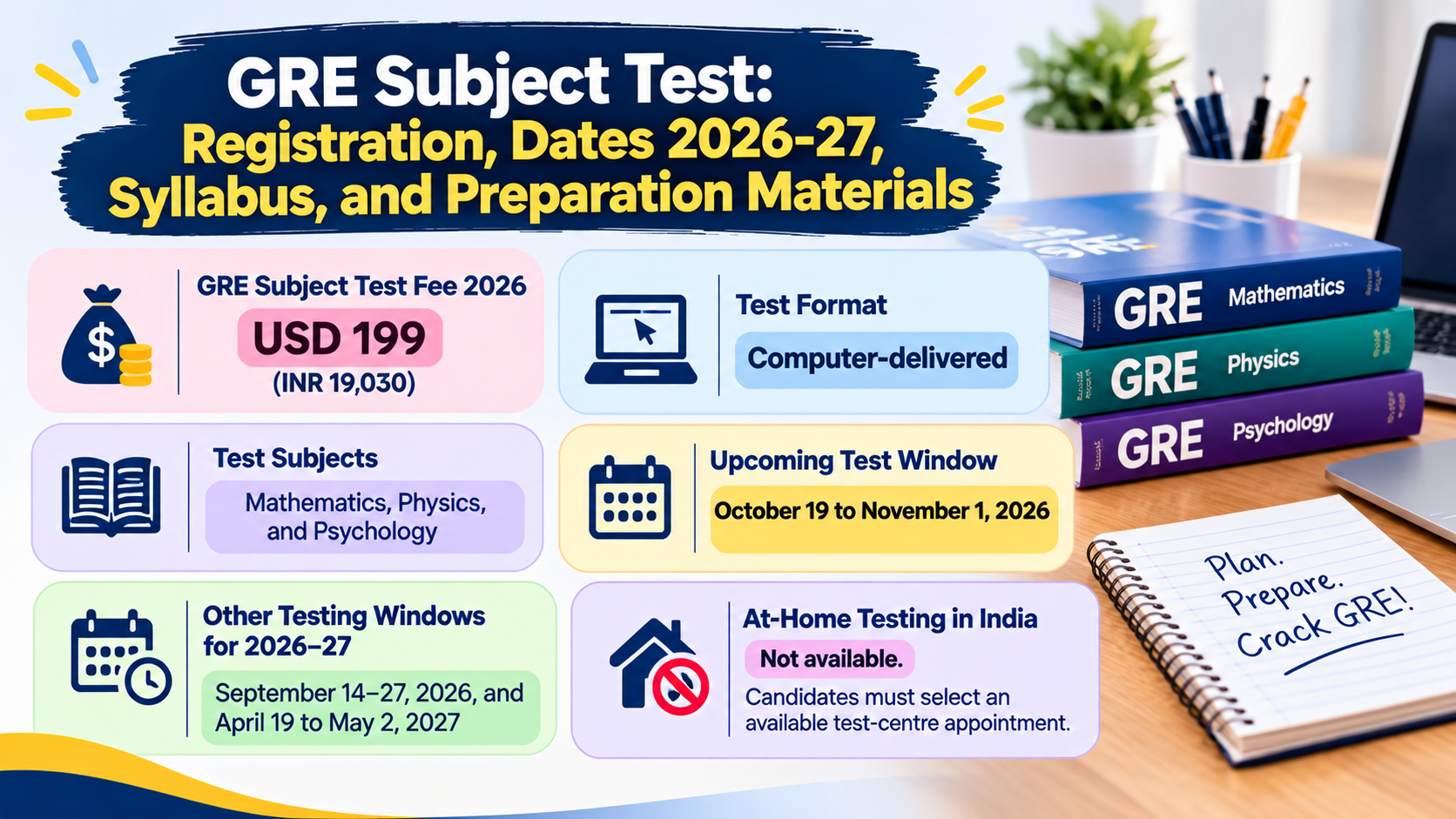
- GRE Subject Test Fee 2026: USD 199 (INR 19,030)
- Test Format: Computer-delivered.
- Test Subjects: Mathematics, Physics, and Psychology.
- Upcoming Test Window: October 19 to November 1, 2026.
- Other Testing Windows for 2026–27: September 14–27, 2026, and April 19 to May 2, 2027.
- At-Home Testing in India: Not available. Candidates must select an available test-centre appointment.
GRE Subject Test vs GRE General Test
The GRE General Test and GRE Subject Tests serve different purposes for graduate admissions.
- The General Test assesses broad academic skills, while Subject Tests measure knowledge in a specific discipline.
- Students should check their target university and programme requirements before deciding which test to take.
| Comparison Factor | GRE General Test | GRE Subject Test |
|---|---|---|
| Purpose | Assesses verbal reasoning, quantitative reasoning and analytical writing skills | Assesses knowledge in a specific academic subject |
| Test sections | Verbal Reasoning, Quantitative Reasoning and Analytical Writing | One subject-specific test |
| Subjects available | Verbal, quantitative and analytical writing skills | Mathematics, Physics and Psychology |
| Question format | Includes selected-response questions and an essay task | Primarily multiple-choice questions |
| Test duration | 1 hour 58 minutes | Varies by subject; check the official ETS page for the selected test |
| Scoring | Verbal and Quantitative Reasoning: 130–170 each | Analytical Writing: 0–6 | 200–990, in 10-point increments |
| Test schedule | Available throughout the year, subject to appointment availability | Offered during scheduled testing windows |
| Who should take it? | Applicants whose graduate programmes require or accept the General Test | Applicants whose programmes require or recommend a specific Subject Test |
Note: The GRE Subject Test is not compulsory for every graduate applicant. Whether you need the General Test, a Subject Test or both depends on the requirements of your chosen programme.
GRE Subject Test Registration
Candidates can register for a GRE Subject Test through their ETS account. Before booking, check the test window, available test centres, identification requirements and fees.
- Upcoming test window: October 19 to November 1, 2026.
- Registration fee: The worldwide GRE Subject Test fee is USD 199 (INR 19,030). Indian students should check the ETS India registration page for the final charge applicable to their booking.
- Registration method: Create or sign in to an ETS account, select the GRE Subject Test, and choose an available appointment.
- Test location: GRE Subject Tests are available at computer-delivered test centres. At-home testing is not available in India.
- Retaking the test: Candidates may take a GRE Subject Test once every 14 days, including when they cancelled their scores from a previous test.
- Booking advice: Register early to improve your chances of finding a suitable appointment.
Also read:
GRE Subject Test Dates
The GRE Subject Tests are offered during scheduled testing windows each year. For the 2026–27 testing year, ETS has announced the following dates:
| GRE Subject Test Window | Dates |
|---|---|
| September 2026 | September 14–27, 2026 |
| October–November 2026 | October 19–November 1, 2026 |
| April–May 2027 | April 19–May 2, 2027 |

GRE Subject Tests are not available to take at home in India, so Indian candidates must select an available test-centre appointment.
Also read: GRE Dates
GRE Subject Test Eligibility Criteria
ETS does not specify a minimum age, academic qualification, or minimum marks requirement for taking a GRE Subject Test. However, universities may set their own academic admission requirements and decide whether they require or recommend a Subject Test.
The GRE Subject Tests are intended for students with an undergraduate major or substantial academic background in Mathematics, Physics or Psychology.
Before registering, candidates should:
- Check whether their target university or graduate programme requires or recommends a GRE Subject Test.
- Select the subject relevant to their academic background and intended programme.
- Review ETS identification requirements for test takers in India and ensure that their registration details match their identification documents.
- Check the test window and available appointments before completing registration.
A GRE Subject Test is not compulsory for every student applying to a specialised master's or doctoral programme. The requirement depends on the institution and course.
Also read: GRE Eligibility for Indian Students
GRE Subject Test Pattern and Syllabus
The GRE Subject Tests are computer-delivered assessments in Mathematics, Physics and Psychology. Each test measures undergraduate-level knowledge in the relevant subject. In the GRE syllabus, the number of questions and test duration vary by subject. There are no separately timed sections within these tests.
| Subject Test | Number of Questions | Duration |
|---|---|---|
| GRE Mathematics | Approximately 66 | 2 hours 50 minutes |
| GRE Physics | Approximately 70 | 2 hours |
| GRE Psychology | Approximately 144 | 2 hours |
GRE Mathematics Syllabus
The Mathematics Test covers three broad areas:
- Calculus (50%): Differential and integral calculus and their applications.
- Algebra (25%): Elementary algebra, linear algebra, abstract algebra and number theory.
- Additional topics (25%): Other undergraduate mathematics topics, including discrete mathematics, geometry and statistics.
GRE Physics Syllabus
The Physics Test assesses undergraduate-level physics, including:
| Topic | Approximate Weightage |
|---|---|
| Classical Mechanics | 20% |
| Electromagnetism | 18% |
| Optics and Wave Phenomena | 8% |
| Thermodynamics and Statistical Mechanics | 10% |
| Quantum Mechanics | 13% |
| Atomic Physics | 10% |
| Special Relativity | 6% |
| Laboratory Methods | 6% |
| Specialized Topics | 9% |
GRE Psychology Syllabus
The Psychology Test covers six broad areas of undergraduate psychology:
| Topic | Number of Questions |
|---|---|
| Biological | 30 |
| Cognitive | 29 |
| Social | 19 |
| Developmental | 18 |
| Clinical | 23 |
| Measurement, Methodology and Other | 25 |
- Questions may test factual knowledge, application of psychological principles, interpretation of data, analysis of relationships, and evaluation of research methods.
- Candidates should use the ETS content specifications and practice materials to prepare for their chosen Subject Test.
- Topic weightages and question counts are intended as guides to test content, not a guarantee of the exact questions on an individual test.
Official source: https://www.ets.org/gre/test-takers/subject-tests/about/content-structure.html
Also read:
GRE Subject Test Score
GRE Subject Tests report a total scaled score ranging from 200 to 990, in 10-point increments.
- The score reflects a candidate's performance on the selected subject test.
- The available score range within each test may be narrower than the overall 200–990 scale.
For the Physics and Psychology tests taken from September 2023 onward, ETS also reports percentage-correct subscores for individual content areas on a scale of 0 to 100. These indicate the percentage of questions answered correctly within each area and should not be compared directly across different test editions.
What Is a Good GRE Subject Test Score?
There is no single score that guarantees admission to a graduate programme. A competitive score depends on the subject, the university, the programme, and the strength of the applicant's overall profile. Candidates should check whether their target programmes publish score expectations and use ETS percentile information to understand their performance.
When Are GRE Subject Test Scores Released?
ETS makes official GRE subject test scores available in candidates' ETS accounts on the published score-reporting date. For the upcoming October 19–November 1, 2026 testing window, the scheduled score-reporting date is November 9, 2026.
GRE Subject Test scores remain reportable for five years after the test date. ETS also sends official score reports to the institutions selected by candidates during registration.
GRE Subject Test Books
The best books to use to study for GRE are Princeton Review GRE Psychology Prep, Kaplan GRE Exam Subject Test, and more. To study for GRE Subject Test candidates must get hands on e-books to get a general overview of the test format. Check GRE subject test preparation books for subject test given below:
- GRE Math Practice Test Book - Check PDF
- GRE Physics Practice Book - Check PDF
- GRE Psychology Practice Book - Check PDF
- Princeton Review GRE Psychology Prep
- Kaplan GRE Exam Subject Test: Psychology
- GRE Physics Review: Comprehensive Review for GRE Physics Subject Test
GRE Subject Test Practice Papers
GRE practice papers are an essential tool for candidates. Math GRE question papers can be obtained from a variety of sources, including online sites, preparatory materials, and coaching. Attempting GRE sample papers more regularly, 2-3 tests each week, will aid in performance analysis. Once candidates begin to reach their desired score and the performance they can expect in the actual exam.
GRE Maths Practice Papers
Below are some of the practice test papers for the GRE Maths Subject Test:
| GRE Maths Practice Tests 2026 | |
|---|---|
| GRE Maths Practice Test 1 | GRE Maths Practice Test 2 |
| GRE Maths Practice Test 3 | GRE Maths Practice Test 4 |
| GRE Maths Practice Test 5 | GRE Maths Practice Test 6 |
GRE Physics Practice Papers
Below are some of the practice test papers for the GRE Physics Subject Test:
| GRE Physics Practice Tests 2026 | |
|---|---|
| GRE Physics Practice Test 1 | GRE Physics Practice Test 2 |
| GRE Physics Practice Test 3 | GRE Physics Practice Test 4 |
| GRE Physics Practice Test 5 | GRE Physics Practice Test 6 |
GRE Psychology Practice Papers
Below are some of the practice test papers for GRE Psychology Subject Test:
GRE subject test assesses a candidate's knowledge of a certain subject. GRE area Test is intended to assess candidates' depth of knowledge in a single area and allow them to pursue further studies in that field. GRE scores are accepted globally, and a candidate who has met GRE Subject Test standards of any university can study that topic at the world's top universities. To be admitted to the world's top institutions, students must demonstrate exceptional knowledge and skills in a given area throughout this test.
FAQs
Ques: What subjects are tested on the GRE?
Ques: What is the GRE Subject Test used for?
Ques: Is the GRE Subject Test available in India?
Ques: Is there maths in GRE?
Ques: Can you take the GRE Subject Test at home?
*The article might have information for the previous academic years, which will be updated soon subject to the notification issued by the University/College.



Comments