



Education Journalist | Study Abroad Lead
Iron (III) Hydroxide is a chemical compound that is made up of Iron, Oxygen, and Hydrogen. The molecular formula of Iron (III) Hydroxide is given as Fe(OH)3 or FeH3O3. This compound is water-insoluble too. In aquarium water treatment, it is also used as a phosphate binder. Depending on the degree of hydration, particle shape and size, and crystal structure, the colour of Iron (III) Hydroxide can range from yellow to dark-brown to black. Ferric Hydroxide and Hydrated Iron Oxide are two other names for Iron III Hydroxide.
| Table of Content |
Key Terms: Iron III Hydroxide, Molecular Formula. Hydration, Ferric Hydroxide, Chemical Compound, Crystal Structure, Chemical Formula, Sodium Hydroxide, Metals, Ions
Read More: Number of Moles Formula
Iron III Hydroxide Formula and Structure
[Click Here for Sample Questions]
Iron, Oxygen, and Hydrogen are the three components that together make up the chemical compound which is known as Iron III Hydroxide.
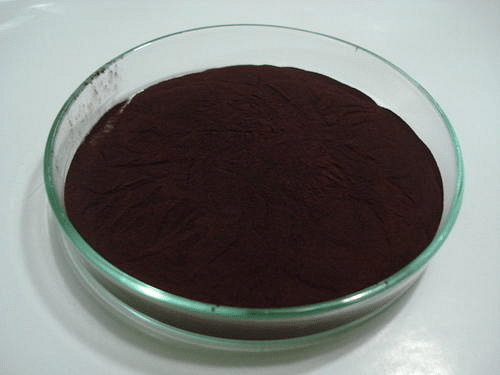
Iron III Hydroxide
Tabulated below are some of the main characteristics and properties of Iron III Hydroxide.
| Chemical Name | Iron III Hydroxide |
| Other Names | Ferric Hydroxide and Hydrated Iron Oxide |
| Molecular Formula | Fe(OH)3 |
| Melting Point | 135 °C |
| Molar Mass | 106.867 g/mol |
| Density | 4.25 g/cm3 |
| Appearance | Vivid Dark Orange Crystals |
| Solubility in Water | Insoluble in Water |
Read More: Iron Oxide
The crystal structure of β-FeOOH (akaganeite) is similar to that of BaMn8O16 or hollandite. The unit cell is tetragonal in shape, with a = 1.048 and c = 0.3023 nm, and it contains 8 formula units of FeOOH. It has dimensions of up to 500 x 50 x 50 nm. Twinning frequently results in particles with the shape of hexagonal stars.
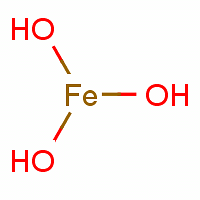
The structure of Iron III Hydroxide is as follows:
Occurrence of Iron III Hydroxide
[Click Here for Sample Questions]
In nature, anhydrous Ferric Hydroxide occurs as the extremely rare mineral bernalite, Fe(OH)3.nH2O (n=0.0-0.25). FeOOH is another name for Iron Oxyhydroxide. They are more common and occur naturally as structurally diverse minerals (or polymorphs), and are represented by the Greek letters α, β, γ, and δ.
- Since prehistoric times, goethite, with the chemical formula α-FeO(OH), has been used as an ocher pigment.
- Feroxyhyte can form under high-pressure conditions on the ocean and sea floors, but it is thermodynamically unstable in comparison to the -polymorph (or goethite) at the surface.
- The polymorph, lepidocrocite, is frequently found as rust on the inside of steel water pipes and tanks.
- Siderogel is a colloidal form of Iron (III) Oxide-Hydroxide that occurs naturally.
- The most common forms of Iron (III) Oxyhydroxide and the most important mineral carriers of iron in soils are goethite and lepidocrocite, which both crystallise in an orthorhombic system.
Read More: Difference between Molar Mass and Molecular Mass
Preparation of Iron III Hydroxide
[Click Here for Sample Questions]
Iron (III) Hydroxide precipitate is formed by adding Sodium Hydroxide (NaOH) to an iron (III) ion-containing solution. Iron (III) Hydroxide (Fe(OH)3) precipitates as a rust-brown gelatinous solid from the solution. The addition of Sodium Hydroxide is used to test for the presence of positive metal ions in the solution.
The technique of precipitation from homogeneous solutions was used in this study to simulate the formation of Iron (III) Hydroxide under conditions similar to those found at the redox boundary of natural waters. The technique allowed for the precipitation of Iron (III) Hydroxide while the precipitant Iron (III) was generated very slowly by the oxygenation of Iron (II) and then hydrolyzed.
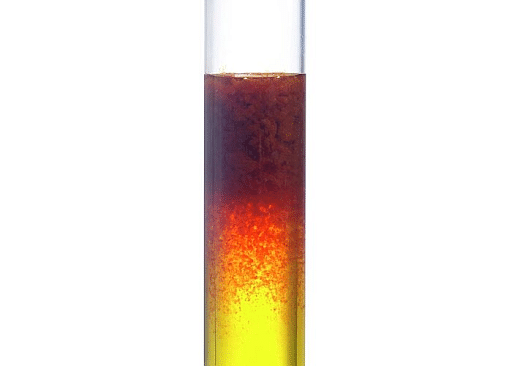
Iron (III) Hydroxide Precipitation
Read More: Sodium- Uses, Physical and Chemical Properties
Properties of Iron III Hydroxide
[Click Here for Sample Questions]
The main properties of Iron III Hydroxide are elaborated below:
- Depending on the degree of hydration, particle size and shape, and crystal structure, the colour of Iron(III) Hydroxide can range from yellow to dark-brown to black. Iron III Hydroxide is also known as Ferric Acid.
- Iron Hydroxide formula or Ferric Hydroxide formula is Fe(OH)3.
- Its molar mass is 106.867g/mol.
- The melting point of Iron III Hydroxide is 135 degrees celsius whereas its density is 4.25g/cm3.
- Iron III Hydroxide is insoluble in water.
Uses of Iron III Hydroxide
[Click Here for Sample Questions]
Some of the important uses of Iron III Hydroxide are as follows:
- Limonite is one of the three primary iron ores and has been used since at least 2500 BC. It is a mixture of different polymorphs and hydrates of Ferric Hydroxide.
- Pigment Yellow 42, also known as yellow iron oxide, has been approved by the Food and Drug Administration (FDA) for use in cosmetics and can be found in a few tattoo inks.
- Iron Hydroxide can also be used as a phosphate binder in aquarium water treatment. Iron oxide-Hydroxide nanoparticles have been investigated as potential adsorbents for the removal of lead from aquatic media.
- Ferric Hydroxide gradually loses water to form a ferric oxide, also known as rust. It's a pigment, a catalyst, and a rubber filler. Mars yellow, Mapico yellow, Ferrite, and Ferrox are some commercial names for synthetically prepared yellow iron oxide compounds.
Read More: Polymorphism
Iron III Hydroxide Safety Hazards
[Click Here for Sample Questions]
The main safety hazards associated with Iron III Hydroxide are:
- Mechanical abrasion from airborne Iron Hydroxide dust may cause eye and/or respiratory tract irritation. Overexposure that is repeated or prolonged may result in the effects listed under Short-Term Health.
- Under normal storage conditions, Iron Hydroxide is stable. Temperatures above 356°F (180°C) may cause a gradual colour change in the product. Store Iron Hydroxide away from furnaces, kilns, boilers, and other potential heat sources. Strong oxidising agents should be avoided. Keep Iron Hydroxide away from combustible materials.
Read More: Combustion
Things to Remember
- Iron (III) Hydroxide, also known as Ferric Hydroxide and Hydrated Iron Oxide, can be defined as a chemical compound that is composed of Iron, Oxygen, and Hydrogen.
- Fe(OH)3 or FeH3O3 is the molecular formula of Iron (III) Hydroxide. is given as This compound is water-insoluble too. In aquarium water treatment, it is also used as a phosphate binder.
- The colour of Iron (III) Hydroxide can range from yellow to dark-brown to black as it depends upon the degree of hydration, particle shape and size, and crystal structure.
- The molar mass of this compound is 106.867g/mol while the melting point is 135 degrees celsius.
Read More: Dalton’s atomic theory
Solved Questions
Ques. What exactly is amorphous Iron III Hydroxide crystallisation? (2 Marks)
Ans. Hydrolysis of ferric solutions can result in mono- and dinuclear species at first. Furthermore, these species interact with one another, resulting in the creation of new species with higher nuclearity. These polynuclear species eventually transform into amorphous precipitates (amorphous Iron (III) Hydroxide Hydrate) or crystalline compounds.
Ques. How Is Solid Iron III Hydroxide Separated From Solid Sodium Chloride? What is the chemical formula for Iron III Hydroxide? (2 Marks)
Ans. To begin, dissolve the mixture in water. It is important to understand that the transition metal (Fe) oxides in this case will not dissolve in water. So, filter the solution and then boil the filtrate until all of the water has been removed (evaporation). The ones on the left are pure NaCl crystals. Meanwhile, the dirty brown residue left over from the earlier filtration of the mixture will be pure Fe(OH)3. The formula for ferric Hydroxide, also known as iron Hydroxide, is Fe(OH)3.
Ques. Give any application of sodium Hydroxide. (2 Marks)
Ans. Sodium Hydroxide is widely used in the production of paper from wood. In the most common Kraft method, wood is treated with a solution containing a combination of Sodium Hydroxide and Sodium Sulphide. The majority of the undesirable material in the wood, such as lignins, will dissolve in the liquor, leaving only the relatively pure cellulose that is filtered off. This cellulose, after further purification, serves as the foundation for the paper.
Ques. Iron (III) Hydroxide has a solubility product of 1.610 39. Which of the following expressions can be used to calculate X if X is the solubility of iron(III) Hydroxide? (2 Marks)
(a) Ksp = X4
(b) Ksp = 9X4
(c) Ksp = 27X3
(d) Ksp = 27X4
Ans.The correct answer is option (d).
Fe(OH)3 ? Fe3+ +3OH
Ksp = [Fe3+ ][OH-]3
Ksp = (X)(3X)3 =27X4
As a result, option D is correct.
Ques. What is the pH of Iron III Hydroxide? (2 Marks)
Ans. 5 to 8. Iron (III) Hydroxide (Fe(OH)3) precipitates out of solution as a rust-brown gelatinous solid. Under the pH range of 5 to 8, the most dominant form of dissolved iron is soluble Fe+2.
Ques. Is iron III Hydroxide an electrolyte that is strong or weak? (2 Marks)
Ans. Because the compound iron (III) Hydroxide [Fe(OH)3] is a weak base, it is a weak electrolyte. When dissolved in water, it does not completely dissociate into its constituent ions. Therefore because of its weak basic behaviour, it has weak electrolytes.
Ques. What happens when iron Hydroxide is heated? (2 Marks)
Ans. In the presence of heat, Ferric Hydroxide decomposes, yielding ferric oxide and water molecules. When heated, it degrades into oxalic acid and water.

Ques. Is rust iron Hydroxide? (2 Marks)
Ans. Rust is an iron oxide, a typically reddish-brown oxide formed by the reaction of iron and oxygen in the catalytic presence of water or air moisture. Rust is composed of hydrous iron(III) oxides (Fe2O3nH2O) and Iron (III) oxide-Hydroxide (FeO(OH)), Fe(OH)3) and is commonly associated with the corrosion of refined iron.
Ques. Is Iron III Hydroxide water soluble? (2 Marks)
Ans. Iron (III) Hydroxide is a chemical compound with the formula Fe(OH)3 that is composed of iron, hydrogen, and oxygen. It has a low tendency to dissociate into water. As a result, it is insoluble in water.
Ques. Is Fe(OH)3 water-soluble? (2 Marks)
Ans. Although it is insoluble in water, it is soluble to varying degrees in dilute hydrochloric-acid solutions like those found in the stomach. The MFR method can be used to control the degree of solubility.



Comments