



Content Curator
Isosceles Trapezoid formula is based on two components: Area of an Isosceles Trapezoid and Perimeter of an Isosceles Trapezoid
- An isosceles trapezoid has legs or non-parallel sides that are equal in length. The parallel sides (base) of the isosceles trapezoid has angles equal to one another.
- An isosceles trapezoid is simply a form of a trapezoid that has congruent base angles and non-parallel sides.
- A trapezoid, also called a trapezium, is a quadrilateral or a polygon with four sides. It has a set of parallel and opposite sides, along with a set of non-parallel sides.
- The bases and legs of the trapezoid are known as the parallel and non-parallel sides, respectively.
A trapezoid is a four-sided closed 2-dimensional figure, where the shortest distance between the two parallel sides, is called “Altitude”. There are three types of trapezoids:
- Right Trapezoids
- Isosceles Trapezoids
- Scalene Trapezoids
Read Also: Centroid of a Trapezoidal Formula
Key Terms: Trapezoid, Isosceles Trapezoid, Median, Bases, Rectangle, Symmetry, Altitude, Scalene Trapezoid, Right Trapezoid
What is Trapezoid?
[Click Here for Sample Questions]
A trapezoid is a quadrilateral or a polygon that has four sides.
- A trapezoid is also often called a “Trapezium”.
- It is a polygon with only one pair of parallel sides.
- The parallel sides of the trapezium is also known as “Parallel Bases of Trapezoid”.
- The other two non-parallel sides of the trapezoid are known as the legs of the trapezoids.
- In a trapezoid, the distance between the parallel sides is termed “Altitude”.
Types of Trapezoid
There are three different kinds of trapezoids, and they are:
- Isosceles Trapezoid
- Scalene Trapezoid
- Right Trapezoid
Properties of Trapezoid
[Click Here for Sample Questions]
Some of the properties of a trapezoid are:
- The top and bottom bases in a trapezoid are parallel to one another.
- A trapezoid's opposite sides (isosceles) are equal in length.
- Both of the bases are parallel to the median.
- The median's length is equal to (a + b)/2, the average of the two bases.
- A trapezoid is referred to as a parallelogram if both pairs of opposite sides are parallel.
- A trapezoid can serve as a square if all sets of opposite sides are parallel, all sides are equal in length, and all sides are at right angles.
- A trapezoid can serve as a rectangle if its opposite side pairs are all parallel, equal in length, and at right angles to one another.
Isosceles Trapezoid
[Click Here for Sample Questions]
An isosceles trapezoid is one that has legs or non-parallel sides that are equal in length.
- The parallel sides (base) of the isosceles trapezoid have angles that are equal to one another.
- A line of symmetry and equal lengths for both diagonals define an isosceles trapezoid.
- If the two opposite sides (bases) of the trapezoid are seen to be parallel, and the two non-parallel sides are of equal lengths, then it is known as an isosceles trapezoid.
- The image below indicates that c and d are equal in lengths, while the opposite sides a and b (bases of the trapezoid) are parallel to one another.
![Isosceles Trapezoid]()
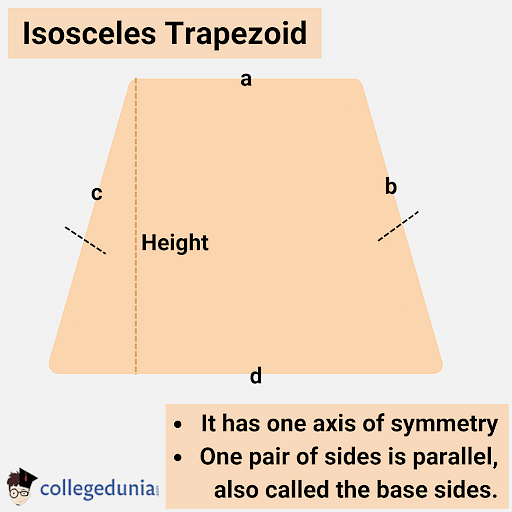
Isosceles Trapezoid
Properties of Isosceles Trapezoid
[Click Here for Sample Questions]
An isosceles trapezoid has the following characteristics:
- It has a symmetry axis. An isosceles trapezoid only has one line of symmetry connecting the middle of the parallel sides and no rotational symmetry.
- The base sides are the only pair of sides that are parallel. (In the figure, AB II DC)
- Other than the base, the remaining sides are all non-parallel and equal in length. (In the image shown, c = d)
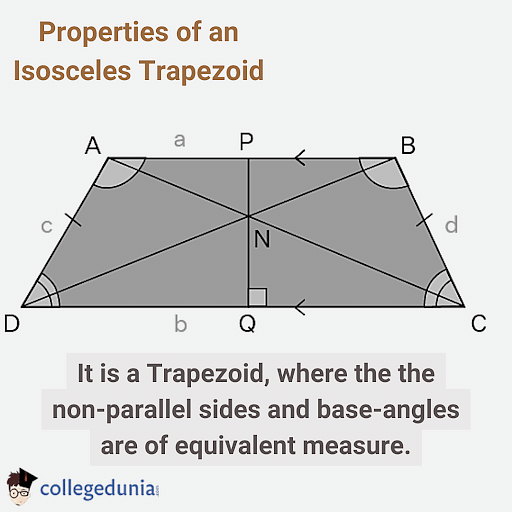
Properties of Isosceles Trapezoid
- The length of the diagonals is constant. (AC = BD)
- the same for the base angles. (∠D = ∠C, ∠A=∠B)
- 180° or supplementary is the product of all opposite angles. (A + C and B + D both equal 180 degrees)
The parallel sides' midpoints are connected by a line segment that is perpendicular to the bases. (PQ ⊥ DC)
Read More:
Isosceles Trapezoid Formula
[Click Here for Sample Questions]
There are two main trapezoid formulas, they are:
- Area of an Isosceles Trapezoid
- Perimeter of an Isosceles Trapezoid
The formulas to determine the isosceles trapezoid's area and perimeter are listed below.
Area of Isosceles Trapezoid
To find the area of the isosceles trapezoid we have to add the base sides or parallel sides and divide it by 2 and then multiply the result with height.
Area of Isosceles Trapezoid = (sum of parallel sides/2) × h
Perimeter of Isosceles Trapezoid
To find the perimeter of the isosceles trapezoid we have to add all the sides of the isosceles trapezoid.
Perimeter of Isosceles Trapezoid = sum of all sides
Some other important formulas of trapezoid, as per the following image, include:
- Sum of bases = B + b = 2A/h
- Height = 2A/B + b
- Oblique Side Projection = p1 = B - b/2
- Difference of bases = B - b = 2 x p1
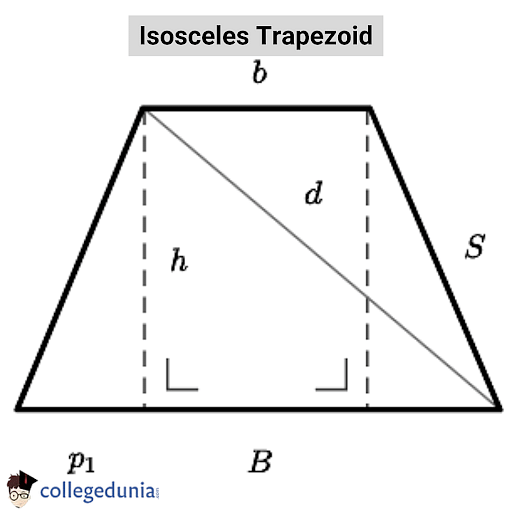
Isosceles Trapezoid Formula
Also Read:
Things to Remember
- An isosceles trapezoid is a type of trapezoid with congruent base angles and non-parallel sides.
- A trapezoid, also known by the name trapezium, is a quadrilateral or a polygon with four sides
- A trapezoid has a set of parallel and opposite sides and a set of non-parallel sides.
- The area of isosceles trapezoid is = (sum of parallel sides/2) × h
- The perimeter of an isosceles trapezoid is = Perimeter of Isosceles Trapezoid = sum of all sides.
- An isosceles trapezoid has legs or non-parallel sides that are equal in length.
Sample Questions
Ques. What is an isosceles trapezoid? (1 mark)
Ans. An isosceles trapezoid is a type of trapezoid where the legs or non-parallel sides are equal in length. The parallel sides (base) of the isosceles trapezoid possess angles are equal to one another.
Ques. What are the three types of Trapezoids? (2 marks)
Ans. There are three types of trapezoids are:
- Isosceles Trapezoid
- Scalene Trapezoid
- Right Trapezoid
Ques. Determine the perimeter of an isosceles trapezoid assuming that its bases are 20 inches and 25 inches, while its non-parallel sides are 30 inches each. (2 marks)
Ans. As we are aware,
Perimeter of an isosceles trapezoid = sum of all sides of isosceles trapezoid
Perimeter of an isosceles trapezoid = 20 + 25 + 30 + 30
= 105 inches
Ques. Find the height of the isosceles trapezoid if the area is 168 inches2 and the lengths of the bases are 14 inches and 28 inches. (2 marks)
Ans. Given area = 128 inches2 , Bases = 12 inches and 20 inches
we know that area of isosceles trapezoid = (sum of parallel sides ÷ 2) × height
... 168 = [(14 + 28) ÷ 2] × height
Height = 168/16 = 8 inches
Ques. Find the area of an isosceles trapezoid if its bases are 5 inches and 7 inches and its height is 6 inches. (2 marks)
Ans. We all know that the Area of isosceles trapezoid = (sum of parallel sides ÷ 2) × height
... bases = 5 inches and 7 inches, height = 6 inches
Area = [(5 + 7) ÷ 2] × 6
Area = 36 inches2
Ques. Find the perimeter of an isosceles trapezoid if its bases are 30 inches and 35 inches and non-parallel sides are 40 inches each. (2 marks)

Ans. We know that the Perimeter of an isosceles trapezoid is = sum of all sides of the isosceles trapezoid
Perimeter of an isosceles trapezoid = 30 + 35 + 40 + 40
= 145 inches
Ques. What is the area of an isosceles trapezoid with bases 9 inches and 3 inches and its height is 5 inches. (2 marks)
Ans. As per the formula, Area of isosceles trapezoid = (sum of parallel sides ÷ 2) × height
With the given data, Bases = 9 inches and 3 inches, height = 5 inches
Area = [(9 + 3) ÷ 2] × 5
Area = 30 inches2
Ques. Determine the area of isosceles trapezoid assuming that its bases are 6 inches and 6 inches with a height is 4 inches. (2 marks)
Ans. As per the formula, Area of isosceles trapezoid = (sum of parallel sides/ 2) × height
As per the given data, bases = 6 inches and 6 inches, height = 4 inches
Area = [(6 + 6) ÷ 2] × 4
Area = 24 inches2
Ques. Find the perimeter of an isosceles trapezoidal. (3 marks)
Ans. Since we know that ABCD is an isosceles trapezoidal, we can say that both parallel sides are equal i.e. AD = BC
... , AD = BC = 4 cm.
Now, we know that Perimeter of an isosceles trapezoid = sum of all sides of isosceles trapezoid
Thus, AB + BC + CD + DA
= 12 + 4 + 8 + 4
= 28
Hence, the perimeter of the given trapezium is 28 cm.
Ques. Determine the height of an isosceles trapezium assuming that the length of parallel sides are 6 cm, and 4 cm along with an area of 24cm2. (3 marks)
Ans. Length of the given parallel sides (a) = 6 cm, b = 4 cm
Area = 24cm2
Thus, as per the formula, Area = ((a+b)/2) × h
Hence,
24 = ((6+4)/2) × h
24 = (10/2) × h
24 = 5 × h
h = 24/5
= 4.8 cm
Check-Out:



Comments