



Content Curator
The major difference between distance and displacement is that distance is the length of a path between two points while displacement is the shortest distance between two points. Although distance and displacement seem similar, they are different quantities with different meanings and definitions. Here we will discuss more differences between distance and displacement.
Read More: Displacement Vector
| Table of Content |
Key Terms: Distance, Displacement, Difference, Length, Unit, Magnitude, Formula, Scalar, Vector, Speed, Velocity
What is Distance?
[Click Here for Sample Questions]
Distance is the sum of the total length of the path traveled by an object from one place to another. The path may or may not be directly from the initial point to the final point. Distance is a scalar quantity, it only has magnitude, and does not have any direction.
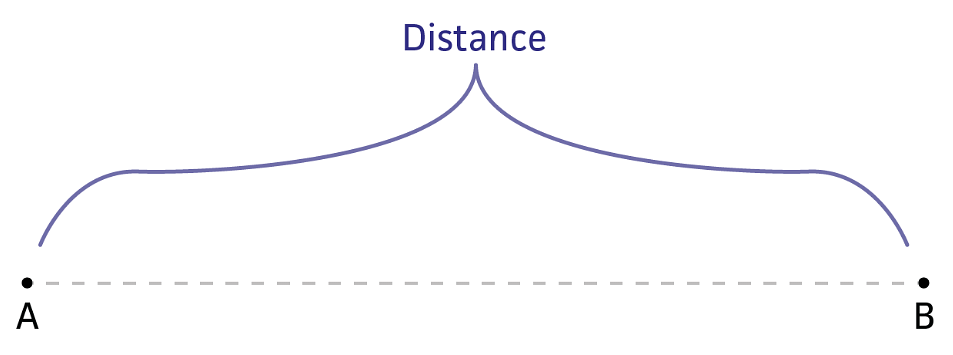
Distance of the Path = AB
Mathematically distance can be explained as,
| Distance= the sum of all lengths of paths traveled to reach one point from another Speed = Distance / Time Distance= Speed * Time |
With the following diagram, let's understand the concept of distance:
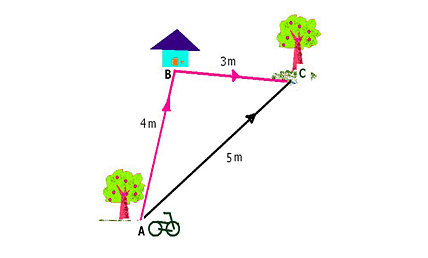
Calculating Distance
Here, the goal of the bicyclist is to reach point C from point A. So at first, he reached point A to B then B to C, and finally reached his destination.
Therefore,
Distance covered by him = AB + BC = 4m + 3m = 7m
Read More:
What is Displacement?
[Click Here for Previous Year Questions]
Displacement is the length of the shortest path from the initial point to the final point. It is a vector quantity that has magnitude as well as direction.

Displacement Representation
Mathematically displacement can be defined as:
| Velocity= Displacement / Time Therefore, Displacement = Velocity x Time |
For Example:

Distance Vs Displacement Example
Suppose a person is walking at a park and he first goes A to B, then B to C, after that C to D and finally he comes back to A from point D.
Therefore, here the initial and final point is A. so the distance covered by that person is AB + BC + CD + DA = 3+5+3+5 = 16m
And the displacement of that person is zero because his initial and final position is the same.
Differences between Distance and Displacement
[Click Here for Sample Questions]
Tabulated below are the difference between distance and displacement.
| Sl. No. | Differentiating Property | Distance | Displacement |
|---|---|---|---|
| 1 | Definition | It is the sum of a path that an object takes in order to travel from one place to another. | Displacement is the length of the shortest path from the initial point to the final point. |
| 2 | Denotation | Distance is denoted by the letter ‘d’ | Displacement in denoted by the letter ‘s’ |
| 3 | Quantity | Distance is a scalar quantity since it only depends on its magnitude, not on its direction. | Displacement is a vector quantity since it depends on both magnitude and direction. |
| 4 | Direction | In order to calculate distance, the direction of the path taken is not considerable | The direction is taken into account when calculating displacement. |
| 5 | Route Information | Distances give detailed information about the routes that are followed to get from one place to another. | Since displacement refers to the shortest path, it does not provide a complete picture of the route. |
| 6 | Magnitude | The distance traveled is either equal to or greater than displacement and is never less than the magnitude of displacement. i.e., Distance ≥ |Displacement| | The magnitude of displacement is less than or equal to the distance traveled during the course of motion. i.e., |Displacement| ≤ Distance |
| 7 | Formula | Speed × Time | Velocity × Time |
| 8 | Relation with Time | The distance can never decrease as time increases. | The displacement may increase or decrease as time increases. |
| 9 | Possible Values | The distance can only have positive values. | Displacement can be positive, negative, and even zero. |
| 10 | Indication with arrow | As distance has no direction, it is not indicated with an arrow. | Displacement depends upon its direction so is always indicated with an arrow. |
| 11 | Measurement in straight Path | The path according to which distance is calculated is not necessarily a straight line. | Displacement can only be measured along a straight path. |
| 12 | Path Dependence | Distance depends upon the path taken by an object. It changes according to the path taken. | Displacement does not depend upon the path and it only depends upon the initial and final position of the object. |
Things to Remember
- Distance is the total length of the path covered by an object.
- Displacement is the shortest distance between the initial and final position of an object.
- Distance is a scalar quantity but displacement is a vector quantity.
- Distance covered by an object can never be zero, but the displacement of an object can be zero.
- The distance between two points can have different values.
- The displacement of the body between two points has a unique value.
Read More:
Previous Year Questions
- A man moves 20 m North, then 10 m East and then 10… [AP EAPCET]
- The ratios of the distance traversed, in successive intervals of time by a body… [AMUEEE 2010]
- A body is moved along a straight line by a machine delivering constant power… [NEET 2000]
- The numerical ratio of displacement to the distance covered is always… [BHU VET]
- The masses of blocks A and B are m and M respectively… [BITSAT 2015]
- The displacement-time graph of a moving particle is shown below… [NEET 1994]
- The displacement-time graphs of two moving particles make angles of… [KCET 2011]
- A particle moves along a straight line OX. At a time…
- If a car at rest accelerates uniformly and attains a speed of… [AMUEEE 2005]
- Position-time graph for motion with zero acceleration is… [JKCET 2011]
- The displacement ′x′ (in meter) of a particle of mass ′m′ (in Kg) moving in… [AMUEEE 2014]
- The relationship between the force F and position x of a body is…
- The displacement of a particle at time t is…
Sample Questions
Ques. A car travels along a straight road 100 m east then 50 m west. Find distance and displacement of the car. (1 mark)
Ans:

Distance = 100 meters + 50 meters = 150 meters
Displacement = 100 meters – 50 meters = 50 meters, to the east.
Ques. A runner travels around a rectangle track with length = 100 meters and width = 50 meters. After traveling around the rectangle track two times, the runner went back to the starting point. Determine distance and displacement. (2 marks)
Ans:
Circumference of rectangle = 2 * (100 meters + 50 meters) = 300 meters.
Travels around a rectangle 2 times = 2 * (300 meters) = 600 meters.
Therefore, Distance covered = 600 m
Displacement = 0
Ques. An athlete covers 3 rounds on a circular track of a radius of 30 m. Calculate the total distance and displacement traveled by him. (2 marks)
Ans:

The total distance the athlete covered = 3 x circumference of track
Distance = 3*2*30 = 565.2 m
The displacement is zero since the athlete reaches the same point A after three rounds from where he started.
Ques. A boat sailing through a river moves eastward for 5 km, then crosses the river by moving 3 km southward. On reaching the other side it moved westward through 1 km and reached the jetty. Find the distance covered and displacement of the boat. (3 marks)
Ans:

From the fig, AB = 5 km
ED = BC = 3 km
CD = 1 km
∴ AE = 5 km – 1 km = 4 km
Distance covered = AB + BC + CD
= 5km + 3km + 1 km
= 9 km

So the distance covered by the boat is 9 km and the displacement is 5 km
Ques. Displacement can be zero but distance can never be zero. Explain. (2 marks)

Ans. Distance is the sum of the length of the path taken to reach the initial to the final point. But Displacement is the shortest distance between the initial and final point. If the initial and final position of an object is the same, then the displacement will be zero. But distance is the path covered to reach the final point, even if the initial and final point is the same, so distance can never be zero.
Ques. A car is moving on a highway from Point P to Q to R to S and back to Q and then finally to R as shown in the figure.
Calculate:
a. The distance traveled by the car.
b. The displacement of the car.

Ans: From the question,
PQ= 3km
QR=5km
RS= 7km
- The distance traveled by the car is= PQ +QR+RS+SR+RQ+QR = 3+5+7+7+5+5
= 32 km
- The Displacement traveled by car =3+5
= 8 km
Ques. A body that is displaced would definitely have covered some distance. Explain why.
Ans: Distance is defined as the actual path covered by a body whereas displacement is the distance between the initial and final positions. So, for a body is displaced by some amount, it must cover some distance.
Ques. Which of the following can be zero when a particle is in motion for some time?
a. Speed
b. Displacement
c. Distance
d. None of these
Ans. The correct option is B)
(A) For the scalar quantities, they depend only on the magnitude of the term. The direction does not matter for scalar quantities.
(B) For the vector quantity, it depends upon the direction of that vector as well as magnitude.
So, the vector sum can be zero after some time.
In this case, only Displacement can be zero after some time.
Ques. If the distance covered is zero, the displacement must be zero. Explain why.
Ans. If the distance covered is zero then the body was at rest the whole time, so displacement will be zero as initial and final points coincide.
Ques. If the distance covered by a particle is zero, what can be its displacement?
Ans. As the distance covered by the particle is zero. This implies that the particle is at rest or stationary. Hence, its displacement is also zero.
Ques. Under what condition(s) is the magnitude of the average velocity of an object equal to its average speed?
Ans. If the distance traveled by a body is equal to the displacement, then the magnitude of the average velocity of an object will be equal to its average speed.
Ques. A person walks along the path of a rectangle from point P to point R as shown in the below figure.
a) Find the distance traveled by the person.
b) Find out the magnitude of the displacement of the person.
Ans. Given the distances, PQ = 5 km, QR = 2 km
a) The distance traveled by the person = PQ + QR = 5 + 2 = 7 km
b) The magnitude of displacement is equal to the shortest distance between the final point R and the initial point P, which is equal to the diagonal PR and can be calculated using Pythagora’s theorem.
i.e., magnitude of displacement = PR
By Pythagora’s theorem, PR2 = PQ2 + QR2
Thus, Displacement = PR
= \(\sqrt{(PQ)^2 + (QR)^2}\)
= \(\sqrt{5^2 + 2^2}\)
= \(\sqrt{29}\)= 5.385 km
Ques. A motorcycle rides from point P to Q to R to S and finally to P in a circular path as shown in the below figure.
Find a) the distance traveled by motorcycle.
b) the displacement.
Ans. Given radius, r = 5 km
a) Here, the distance traveled by motorcycle = circumference of the circle (∵ the motorcycle moves one complete rotation)
= 2πr
= 2 × 3.14 × 5
= 31.4 km
b) Here, the initial point is P and the final point is also P. Therefore, there will be no change in position and hence the displacement is equal to zero.
Ques. Provide the features of displacement.
Ans. Here are some of the important properties of displacement:
- Displacement is a vector quantity. It can be a positive, a negative, or a zero value.
- The magnitude of displacement of a particle between two points gives the shortest distance between the two points.
- The SI unit for displacement is meter and it has the dimension of length [M0L1T0]
- The magnitude of the displacement will be less than or equal to the actual distance traveled by the object in the given interval of time. i.e., |Displacement| ≤ Distance
- If an object, after traveling a certain distance returns to the starting point, then its displacement is zero.
Ques. A car moving along a straight highway from point P to point Q to point R and to point S, then back to point Q and finally to the point R as shown in the figure below.
a) Find the distance traveled by car.
b) Find the displacement of the car.
Ans. Given the distances, PQ = 3 km, QR = 5 km and RS = 7 km
Also, SQ = 7 + 5 =12 km,
PR = 3 + 5 = 8 km
a) Distance travelled by the car = PQ + QR + RS + SQ + QR
= 3 + 5 + 7 + 12 + 5
= 32 km
b) Displacement of the car = the shortest distance between the final point R and the initial point P
= PR
= 8 km
Ques. Shipra went from her home to school 2.5km away. On finding her home closed she returned to her home immediately. Find her net displacement and what is the total distance covered by her. (1 mark)
Ans. Displacement = 0
Distance = 2.5km + 2.5km = 5.0km.
Ques. In which of the given below examples of motion, can the body be considered approximately a point object: (a) a railway carriage moving without jerks between two stations. (b) a monkey sitting on top of a man cycling smoothly on a circular track. (c) a spinning cricket ball that turns sharply on hitting the ground. (d) a tumbling beaker that has slipped off the edge of a table. (2 marks)
Ans. (a), (b)
(a) The size of a carriage is very small as compared to the distance between two stations. Therefore, the carriage can be treated as a point-sized object.
(b) The size of a monkey is very small as compared to the size of a circular track. Therefore, the monkey can be considered as a point-sized object on the track.
Also check:



Comments