



Content Curator
A polygon is a 2-D shape that contains three or more straight lines. The word Polygon is derived from the Greek language in which the word “Poly” signifies “many”, and the word “Gon” means “angle”. So, it can be said that a closed figure which has many angles is a Polygon.
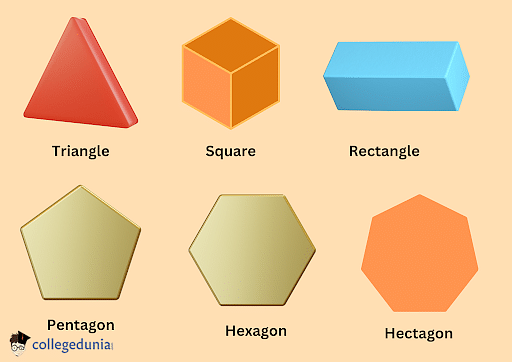
- Some of the major examples of polygons are Triangles, squares, rectangles, pentagons, and hexagons.
- A point at which the segments of a polygon meet is referred to as the vertices.
- Similarly, the segments that share the same vertex are referred to as the adjacent sides.
- A segment whose endpoints are nonadjacent vertices is also known as a diagonal.
| Table of Content |
Key Terms: Polygon, Triangle, Square, Rectangle, Hexagon, Interior Angles
What is a Polygon?
[Click Here for Sample Questions]
Polygons must have at least three sides. Each side of the line segment should intersect with the other line segment at a point which is called a vertex.
- Simply, a point at which segments meet is referred to as the vertices.
- Segments that share the same vertex are referred to as the adjacent sides.
- A segment whose endpoints are nonadjacent vertices is called a diagonal.
- Triangles, squares, rectangles, pentagons, and hexagons, are some examples of polygons.
- There is also a special class of polygon whose sides and angles are of the same length, such polygons are called regular polygons. No matter how one lays that polygon down, it will look the same from all four sides.

Polygon Diagram
Polygon Formulas
[Click Here for Sample Questions]
Sum total of all internal angles: T =( n - 2) X 180
Where,
- T = Sum of internal angles
- n = Number of sides
Each Interior Angle: IA = [(n−2)180] / n
Where,
- IA = Each internal angle
- n = Number of sides
Each Exterior Angle: EA = 360/n
Where,
- EA = Each exterior angle
- n = Number of sides
Perimeter of a Polygon: P = n × s
Where,
- P = Perimeter
- n = Number of sides
- s = The length of the sides
Area of the polygon: A= s/2 tan (180/n)
Where,
- A = Area of Polygon
- s = the length of the sides
- n = Number of sides
The number of diagonals: D= [n(n−3)]/ 2
Where,
- D = Diagonal of Polygon
- n = Number of sides
Polygon Types
Types of Polygons
[Click Here for Sample Questions]
Based on the sides and the angle measure the polyones can be classified into different types. These are:
Regular Polygon- All the sides as well as interior angles are of the same measure. Given below is an example of a Regular Polygon.

Regular Polygon
Irregular Polygon- All the sides as well as angles are of different measures in an irregular polygon. Given below is an example of an Irregular Polygon.

Irregular Polygon
Convex Polygon- All the interior angles of a convex polygon are less than 180 degrees. Given below is an example of a Convex Polygon.

Convex Polygon
Concave Polygon- These are the Polygons that have one or more interior angles with a measure of greater than 180 degrees. Given below is an example of a Concave Polygon.

Concave Polygon
List of Polygons
[Click Here for Sample Questions]
Generally the number of sides of a polygon determines its shape and on the basis of sides, a polygon is named. Common examples are triangles, squares, pentagons, hexagons, etc. Mentioned below is the list of polygons based on the number of sides they have:

List of Polygons
Properties of Polygons
[Click Here for Sample Questions]
Important properties of Polygons are:
- The sum of all the interior angles of all the quadrangles is 360°.
- If at least one of the interior angles is greater than 180 degrees, then it is called a concave polygon.
- If a polygon does not cross over itself and has only one boundary, it is known as a simple polygon; otherwise, it is referred to as a complex polygon.
- An angle inside the polygon at one of its vertices is called an interior angle.
- An angle outside the polygon formed by one of its sides and the extension of an adjacent side is called the exterior angle of the quadrilateral.
- The Interior angle plus the corresponding exterior angle is equal to 1800.
Read Also:
Things to Remember
- A polygon is a 2-D shape that contains three or more straight lines.
- Sum total of all internal angles of a Polygon is T =( n – 2) X 180( Here, T= Sum of internal angles and n= Number of sides )
- Each Interior Angle of a Polygon is IA = [(n−2)180] / n (Here, IA= Each internal angle and n= Number of sides)
- Each Exterior Angle of a Polygon is EA = 360/n (Here, EA= Each exterior angle and n= Number of sides)
- Perimeter of a Polygon is P=n×s (Here, P= Perimeter, n= Number of sides and s= The length of the sides)
- The Area of the polygon is A= s/ 2 tan (180/n) (Here, A= Area of Polygon, s= the length of the sides and n= Number of sides)
- The number of diagonals in a Polygon is D= [n(n−3)]/ 2 (Here, D= Diagonal of Polygon and n= Number of sides)
Sample Questions
Ques. Find the sum of the interior angles of an Octagon. (2 marks)
Ans. We know that a hexagon has eight sides.
Using the polygon formula, we know that the sum of interior angles is given by:
Interior angle sum = 180°(n-2)
= 180°(8-2)
= 180° (6)
= 1080°
Hence, the sum of the interior angles of a hexagon is 1080°.
Ques. Calculate the measure of 1 exterior angle of a regular hexagon. (2 marks)
Ans. The polygon is a hexagon, so we have n = 6
An exterior angle of a regular polygon (EA) = 360/n
= 360/ 6
= 600
Therefore the measure of an exterior angle of a regular pentagon is 600.
Ques. Using the polygon formula, find the sum of the interior angle of a Nonagon. (2 marks)
Ans. We know that a Nonagon has 9 sides.
Using the polygon formula, we know that the sum of interior angles is given by:
Interior angle sum = 180°(n-2)
= 180°(9-2)
= 180° (7)
= 1260°
Hence, the sum of the interior angles of a triangle is 1260°.
Ques. A polygon has 54 diagonals. What is the number of sides in the polygon? (2 marks)
Ans..We know that The number of diagonal: D= [n(n−3)]/ 2
Where D= Diagonal of Polygon
n= Number of sides
So, 54= [n(n-3]/2
54= [nXn-3n]/2
54=[nXn-3n]
108= n2 -3n
0= n2 -3n-108
n=12
Ques. The sum of all the interior angles of a regular polygon is four times the sum of its exterior angles. What polygon is this? (2 marks)
Ans. We know the sum of the exterior angle is= 360
Sum of the interior angles= 4X 360= 1440
So, 1440=(n-2)X180
n= 10
So the polygon is Decagon
Ques. Determine the area of a regular hexagon whose apothem length is 6 units (2 marks)
Ans. Given polygon is a hexagon. So, n = 6.
Apothem length (l) = 6 units
We know that,
Area = l/[2tan(180°/n)]
A = 6/[2tan(180°/6)]
= 3/tan 30°
= 3/(1/√3) = 3√3 square units.
Hence, the area of the given polygon is 3√3 square units.
Ques. Under how many categories Polygon be categorised? (3 marks)
Ans. Based on the sides and the angle measure the polygons can be classified into different types. These are:
Regular Polygon- All the sides as well as interior angles are of the same measure.
Irregular Polygon- All the sides as well as the angles are of different measures.
Convex Polygon- All the interior angles of a polygon are less than 180 degrees.
Concave Polygon- These are the Polygons that have one or more interior angles with a measure of greater than 180 degrees.
Ques. A polygon is an octagon and its side length is 6 cm. Calculate the perimeter and value of one interior angle. (3 marks)
Ans. The polygon is an octagon. Hence, n = 8
Length of each side, s = 6 cm
The perimeter of the octagon is P = n × s
P = 8 × 6
= 48 cm
Now, to find each interior angle by using the polygon formula,
Interior Angle = [(n-2)180°]/n
= [(8 - 2)180°] / 8
= (6 × 180°) / 8
= 135°
Thus, the perimeter of the given octagon is 48 cm and the value of each internal angle is 135 degrees.
Ques. A polygon is a hexagon and its side length is 5 cm. Calculate its perimeter and value of one interior angle. (3 marks)
Ans. Given in the problem:
The polygon is a hexagon. Hence, n = 6
Length of one side, s = 5 cm
The perimeter of the hexagon P = n × s
P = 6× 5
=30 cm.
Now, to compute interior angle, IA = [(n−2)180] / n
Where IA= Each internal angle
n= Number of sides
IA=[(6-2)180]/6
IA=[(4)180]/6
IA=[ 720]/6
IA= 120
So the perimeter is 30 cm and the interior angle is 120.
Ques. Write some of the Properties of a Polygon. (4 marks)
Ans. Mentioned below are some properties of a Polygon:
- The sum of all the interior angles of all the quadrangles is 360°.
- If at least one of the interior angles is greater than 180 degrees, then it is called a concave polygon.
- If a polygon does not cross over itself and has only one boundary, it is known as a simple polygon Otherwise, it is referred to as a complex polygon.
- An angle inside the polygon at one of its vertices is called an interior angle.
- An angle outside the polygon formed by one of its sides and the extension of an adjacent side is called the exterior angle of the quadrilateral.
- The Interior angle plus corresponding exterior angle is equals to 1800
Check-Out:



Comments