



Content Curator
Large numbers are the numbers much bigger than what we use in daily life.
- In the number system, the number that is bigger than the other numbers is called a large number.
- Examples of big numbers, that we do not use in daily life include 1 lakh, 1 million,1 billion, and so on.
- These large numbers are usually written in standard form for better readability.
- The population of the country or the amount in a bank account is represented by the positive large numbers.
| Table of Content |
Key Terms: Large numbers, Addition, Subtraction, Multiplication. Division, Positive numbers, Place value system, One billion, One million
What are the Large Numbers?
[Click Here for Sample Questions]
“The numbers much bigger than the numbers we generally use in daily life are called large numbers.”
We all learn to count numbers from single digits up to several digits using the place value system. This system is of two types
- Indian place value system
- International place value system
Indian Place Value System
In this system, large numbers written in standard form are grouped by commas, with each group called a period. These periods have specific names based on their position:
- Ones period: Rightmost group (last 3 digits)
- Thousands period: Next group to the left (2 digits)
- Lakhs period: Next group to the left (2 digits)
- Crores period: Next group to the left (2 digits), and so on.
| For Example: The number 45678954, in the Indian number value system can be
|
International Place Value System
In this system, large numbers written in standard form are also grouped by commas, with each group called a period.
- Each period represents 3 digits.
- Periods are named as ones, thousands, millions, billions, and so on.
| For Example: The number 45678954, in the International number value system can be
|
The below points show how to read and write very large numbers
- 1,000,000,000 are “one billion”.
- 1,000,000,000,000 are “one thousand billion”.
- 1,000,000,000,000,000 are “one million billion”.
- 1,000,000,000,000,000,000 are “one billion billion”.
- 1,000,000,000,000,000,000,000 are “a thousand billion billion” and so on…
Also check:
| Related Concepts | ||
|---|---|---|
| Multiplication and Division of Integers | Scintillation Counter | |
| Probability | Pair of Linear Equations in Two Variables MCQs | |
Addition of Large Numbers
[Click Here for Sample Questions]
The column addition method is used for adding large numbers.
- Step 1: Write the numbers vertically, one below the other, aligning the digits by their place value.
- Step 2: Start from the rightmost column (ones place) and add the digits in that column.
- Step 3: If the sum in a column is greater than or equal to 10, carry over the tens digit to the next column (left side) and add it to the digits in that column.
- Step 4: Repeat steps 2 and 3 for each subsequent column (tens, hundreds, thousands, etc.) moving leftward.
Addition of Large Numbers Example
| Ques. Find the sum of the following large numbers: 96,243,579 and 71,394,235 Ans. First, we arrange the numbers in columns according to their place value and then we add them.  Addition of large numbers Therefore, the sum of the given numbers is 167,637,814. |
Subtraction of Large Numbers
[Click Here for Sample Questions]
Subtracting large numbers can be done using a method called column subtraction. The process involves the following steps:
- Step 1: Write the numbers vertically, one below the other, aligning the digits by their place value.
- Step 2: Start from the rightmost column (ones place) and subtract the digits in that column.
- Step 3: If the top digit is smaller, borrow 1 from the digit above (tens, hundreds, etc.) in the top number.
- Step 4: After borrowing subtract the digits in the current column.
- Step 5: Repeat steps 2-5 for each subsequent column (tens, hundreds, thousands, etc.) moving leftward.
Subtraction of Large Numbers Example
| Ques. Find the difference between the following large numbers: 735,241,289 and 269,173,428. Ans. First, we arrange the numbers in columns according to their place value and then we subtract them.  Subtraction of large numbers Therefore, the difference of the given numbers is 466,067,861 |
Read Also: Arithmetic progressions practice material
Multiplication of Large Numbers
[Click Here for Sample Questions]
The following are the steps for multiplying large numbers
- Step 1: Write the numbers vertically, one above the other.
- Step 2: Start from the rightmost digit in the bottom number.
- Step 3: Multiply this digit by each digit in the top number.
- Step 4: Write down the product of each multiplication below the line, and shift one place to the left according to the digit's place value in the top number.
- Step 5: Repeat steps 2-4 for each digit in the bottom number, moving leftward.
- Step 6: Finally, add all the individual products you wrote down.
Multiplication of Large Numbers Example
| Ques. Multiply the large number 97,135 by 12. Ans.  Multiplication of large numbers Therefore, the product of the given numbers is 1,165,620. |
Division of Large Numbers
[Click Here for Sample Questions]
Large numbers are divided using the long division method, which is applicable to all division problems.
- There is a dividend, which is divided by the divisor to produce a result known as the quotient, and sometimes a remainder.
- Division involves the complete cycle of division, subtraction, and multiplication.
Division of Large Numbers Example
| Ques. Divide the large number 1,260,257 by 37. Ans. 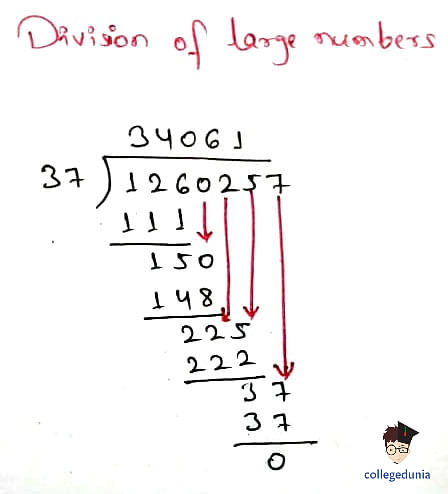 Division of large numbers |
Also check:
| Related Concepts | ||
|---|---|---|
| Remainder Theorem | Angle Formula | Circles |
| Lines and angles | Geometry | Areas of Triangles |
Things to Remember
[Click Here for Sample Questions]
- Large numbers are the numbers much larger than the ones we use in daily life.
- For better readability, these large numbers are usually written in standard form.
- Examples of large numbers include 1 lakh, 1 million, and 1 billion.
- Large numbers are divided using the long division method.
- These are added using the column addition method.
- These are subtracted using the column subtraction method.
Sample Questions
Ques. What is the difference between the smallest 4-digit number and the greatest 4-digit number? (1 Mark)
Ans. The smallest 4-digit number is 1,000, read as one thousand and the greatest number is 9999, read as nine thousand nine hundred ninety-nine.
Ques. What are large numbers? (2 Mark)
Ans. The numbers much bigger than the numbers we generally use in daily life are called large numbers.
Ques. What is the largest 5-digit number? (1 Mark)
Ans. The largest 5-digit number is 99,999.
Ques. By using 8,7,9,5, what will be the largest and smallest numbers that can be formed? (1 Mark)
Ans. The largest number that can be formed is 9875 and the smallest number that can be formed is 5789.
Ques. Find the sum of these two large numbers: 134,679 and 3,659,129. (2 Marks)
Ans. Add these numbers by using the column addition method, we get
134,679 + 3,659,129 = 3,793,808
Ques. What is the seven-digit greatest number? (1 Mark)
Ans. The seven-digit greatest number is 9999999
Ques. What is the sum of the greatest 5 digit number and the smallest 7 digit number? (2 Marks)
Ans. Greatest 5-digit number = 99,999
Smallest 7-digit number = 1,000,000
Sum = 99,999 + 1,000,000 = 1,099,999
Ques. What do we call the number 100000 in words? (1 Mark)
Ans. The number 100000 in words is One lakh.
Ques. Multiply the large number 135,012 by 12. (3 Marks)
Ans. The following steps are used
- Multiply each digit of 135,012 by 2
- Multiply each digit of 135,012 by 1
- Shift the results of step 2 one place to the left
- Add all the partial products
Therefore, 135,012 multiplied by 12 is 1,620,144.
Ques. Multiply the large number 625,425 by 25. (3 Marks)
Ans. The following steps are used
- Multiply each digit of 625,425 by 2
- Multiply each digit of 625,425 by 5
- Shift the results of step 2 one place to the left
- Add all the partial products
Therefore, 625,425 multiplied by 25 is 15,635,625.
For Latest Updates on Upcoming Board Exams, Click Here: https://t.me/class_10_12_board_updates
Also Read:



Comments