



Content Curator
Cosine formula, also known as the law of cosines, cosine rule and al-Kashi’s theorem, denotes the lengths of the sides of a triangle with respect to the cosine of one of its angles.
- This law was developed in the 15th century by a Persian mathematician and astronomer, called Jamshid al-Kashi. The cosine function is one of the primary functions out of the six functions in trigonometry.
- The cosine formula is derived from this function. It is based on the Pythagoras theorem and states that it is the ratio of the adjacent to the hypotenuse.
- The Cosine Rule states that, in a triangle, the square of the length of any of its sides is equivalent to the sum of the squares of the length of the other sides minus twice the product of the other two sides multiplied by the cosine of angle included between them.
For example, consider that a, b and c are lengths of the side of a triangle ABC. Now, for that matter, we have:
- a2 = b2 + c2 – 2bc cos ∠x
- b2 = a2 + c2 – 2ac cos ∠y
- c2 = a2 + b2 – 2ab cos ∠z
Here, ∠x, ∠y and ∠z are known to be the angles between the sides of the triangle.
Read More: NCERT Solutions for Class 11 Mathematics Trigonometric Functions
| Table of Content |
Key Terms: Cosine, Cos, Trigonometric Functions, Trigonometric Identities, Trigonometry, Cot, Sine, Tan, Cosec, Trigonometry Table, Hypotenuse, Adjacent Side, Pythagoras Theorem
What is Cosine?
[Click Here for Sample Questions]
The cosine function is commonly known as the cos function. The law of cosine, or the cosine rule states that:
| “The square of the length of a particular side of the triangle is similar to the total of the squares of the length of the remaining sides minus two times their product multiplied by the cosine of their included angle.” |
Thus,
→ c2 = a2 + b2 + 2ab cos α
In a right-angled triangle, the cos function is denoted by the ratio of the adjacent side of the triangle to its hypotenuse.
For example, let us consider a right-angled triangle PQR.
- PR = hypotenuse
- QR = base
- Acute angle = a
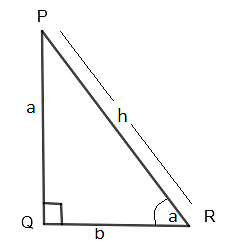
Here, we can say that cos a = adjacent/hypotenuse (hypotenuse is the longest side opposite to the right angle of triangle)
Cos a = QR/PQ
Cos a = base/height
Cos a = b/h
The cosine rule is associated with the lengths of the sides of a triangle with any of its angles being a cosine angle. By means of this, the length of the side of a triangle can be evaluated or the angle between the sides can also be measured.
Trigonometric Functions Detailed Video Explanation
Also Read: Trigonometric Functions
Laws of Cosine
[Click Here for Previous Year Questions]
Cosine rules in order to determine the length of the sides a, b and c of the triangle ABC can be represented by:
- a2 = b2 + c2 – 2bc cos x
- b2 = a2 + c2 – 2ac cos y
- c2 = a2 + b2 – 2ab cos z

Cosine Rule Triangle
Likewise, to determine the angles x, y and z, the formulae can also be shown as:
- cos x = (b2 + c2 -a2)/2bc
- cos y = (a2 + c2 -b2)/2ac
- cos z = (a2 + b2 – c2)/2ab
Cosine Law Proof
The law of cosine implies, for a given triangle, say ABC that has sides a, b and c, we have;
c2 = a2 + b2 – 2ab cos C
Now, to prove the same, we have:
Consider that a triangle ABC is assigned. From the vertex of angle B, we can draw a perpendicular that touches the side AC at point D. It, thus, can be defined as the height of the triangle indicated by h.
In the triangle BCD, according to trigonometry ratio,
cos C = CD/a [\(\therefore\) cos θ = Base/Hypotenuse]
It can also be expressed as:
CD = a cos C … (1)
Now, after we subtract equation 1 from side b on both sides,
b – CD = b – a cos C
or DA = b – a cos C
Now, in triangle BCD, we can see:
sin C = BD/a [\(\therefore\)sin θ = Perpendicular/Hypotenuse]
It can also be expressed as:
BD = a sin C … (2)
By employing Pythagoras' theorem for the triangle ADB, we can obtain;
c2 = BD2 + DA2 [Hypotenuse2 = Perpendicular2 + Base2 ]
After replacing the value of DA and BD from equations 1 and 2, we see:
c2 = (a sin C)2 + (b – a cos C)2
c2 = a2 sin2C + b2 – 2ab cos C + a2 cos2 C
c2 = a2 (sin2C + cos2 C) + b2 – 2ab cos C
As per trigonometric identities, we know;
sin2θ+ cos2θ = 1
Hence,
c2 = a2 + b2 – 2ab cos C (Hence, proved).
Read More:
Cosine Formula
[Click Here for Sample Questions]
The formula to determine the sides of the triangle by using the cosine rule:
- \(\begin{array}{l}a = \sqrt{b^2 + c^2 – 2~b~c~ cos x}\end{array}\)
- \(\begin{array}{l}b = \sqrt{a^2 + c^2 – 2~a~c~ cos y}\end{array}\)
- \(\begin{array}{l}c = \sqrt{a^2 + b^2 – 2~a~b~cos z}\end{array}\)
What is Sine Formula?
According to sine law,
a/Sin A = b/ Sin B = c/Sin C
Here, a,b and c are the sides of a triangle and A, B and C are their respective angles.
It can also be expressed as:
a: b: c = Sin A: Sin B: Sin C
Cosine Formula Using Cofunction Identities
The cofunction identities express the relation between the cofunctions which are sin, cos; sec, cosec, tan, and cot. By using the cofunction identities,
- cos x = sin (90o - x) (OR)
- cos x = sin (π/2 - x)
Cosine Formulas Using Sum or Difference Formulas
The Cosine function of the sum/difference formulas include:
- cos(x + y) = cos (x) cos(y) – sin (x) sin (y)
- cos (x – y) = cos (x) cos (y) + sin (x) sin (y)
Cosine Formula of Double Angle
Cosine Formula of Double Angles can be illustrated as,
- cos 2x = cos2(x) – sin2(x)
- cos 2x = 2 cos2(x) − 1
- cos 2x = 1 – 2 sin2(x)
- cos 2x = [(1 - tan2x)/(1 + tan2x)]
Cosine Formula of Triple Angle
The triple angle formula of the cosine function can be shown as,
→ cos 3x = 4 cos3x - 3 cos x
Cosine Formula of Half Angle
In trigonometry, we also use half-angle formulas which are responsible to deal with half of the angles (x/2). Thus,
→ cos (x/2) =± √[ (1 + cos x) / 2]
Also Check: Right Angle Formula
Law of Cosines Applications
[Click Here for Previous Year Questions]
There are several applications of the Cosile Formula, including:
In Trigonometry
The Cosine Rule states that the square of the length of a side of a given triangle is equal to the sum of the squares of the length of the other sides minus twice the product of the other two sides multiplied by the cosine of the angle present between them.
According to cos law, it is used to find the missing sides of a right-angled triangle.
- a2 = b2 + c2 − 2bc.cosA
- b2 = a2 +c2 − 2ac.cosB
- c2 = a2 + b2 − 2ab.cosC
In Pythagorean Identity
One of the trigonometric identities establishes the relationship between sin and cos. It says, sin2x + cos2x = 1, for any x. We can use this method to solve for cos x.
Consider sin2x + cos2x = 1
Subtracting sin2x from both sides,
cos2x = 1 - sin2x
Taking square root on both sides,
cos x = ± √(1 - sin2x)
There are other important identities of cos as well. These are,
- cos2 (x) + sin2 (x) = 1
- cos θ = 1/sec θ
- cos (−θ) = cos (θ)
- arccos (cos (x)) = x + 2kπ [where k=integer]
- Cos (2x) = cos2 (x) − sin2 (x)
- cos (θ) = sin (π/2 − θ)
Cosine Table in Trigonometry
The cosine table lays down various values associated with different degrees of cos. It helps in arithmetic and geometric calculations.
| Cosine Degrees | Cos 0º | Cos 30º | Cos 45º | Cos 60º | Cos 90º | Cos 120º | Cos 150º | Cos 180º | Cos 270º | Cos 360º |
|---|---|---|---|---|---|---|---|---|---|---|
| Values | 1 | 3/2 | 1/2 | 1/2 | 0 | -1/2 | -3/2 | -1 | 0 | 1 |
Inverse Cosine Formula
[Click Here for Sample Questions]
This function is also known as Arccos and is denoted by cos−1.
For a right triangle, if the given sides are 1, 2, and √3, then the cos function can be effectively used to measure the angle.
cos of angle A, cos(a)= adjacent/hypotenuse.
So, cos(a) = √3/2
Now, the angle “a” will be cos−1(√3/2)
Or, a = π/6 = 30°
Cosine Properties With Respect to the Quadrants
The value of the cos function changes accordingly as the degree varies from 0 to 360. The values of cos are positive in the first and fourth quadrant, whereas they are negative in the second and third quadrant.
| Degree Range | Quadrant | Cos Function Sign | Cos Value Range |
|---|---|---|---|
| 0 to 90 Degrees | 1st Quadrant | + (Positive) | 0 < cos(x) < 1 |
| 90 to 180 Degrees | 2nd Quadrant | – (Negative) | -1 < cos(x) < 0 |
| 180 to 270 Degrees | 3rd Quadrant | – (Negative) | -1 < cos(x) < 0 |
| 270 to 360 Degrees | 4th Quadrant | + (Positive) | 0 < cos(x) <1 |
Things to Remember
- Cosine formula Indicates the lengths of the sides of a triangle with respect to the cosine of one of its angles.
- Cosine formula is also known as the Law of Cosines, the Cosine Rule and Al-Kashi’s Theorem.
- The Cosine formulas are, \(\begin{array}{l}a = \sqrt{b^2 + c^2 – 2~b~c~ cos x}\end{array}\), \(\begin{array}{l}b = \sqrt{a^2 + c^2 – 2~a~c~ cos y}\end{array}\) and \(\begin{array}{l}c = \sqrt{a^2 + b^2 – 2~a~b~cos z}\end{array}\).
- Cosine graphs help in finding out the average daily temperature of any location.
- The cosine graph is similar to that of the sine graph. It goes up and then goes down throughout.
Check Also:
Previous Year Questions
- ABCD is a trapezium such that AB and CD are parallel… [JEE Main – 2013]
- If the angles of elevation of the top of a tower from three collinear points… [JEE MAIN – 2015]
- Consider a triangular plot ABC with sides AB = 7m, BC=5m… [JEE MAIN – 2019]
- If the sum of all the solutions of the equation… [JEE MAIN – 2018]
- Let P={θ:sinθ−cosθ=2cosθ} and Q={θ:sinθ+cosθ=2sinθ} be two sets. Then:….[JEE MAIN 2016]
- If sinθ=1+t22t and ? lies in the second quadrant, then cosθ is equal to….[WBJEE 2011]
- Let tanα = a+1a and tanβ=2a+11 then α+β is..[WBJEE 2011]
- Let p,q and rr be the sides opposite to the angles P,Q and R, respectively…..[WBJEE 2012]
- If 0≤x<2π , then the number of values of x for which sinx − sin2x + sin3x = 0, is...[JEE ADVANCED 2019]
- The expression 1 − cot A tan A + 1 − tanA cot A can be written as...[JEE ADVANCED 2013]
Sample Questions
Ques. Determine the radius of the circle where a central angle of 60° intercepts an arc that is of the length 37.4 cm (Here, use π = 22/7). (3 marks)
Ans. As per the question given,
Arc length = l = 37.4 cm
Central angle = θ = 60° = 60π/180 radian = π/3 radians
We are aware,
r = l/θ
= (37.4) * (π / 3)
= (37.4) / [22 / 7 * 3]
= 35.7 cm
Therefore, the radius of the circle is 35.7 cm.
Ques. Why is the cosine function necessary? (2 marks)
Ans. The cosine function has primary use when it comes to our everyday life. People are dependent on the cosine and sine waves to be able to communicate through radio. They are even helpful in studying the electrical currents and tides. The effect of waves on buildings is designed using cosine graphs so as to be able to express wind and earth motion.
Ques. The adjacent side of the cosine of a right-angle triangle is 24cm. Hypotenuse measures about 30cm. What is the cosine angle of the triangle? (2 marks)
Ans. Given,
Adjacent side = 24 cm
Hypotenuse = 30 cm
cos θ = Adjacent/Hypotenuse
cos θ = 24 cm/30 cm
cos θ = 0.8
Ques. Calculate the angle in the given diagram. (2 marks)
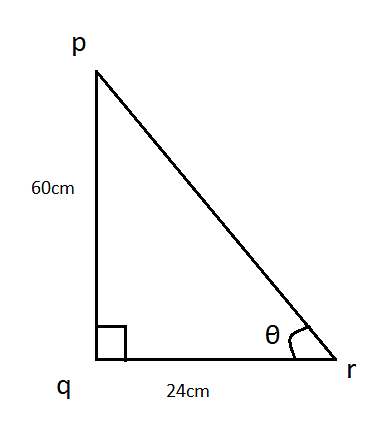
Ans. The equation can be solved by the help of the Pythagoras Theorem, thus:
PR = 242 + 602
PR = 576 + 3600
PR = 4176
PR = 64.6cm
Ques. In a right-angle triangle, the value of cos x = 6.4 units, length of hypotenuse = 20, what is the value of the base? (2 marks)
Ans. We know by formula that,
Cos x = base / hypotenuse
6.4 = base/ 20
6.4 x 20 = base
Base of the triangle = 128 units
Ques. A boy is stuck at the top of a burning building on fire. Rescuers put a ladder against the building which makes an angle of 60 degrees with the ground. The length of the ladder is 70ft. How far does the ladder lie from the wall? (2 marks)
Ans. We know from the cosine table that,
cos 60 degrees = ½
Here, the ladder will be considered as the hypotenuse
Therefore,
Cos x = base/ hypotenuse
½ = base/ 70
= 35 units
Ques. Find cos θ in the given triangle. (2 marks)
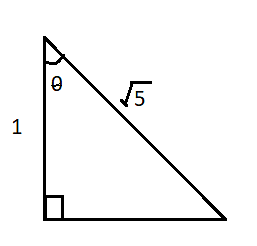
Ans. We know that
12+ b2=(√5)2
1 + b2 = 5
b = 4
b = 2
Therefore, cos θ = 1/√5 = √5/5
Ques. What is the value of cos 570° sin 510° + sin (-330°) cos (-390°)? (3 marks)
Ans. For LHS = cos (570)sin (510) + sin (- 330) cos (- 390)
= cos (570) sin (510) + [ – sin (330) ]cos (390) [Since, sin( – x ) = – sin x and cos( – x ) = cos x ]
= cos (570)sin(510) – sin (330)
= cos (90 * 6 + 30) sin (90 * 5 + 60) – sin (90 * 3 + 60) cos (90 * 4 + 30)
= – cos (30) cos (60) – [ – cos (60) ] cos (30)
= – cos (30) cos (60) + cos (30) sin (60)
hence,
= 0
Ques. Assume a triangle ABC, and prove that a sin (B – C) + b sin (C – A) + c sin (A – B) = 0. (4 marks)
Ans. For a triangle ABC:
a/sin A = b/sin B = c/sin C = k
- a = k sin A
- b = k sin B
- c = k sin C
Thus, for LHS,
= a sin (B – C) + b sin (C – A) + c sin (A – B)
= k sin A [sin B cos C – cos B sin C] + k sin B [sin C cos A – cos C sin A] + k sin C [sin A cos B – cos A sin B]
= k sin A sin B cos C – k sin A cos B sin C + k sin B sin C cos A – k sin B cos C sin A + k sin C sin A cos B – k sin C cos A sin B
= 0
= RHS
Hence,
LHS = RHS.
Thus, a sin (B – C) + b sin (C – A) + c sin (A – B) = 0.
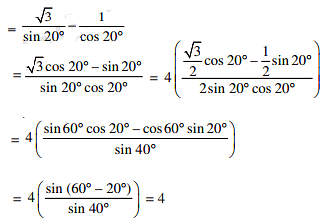
Ques. Determine the value of √3 cosec 20° – sec 20°. (4 marks)
Ans. √3 cosec 20° – sec 20°
For Latest Updates on Upcoming Board Exams, Click Here: https://t.me/class_10_12_board_updates
Also Check:



Comments