



Content Curator
Lithium Bromide is a compound of lithium and bromide which is ionic in nature. Lithium Monobromide formula or Bromo Lithium formula are the other names from which the Lithium Bromide formula is known. In the lithium salt the counterion is bromide. The anhydrous salt of lithium bromide leads to formation of cubic crystals which are identical to Sodium chloride i.e., normal salt. It then becomes a bromide salt as well as lithium salt. This compound is preferable for desiccant in the air conditioning systems, because it is extremely hygroscopic.
Also Read: Sodium Bromide
| Table of Content |
Key Terms: Catalyst, hydroformylation, hygroscopic, ionic bond, anion, catalytic dehydrohalogenation, organic solvents, alkali metal, aqueous solution
Lithium Bromide
[Click Here for Sample Questions]
Lithium Bromide is a lithium salt which includes counterion bromide. The anhydrous salt leads to formation of cubic crystals. These cubic crystals are similar to common salt. The chemical formula for Lithium Bromide is LiBr. It is synthesised by treating lithium carbonate with hydrobromic acid. In this process, hydrobromic acid and lithium hydroxide precipitate lithium bromide when they are in the presence of water.
Structure of Lithium Bromide
[Click Here for Sample Questions]
An ionic bond is formed in lithium bromide by transferring an electron from lithium to bromine. Because lithium donates an electron, it gets a positive charge i.e., L+ and forms a cation. On the other hand, the bromine accepts an electron and forms an anion. Therefore, it gets a negative charge i.e., Br-. The crystal structure of lithium bromide is cubic.
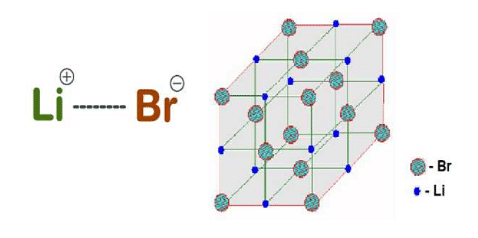
Structure of Lithium Bromide
Also Read: Classification of Organic Compounds
Characteristics of Lithium Bromide
[Click Here for Sample Questions]
The physical and chemical characteristics of Lithium Bromide are as follows:
- The chemical formula for lithium bromide is LiBr.
- The molecular weight of lithium bromide is 86.845 g/ mol.
- The boiling point of lithium bromide is 1,265 °C, whereas the melting point is 552 °C.
- The density of lithium bromide is 3.464 g/ cm3.
- Lithium bromide is a hygroscopic white solid.
- This compound is soluble in water. The solubility of lithium bromide increases in water as the temperature starts increasing.
- Lithium Bromide is inflammable.
- Polar organic compounds like cellulose can dissolve in lithium bromide.
- The nature of this compound is stable and it does not react easily.
- It is anhydrous and hence it leads to formation of cubic crystals like NaCl.
- Reaction of chlorine with lithium bromide reacts with the chlorine molecules which in turn forms lithium chloride salt as well as bromine gas. The reaction is as follows:
Cl2 + 2LiBr \(\rightarrow\) Br2 + 2LiCl
When lithium bromide reacts with silver nitrate, it forms lithium nitrate and silver bromide.
How is Lithium Bromide produced?
[Click Here for Sample Questions]
Lithium Bromide is produced by many methods. Some of those most commonly used methods are as follows:
- The lithium bromide can be produced by the reaction of lithium carbonate and hydrobromic acid. The reaction for the same are as follows:
Li2CO3 + 2HBr → 2LiBr + H2CO3
- The lithium bromide can also be produced by the reaction of lithium hydroxide with aqueous solution hydrogen bromide or hydrobromic acid as it is commonly called. The reaction for the same is given below:
LiOH + HBr → LiBr + H2O
Uses of Lithium Bromide
[Click Here for Sample Questions]
The uses of Lithium Bromide can be seen in many fields. Some of its uses are as follows:
- The most common use of Lithium Bromide is in air conditioning machines. It is used as a desiccant in air conditioners, because it is hygroscopic in nature. Lithium bromide is used with water which leads to chilling in air conditioners.
- It is utilised in the synthesis of many organic compounds.
- Lithium Bromide can be used in pharmaceuticals in the synthesis of many drugs in the industry.
- Inorganic compounds such as lithium chloride can be produced by using lithium bromide.
- To treat bipolar disorder, lithium chloride and lithium bromide are used.
- In synthesis of olefins for catalytic dehydrohalogenation, lithium bromide is used.
- In refrigerators, it is used as a non-CFC alternative because of its hygroscopic nature. Lithium Bromide can easily absorb excess vapour. Therefore, it makes the mechanism environment friendly.
- In emulsions, lithium bromide is used as a soluble in ether and other organic solvents.
Things to Remember
- Lithium Bromide is a compound which is made up of Lithium and Bromide and is ionic in nature.
- Lithium Bromide is also known as Lithium Monobromide or Bromolithium.
- An ionic bond is formed in lithium bromide by transferring an electron from lithium to bromine. Because lithium donates an electron, it gets a positive charge i.e., L+ and forms a cation.
- The lithium bromide is used in air conditioner machines as desiccant. It helps to lower down the temperature and gives a chilling effect.
- Lithium donates an electron and gets a positive charge i.e., L+ and forms a cation. The bromine accepts an electron and forms an anion in the compound. Therefore, it gets a negative charge i.e.,Br-. Therefore, the crystal structure of lithium bromide is cubic.
Also Read: Periodic Classifications of Elements
Sample Questions
Ques. Describe how Lithium Bromide is formed. (4 marks)
Ans. Lithium Bromide consists of lithium and bromine and it is an ionic compound. Lithium has 3 electrons and is an alkali metal. Lithium has 1 electron in its valence shell, because its electronic configuration is 2,1. Bromine has 35 electrons in a single atom and is a non-metal. The electronic configuration of bromine is 2,8,1,8,7. Hence, it has 7 electrons in the valence shell. Because lithium donates an electron, it gets a positive charge i.e., L+ and forms a cation. On the other hand, the bromine accepts an electron and forms an anion. Therefore, it gets a negative charge i.e., Br-. And this is how Lithium Bromide i.e., LiBr is formed.
Ques. What is the most important quality of Lithium Bromide? (3 marks)
Ans. Hygroscopic properties are the most important qualities of lithium bromide. Hygroscopic is a substance which is able to attract water molecules through absorption easily. With the help of the surrounding environment, this process can be completed. It usually occurs only at room temperature. This is the reason you see lithium bromide has widely been used as a desiccant. It absorbs the moisture from surroundings.
Ques. Why is lithium bromide used in air conditioners? (2 marks)
Ans. Lithium bromide is an ionic compound which is used in air conditioners because it has desiccant properties. The key factor about using lithium bromide is its ability to remove moisture from the surrounding environment which in result gives a cooling effect. This happens because of the hygroscopic nature of lithium bromide.
Ques. In a lithium bromide VAR system, which refrigerant is used? (3 marks)
Ans. A solution of lithium bromide in water is used in the lithium bromide absorption refrigeration system. Lithium bromide is a highly hygroscopic salt which is used as an absorbent, on the other hand water is being used as refrigerant. Because of its very low vapour pressure, the lithium bromide solution has a strong affinity for water vapour.
Ques. What do you mean by Desiccants? (3 marks)
Ans. We need an environment which is humidity free in various conditions. Packaged food products, conditioning of room temperature by the use of air conditioners or manufacturing a wide range of products all of these need an environment which is free from water. Desiccants are the substances which are used for absorbing any vapour in the atmosphere like lithium bromide or silica gels.
Ques. List down the properties of Lithium bromide? (4 marks)
Ans. The properties of compound Lithium Bromide are listed below:
- The chemical formula for lithium bromide is LiBr.
- The molecular weight of lithium bromide is 86.845 g/ mol.
- The boiling point of lithium bromide is 1265C, whereas the melting point is 552﮿C.
- The density of lithium bromide is 3.464 g/ cm3.
- The most important property of lithium bromide is that it is hygroscopic in nature. Hence, used mostly in air conditioners as a desiccant.
- This compound is soluble in water. The solubility of lithium bromide increases in water as the temperature starts increasing.
- Lithium Bromide is inflammable.
Ques. What are the methods to prepare lithium bromide? (4 marks)
Ans. There are two different methods to prepare lithium bromide. First is by the reaction of lithium carbonate with an aqueous solution of hydrobromic acid. The chemical representation of the reaction is as follows:
Li2 CO3 + 2HBr ⶠ2LiBr2 + H2CO3
And the second method by which the lithium bromide can be prepared is by the reaction of lithium hydroxide with aqueous solution hydrogen bromide or hydrobromic acid. The reaction for that is given below:
LiOH + HBr ⶠLiBr + H2O
Ques. How to find the mass of 4.8 mol of lithium bromide ? (4 marks)
Ans. Given: Moles of lithium bromide = 4.8
Mass of 4.8 moles of lithium bromide = ?
Chemical formula of lithium bromide = LiBr
From the chemical formula we can understand that the lithium bromide is made up of two elements Lithium and Bromide.
Molar mass of Li = 7g/ mol
Molar mass of Br = 80g/ mol
Therefore,
Molar mass of LiBr = (7+8)g/ mol
= 87g/ mol
Now,
No. of moles = Given mass/ Molar mass
Mass= No of moles Molar mass
Mass = 4.8 87
Mass = 417.6 g
Hence, the mass of 4.8 moles of lithium bromide is 417.6 g.
Ques. Lithium Bromide is soluble in water. Justify the statement is true or false. (2 marks)
Ans. This compound is soluble in water. The solubility of lithium bromide increases in water as the temperature starts increasing. Lithium bromide is soluble in amyl alcohol, ether and glycol as well. 1 gram of lithium bromide is soluble in 1.3 ml of cold water and 0.8 ml of boiling water. The solubility of lithium bromide is highly dependent on the temperature of water.
Ques. What are the uses of lithium bromide in the industry? (3 marks)
Ans. Lithium bromide is used in various ways in the industry. It is mostly used in air conditioners as a desiccant. It is utilised in the synthesis of many organic compounds. Lithium Bromide can be used in pharmaceuticals in the synthesis of many drugs in the industry. Inorganic compounds such as lithium chloride can be produced by using lithium bromide. Apart from this, to treat bipolar disorder, lithium chloride and lithium bromide are used.
Read Also:



Comments