



Content Writer
Open Circulatory System is part of the Circulatory System where blood directly suffuses throughout the body. It may be directly open to the environment, such as the digestive tract.
- Open Circulatory System make use of hemolymph instead of blood.
- Hemolymph functions as a blood, lymph, and intestinal fluid.
- The circulatory system is developed as multicellular organisms cannot exchange the material directly with the environment.
- They are efficient in transporting nutrients like oxygen and wastes like carbon dioxide throughout their bodies.
- The Open circulatory system pumps blood into a cavity called a hemocoel.
- The system surrounds the organs and returns to the heart through the ostia pathway, a form of opening.
| Table of Content |
Key Terms: Open Circulatory System, Circulatory System, Oxygen, Carbon Dioxide, Blood, Human Body, Nutrients, Organs, Hemolymph, Hormones, Cells, Organisms, Blood Vessels
Open Circulatory System
[Click Here for Sample Questions]
The open circulatory system is the type of circulatory system in which there are no blood vessels to carry out the function of blood transportation throughout the body of the organism.
- The organs and tissues in the bodies of the organisms are directly fed with blood.
- The blood flows directly through the cavities; hence, the role of the blood vessels is neutralized in the open circulatory system.
- Since no blood vessels are involved in the open system, there is no difference between the blood and the interstitial fluid.
- However, the heart has an active role to play in this type of circulatory system.
The heart directly pumps the hemolymph into the cavity called hemocoel, and it is transported to the cells that surround the organs so that the material is transported.
- The hemolymph travels back to the heart through the ostia.
- The ostia closes during the contraction of the heart.
- This type of blood circulatory system is found in arthropods.
- There is no exchange of gases in this type of circulatory system.
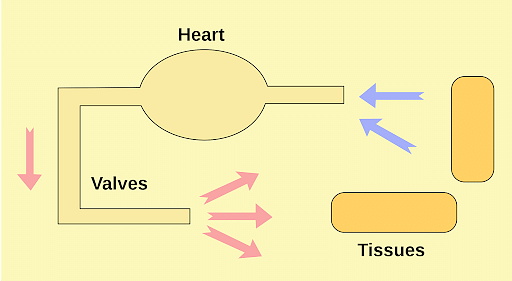
Open Circulatory System
Also Read:
| Related Articles | ||
|---|---|---|
| Pollination | Polyembryony | Reproduction |
| Sporulation | Apomixis | Asexual Reproduction |
Circulatory System
[Click Here for Sample Questions]
The circulatory system is responsible for the circulation of material such as amino acids and electrolytes, oxygen and carbon dioxide, and hormones through the body of these organisms.
- The circulatory system also carries the blood cells that help in providing nutrition to the cells in the body.
- It strengthens the immune system of an individual.
- This system is also named the cardiovascular system or the vascular system.
It includes the following essential components:
- Blood
- Heart
- Blood Vessels (veins and capillaries)
The blood circulatory system in organisms includes the lymphatic system that helps transport lymph in the body.
- Both systems work differently in the bodies of living organisms.
- The two major types of circulatory systems are the Open Circulatory System and the Closed Circulatory System.
Example of Circulatory SystemExample: For example, humans and other vertebrates have the Closed Circulatory System to circulate blood (consisting of different materials) through defined channels like arteries, veins, and capillaries. Some invertebrates have an Open Circulatory System like some insects and certain mollusks. |

Functions of Open Circulatory System
[Click Here for Sample Questions]
The functions of the Open Circulatory System are as follows:
- The Open Circulatory System is used for transporting oxygen, which is necessary for cellular respiration.
- The system helps fight against infection by transporting immune cells to any area of the body.
- It sends messages between cells, which include signalling hunger, thirst, oxygen deprivation, or other bodily needs.
- The system helps in removing excess material from the body.
Advantages of Open Circulatory System
[Click Here for Sample Questions]
The advantages of an Open Circulatory System are as follows:
- Open Circulatory System requires less energy for distribution in the body compared to Closed Circulatory System.
- There is no urgency to restore balance between the system.
- The processing of oxygen and carbon dioxide is done through different systems.
- It consists of specialized cells that perform the trade and communication upon which the survival of an organism depends.
Hemolymph
[Click Here for Sample Questions]
The hemolymph is plasma that mostly contains (water, organic compounds, and some inorganic salts, for example, Na+, Cl-, K+, Mg2+, and Ca2+). It is directly pumped into the cavity, and the material in it is directly exchanged between the blood and the cells of the body.
- Hemocytes are also present in the hemolymph as the free-floating cells.
- It plays a function in the immune system.
- Hemolymph contains high levels of free amino acids.
- It helps in the functioning of chroma proteins, protease inhibitors, enzymes and lipid transport.
Things to Remember
- The open circulatory system is the type of circulatory system in which there are no blood vessels found in the body.
- Since there are no vessels to conduct the blood, as a result, blood flows freely through cavities.
- This type of system is mainly found in molluscs and arthropods.
- An open circulatory system prohibits the exchange of gases between cells of the organisms.
- The interstitial fluid contains all materials like water, sugar, hormones, fatty acids, salts and other enzymes.
- Living beings are efficient in transporting nutrients, gases like oxygen, and wastes like carbon dioxide throughout their bodies.
Also Read:
Sample Questions
Ques. What is a circulatory system? Discuss the role played by the circulatory system in the bodies of living organisms? (2 marks)
Ans. The circulatory system is responsible for the circulation of the material such as amino acids and electrolytes, oxygen and carbon dioxide, and hormones through the body of these organisms. The circulatory system also carries the blood cells that help in providing nutrition to the cells in the body and strengthen its immune system.
Ques. Explain: (A) What are the two major types of the circulatory system
(B) Discuss the function of the open circulatory system in the bodies of living organisms? (2 marks)
Ans. (A) The two major types of circulatory systems are open circulatory system and closed circulatory system.
(B) The open circulatory system helps in circulation of the arthropods. No blood vessel is involved in this type of system.
Ques. What is hemolymph? What is its function in the open circulatory system? (3 marks)
Ans. Hemolymph is a plasma which helps in exchange of nutrients from blood to cells. It also contains free floating hemocytes working as immunity.
- Hemolymp is used in transporting oxygen via the tracheal system.
- It is blue-green which does not contain any Haemoglobin.
- The system is directly connected with the tissues and lubricates them.
- It contain copper-based haemocyanin which gives haemolymph its colour.
Ques. What are hemocytes and their function? (3 marks)
Ans. Hemocytes are present in the hemolymph as the free-floating cells and play a function in the immune system. They are immune effector cells that help in phagocytosis, encapsulation, and clotting.
- Hemocytes are involved in synthesizing antimicrobial peptides after going through immune challenge.
- They act as a mediator between systemic immune responses.
- They help in circulating clear fluid within the plasma.
Ques. Give some examples of the organisms having the open circulatory system? (1 mark)
Ans. Arthropods and molluscs have an open circulatory system. Some of the common examples are bees, centipedes, flies etc.
Ques. What is the difference between open and closed circulatory system? (3 marks)
Ans. The difference between open and closed circulatory system are as follows:
| Open Circulatory System | Closed Circulatory System |
|---|---|
| Open Circulatory System have blood pumped into the cavity. | Closed Circulatory System have blood pumped through the heart. |
| In this nutrients are exchanged between tissues and blood | In this nutrients are exchanged between tissues fluid. |
| The system does not have capillary system. | The system have capillary system. |
Ques. What are the functions of circulatory system? (3 marks)
Ans. The functions of circulatory system are as follows:
- The circulatory system is used for circulating blood throughout the body.
- It helps in removing toxic and hazardous waste from the body.
- The system is responsible for providing cells with the required nutrients.
- It acts as a shield to the body by protecting it against infection and disease.
Ques. What type of circulatory system is found in human beings? (2 marks)
Ans. All human beings contain a closed circulatory system as in this type of system, blood is enclosed in the vessels and heart while circulating. In the human body, blood flows unidirectionally, which means it goes from the heart to the required route and returns back to the heart only. It is helpful in delivering required oxygen and nutrients to different parts of the body.
Ques. What are the components of circulatory system? (3 marks)
Ans. The three main components of circulatory system are as follows:
- Heart: Heart is a type of muscular organ that is responsible for pumping blood throughout our body.
- Blood Vessels: Blood Vessels include arteries, veins and capillaries that is used for carrying water, nutrients, hormones, and other relevant material for the proper metabolism of the body
- Blood: Blood is made up of red and white blood cells, plasma and platelets that act as the specialized cells which are embedded in plasma.
Ques. What are the disorders that affect the open circulatory system? (2 marks)
Ans. The disorders that affect the open circulatory system are as follows:
- High blood pressure
- Cholesterol
- Diabetes
- Plaque Deposits
- Venous disease
- Aneurysms
Ques. What are the disadvantages of open circulatory system? (3 marks)
Ans. The disadvantages of open circulatory system are as follows:
- The delivery of oxygen in another part of the body is not rapid as compared to a closed circulatory system.
- The level of activity is limited.
- An open circulatory system is not feasible in larger animals.
For Latest Updates on Upcoming Board Exams, Click Here: https://t.me/class_10_12_board_updates
Check-Out:



Comments