



Content Curator
Molecular Weight is the sum of all atoms in a molecule. Molecular weight is represented in the atomic mass unit (amu or u). It tells us the number of grams of a substance is present in one mole of that compound. Molecular weight is based on the scale in which the atomic mass of Hydrogen, Oxygen, nitrogen and carbon are 1, 16, 14 and 1.
| Table of Content |
Key Terms: Molecular Weight, Atomic Mass, Molar Mass, Molar mass of oxygen, Noah Molar mass
Molecular Formula
[Click Here for Sample Questions]
Molecular formula calculates the atoms present and the number of those atoms present in a molecule. It is the formula which shows the actual number of each atom in a molecule.
The Molecular Formula is calculated by the empirical formula, when the molar mass value is known. The empirical formula is often the same as a molecular formula or an exact multiple of it.
For Example. Molecular formula of oxygen is O2 and Carbon is C4.

Molecules
Calculation of Molecular Weight
[Click Here for Sample Questions]
Molecular weight of an element can be calculated by multiplying the number of every type of atom present in a molecule by the atomic weight and adding the weights of other atoms. For
Example, the molecular weight of NaCl can be calculated as-
Molecular Weight of Na = 23
Molecular Weight of Cl = 35
No. of Na molecules = 1
No. of Ca molecules = 1
Hence, the total molecular weight of NaCl = 23(1) + 35(1) = 58
There are various ways with which one could calculate the molecular weight-
- Mass Spectrometry
- Hydrodynamic Method
- Static Light Scattering
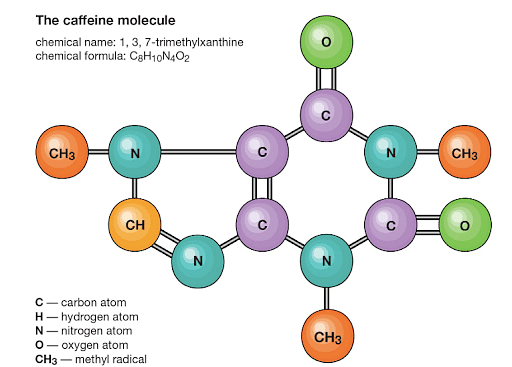
Caffeine Molecule Example
Also Read:
Difference Between Molecular Weight and Molar Mass
[Click Here for Sample Questions]
Molecular weight is the force acting on a molecule with a certain molar mass. As the molecules are very tiny, this force applied is also very minute.Therefore, molar mass and molecular weight are often used interchangeably. More differences between molecular mass and Molecular weight are-
| Parameters | Molar Mass | Molecular weight |
|---|---|---|
| Definition | Molar mass is the mass of a mole of a particular substance. | Molecular weight is the mass of a molecule. |
| Unit | Kgmol-1 or kg/mol | Unitless but is given as amu or (atomic mass units) |
| Calculation | Calculated by dividing the mass of a substance by the amount of the substance. | Calculated as the mass of substance relative to the 1/12th of the mass of carbon -12 atoms. |
Things To Remember
- Sum of the atomic masses of all the atoms in a molecule is called the molecular mass or molecular weight.
- One atomic mass unit is 1/12th the weight of the carbon-12 isotope. It is represented as ‘amu or u’.
- Formula unit mass is calculated for substances that have constituent elements as ions. It is calculated just like the molecular mass.
- For any molecule, the representation of the atoms present in it along with the number of these atoms is called the molecular formula.
Sample Questions
Ques. Calculate the molecular masses of H2O and HNO3. (3 marks)
Ans. Atomic mass of hydrogen (H) = 1 u
Atomic mass of O = 16 u
Atomic mass of N = 14 u
- Molecular mass of H2O = (2 × atomic mass of H) + atomic mass of O = (2 × 1) + 16 = 2 + 16 = 18 u
- Molecular mass of HNO3 = atomic mass of H + atomic mass of N + (3 × atomic mass of O) = 1 + 14 + (3 × 16) = 15 + 48 = 63 u
The molecular masses of H2O and HNO3 are 18 u and 63 u respectively.
Ques. Calculate the formula unit masses of CaCl2. (3 marks)
Ans. Atomic mass of Cl = 35.5
Atomic mass of Ca = 40
Formula unit of CaCl2 = atomic mass of Ca + (2 × atomic mass of Cl) = 40 + (2 × 35.5) = 40 + 71 = 111 u
So, the formula unit mass of CaCl2 is 111 u respectively.
Ques. What is the molecular weight of an element? (1 mark)
Ans. Molecular weight of an element is the mass of 1 mole of an element.
Ques. Calculate the molecular masses of H2, Cl2, O2, CO2, NH3, CH4, C2H4 and CH3OH. (5 marks)
Ans. Atomic mass of H = 1 u
Atomic mass of Cl = 35.5 u
Atomic mass of O = 16 u
Atomic mass of N = 14 u
Atomic mass of C = 12 u
- Molecular mass of H2 = 2 × atomic mass of H = 2 u
- Molecular mass of Cl2 = 2 × atomic mass of Cl = 71 u
- Molecular mass of O2 = 2 × atomic mass of O = 32 u
- Molecular mass of CO2 = atomic mass of C + (2 × atomic mass of O) = 12 + (2 × 16) = 12 + 32 = 44 u
- Molecular mass of NH3 = atomic mass of N + (3 × atomic mass of H) = 14 + (3 × 1) = 14 + 3 = 17 u
- Molecular mass of CH4 = atomic mass of C + (4 × atomic mass of H) = 12 + (4 × 1) = 12 + 4 = 16 u
- Molecular mass of C2H4 = (2 × atomic mass of C) + (4 × atomic mass of H) = (2 × 12) + (4 × 1) = 24 + 4 = 28 u
- Molecular mass of CH3OH = atomic mass of C + (4 × atomic mass of H) + atomic mass of O = 12 + (4 × 1) + 16 = 28 + 4 = 32 u
Ques. Calculate the formula unit masses of Na2O, ZnO and K2CO3. (3 marks)
Ans. Atomic mass of Na = 23
Atomic mass of O = 16
Atomic mass of Zn = 65
Atomic mass of K = 39
Atomic mass of C = 12
- Formula unit mass of Na2O = (2 × atomic mass of Na) + atomic mass of O = (2 × 23) + 16 = 62 u
- Formula unit mass of ZnO = atomic mass of Zn + atomic mass of O = 65 + 16 = 81 u
- Formula unit mass of K2CO3 = (2 × atomic mass of K) + atomic mass of C + (3 × atomic mass of O) = (2 × 39) + 12 + (3 × 16) = 138 u
Ques. Calculate the molar mass of these substances: sulphur molecule, phosphorus molecule,ethyne and hydrochloric acid. (4 marks)
Ans. Atomic mass of C = 12
Atomic mass of H = 1
Atomic mass of S = 32
Atomic mass of P = 31
Atomic mass of Cl = 35.5
- Molar mass of ethylene, C2H2 = (2 × atomic mass of C) + (2 × atomic mass of H) = (2 × 12) + (2 × 1) = 24 + 2 = 26 g/mol
- Molar mass of sulphur molecule, S8 = 8 × atomic mass of S = 8 × 32 = 256 g/mol
- Molar mass of phosphorus molecule, P4 = 4 × atomic mass of P = 4 × 31 = 124 g/mol
- Molar mass of hydrochloric acid, HCl = atomic mass of H + atomic mass of Cl = 1 + 35.5 = 36.5 g/mol
Ques. How to calculate the molecular weight of a molecule? (3 marks)
Ans. The molecular weight is the sum of the atomic masses of all the elements present in a molecule. And the information regarding which atoms are present and in what number of those atoms are present in any molecule can be known from its molecular formula. So, the molecular weight can be calculated with the knowledge of the molecular formula of the molecule and the atomic masses of the elements present in it.
Ques. What is the difference between atomic mass and molecular weight? (5 marks)
Ans. Atomic mass is the sum of the masses of all the atomic units of an atom. It is calculated as the sum of the masses of protons and neutrons in an atom. Whereas the molecular mass is the sum of the atomic masses of all the elements in a molecule. More differences between Atomic mass and Molecular weight is-
| Parameters | Atomic Mass | Molecular Weight |
|---|---|---|
| Definition | Atomic mass is simply the mass of an atom. | Molecular weight is the collection of weights of all the atoms in a molecule. |
| Nature of value | Direct value (without considering the atomic masses of isotopes). | Average Value (considering atomic mass of isotopes as well) |
| Determination | Adding the masses of neutrons, electrons and protons of an atom. | Adding the average masses of atoms in the molecule |
| Unit | Amu (Atomic Mass Unit) | g/mol |
| Chemical Species | Gives the mass of atoms. | Gives the mass of molecules. |
Also Read:



Comments