NCERT Solutions For Class 11 Biology Chapter 4: Animal Kingdom

Collegedunia Team logo

Collegedunia Team

Content Curator

NCERT Solutions for Class 11 Biology Chapter 4 Morphology of Animal Kingdom are provided in this article. It covers all the important definitions, concepts, and methodologies that will be really beneficial for the students appearing for CBSE Class 11 Exam 2022-23. The important topics that are included in this chapter are:

​Expected no. of Questions: 2-3 questions of around 4 marks.

Download PDF: NCERT Solutions for Class 11 Biology Chapter 4 Animal Kingdom


NCERT Solutions for Class 11 Biology Chapter 4


Class 11 Biology Chapter 4 Animal Kingdom: Important Topics

The Animal Kingdom is a diverse group of organisms that share certain characteristics. Kingdom Animalia consists of organisms that range from the simplest of animal forms to the most complex. Some members of this kingdom seem like they would fit in elsewhere, like sponges or coral. The Animal Kingdom is the largest of all kingdoms with more than one million species.

  • Classification of Animal Kingdom

Taxonomy is the science of classifying organisms. Every species that discovered so far can be classified into five kingdoms – one among them is Kingdom Animalia or Animal kingdom. The members of kingdom Animalia, based on certain identifiable characteristic features, are further classified into different PhylaClass, Order, Family, and Genus.

Chapter Related Links:

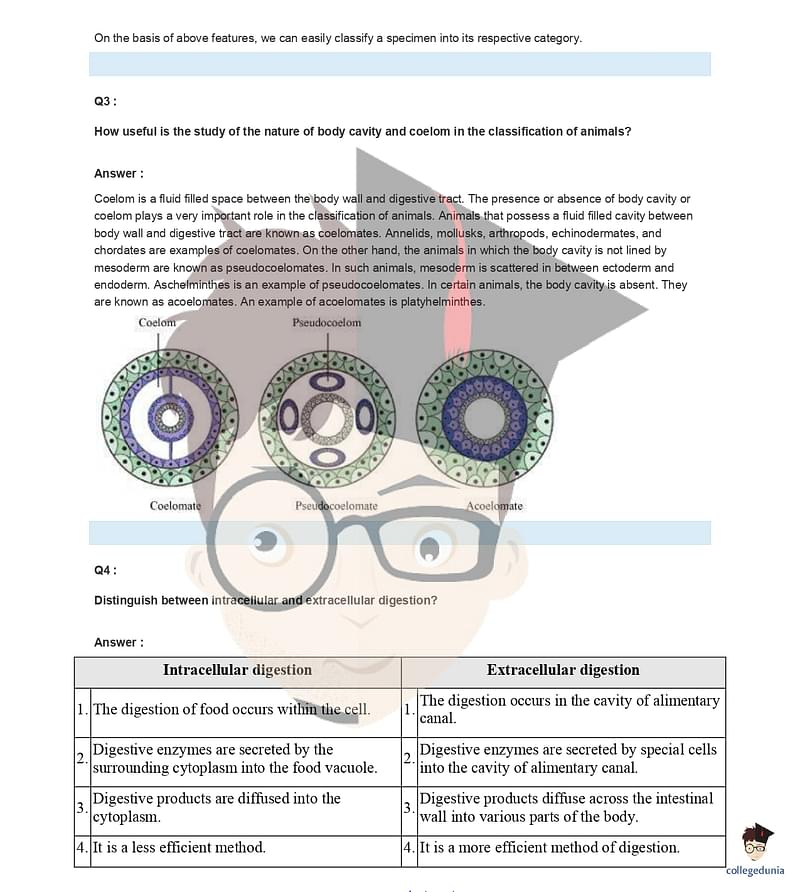
Coelom Phylum – Aschelminthes Phylum – Hemichordata
Class – Chondrichthyes Class – Osteichthyes Zoology
Classification of Animal Kingdom Living Fossil Difference Between Frog and Toad

CBSE Class 11 Biology Study Guides:

CBSE CLASS XII Related Questions

  • 1.
    In vitro fertilization (IVF) is a popular method these days that is helping childless couples to bear a child.
    Write the different steps that are carried out in this technique.
    Would you consider gamete intra fallopian transfer as a type of IVF? Justify your answer.


      • 2.
        Work out the crosses between:
        Normal female and Haemophilic male
        Carrier female and Normal male
        (III) Carrier female and Haemophilic male
        Write the conclusions you draw from these crosses. Comment on the type of inheritance of the disease.
        (Use: $X$ - Normal, $X^h$ - Haemophilic)


          • 3.
            Describe the series of experiments conducted by Frederick Griffith. Comment on the significance of the result obtained.
            State the contribution of Avery, MacLeod and McCarty.


              • 4.
                Draw a labelled two-celled structure of male gametophyte of an angiosperm.
                Name the three layers that surround the cytoplasm of a male gametophyte starting from innermost to outermost layer.
                (iii) Which organic material makes the outermost layer? Mention its advantage.
                (iv) Why is the outermost layer of male gametophyte not continuous ?


                  • 5.
                    Explain any two basic principles/core techniques on which biotechnology is based.
                    Describe any three key tools used in Recombinant DNA technology.


                      • 6.
                        What is meant by translation in protein synthesis?
                        Explain charging of tRNA (aminoacylation of tRNA) and mention its importance in the process of translation.

                          CBSE CLASS XII Previous Year Papers

                          Comments


                          No Comments To Show