NCERT Solutions for class 11 Physics Chapter 8: Gravitation

NCERT Solutions for Class 11 Physics Chapter 8: Gravitation covers concepts of Kepler’s Planetary Laws of Motion, Newton’s Law of Gravitation, Acceleration Due to Gravity, and its variation. Gravity, also known as Gravitational Force, is the universal force of attraction that helps to keep things together.

Class 11 Physics Chapter 8 Gravitation along with Unit 4 Work, Energy, and Power and Unit 5 Motion of System of Particles and Rigid Body has a weightage of 17 marks in the Class 11 Physics Examination. Gravity is the force that holds us onto the Earth and does not let us fly up into space. Although we barely think about it in our daily lives Gravity is essential to keep the systems operating on the Earth and the Universe.

Download PDF: NCERT Solutions for Class 11 Physics Gravitation


NCERT Solutions for Class 11 Physics Chapter 8

NCERT SolutionsNCERT SolutionsNCERT SolutionsNCERT SolutionsNCERT SolutionsNCERT SolutionsNCERT SolutionsNCERT SolutionsNCERT SolutionsNCERT SolutionsNCERT SolutionsNCERT SolutionsNCERT SolutionsNCERT SolutionsNCERT SolutionsNCERT SolutionsNCERT SolutionsNCERT SolutionsNCERT SolutionsNCERT SolutionsNCERT SolutionsNCERT SolutionsNCERT SolutionsNCERT SolutionsNCERT SolutionsNCERT SolutionsNCERT Solutions

Class 11 Physics Chapter 8 – Basic Concepts

  • Kepler’s Laws of Planetary Motion: Kepler formulated three laws to describe planetary motion – Law of Orbits, Law of areas, and Law of periods.

1. Law of orbits: All the planets revolve around the sun in an elliptical orbit with the sun being at one of the foci of the ellipse.
2. Law of areas: The speed of a planet varies such that its radius, the vector drawn from the sun to the planet sweeps out equal areas in equal intervals of times.​
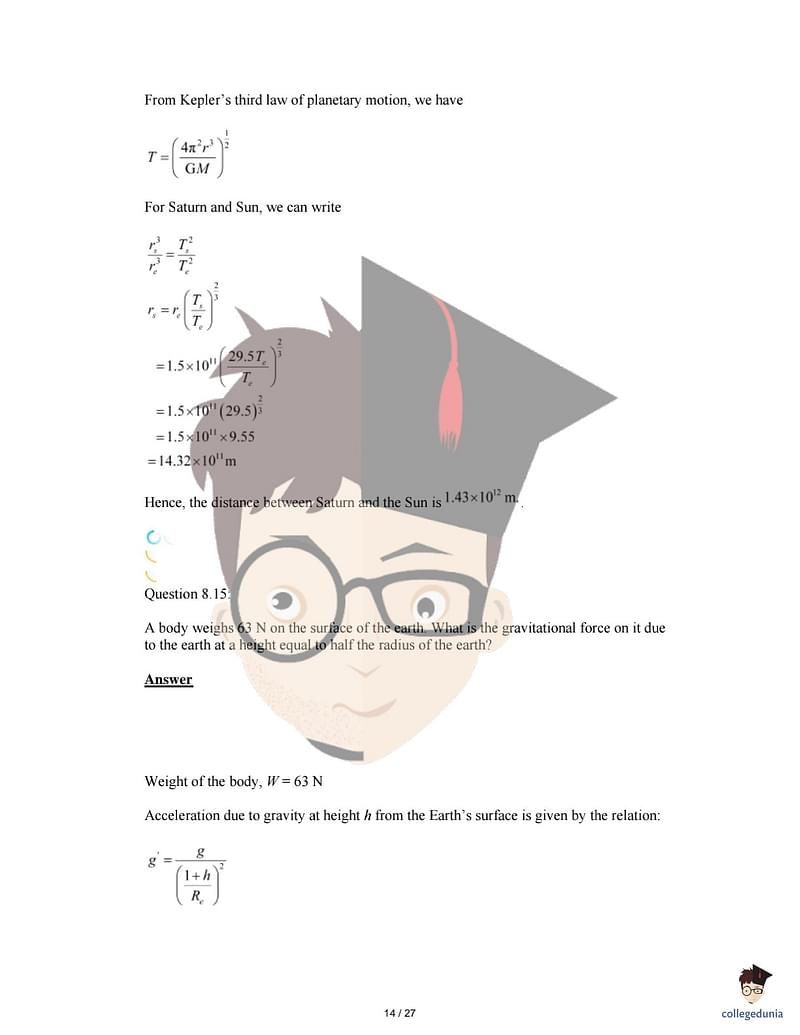
3. Law of Periods: The square of the time period of revolution of a planet is proportional to the cube of the semi-major axis of the elliptical orbit. \(T^2 \propto r^3\) 

  • Newton’s law of gravitation states that each particle in the universe attracts another particle with a force that is directly proportional to the product of their masses. It is also inversely proportional to the square of the distance that exists between them. 
\(F_g = {Gm_1m_2 \over r^2}\)
  • The gravitational potential is the amount of work done in bringing a body with unit mass from infinity to a point in the gravitational field of a body.
V = \(-GM \over R\)
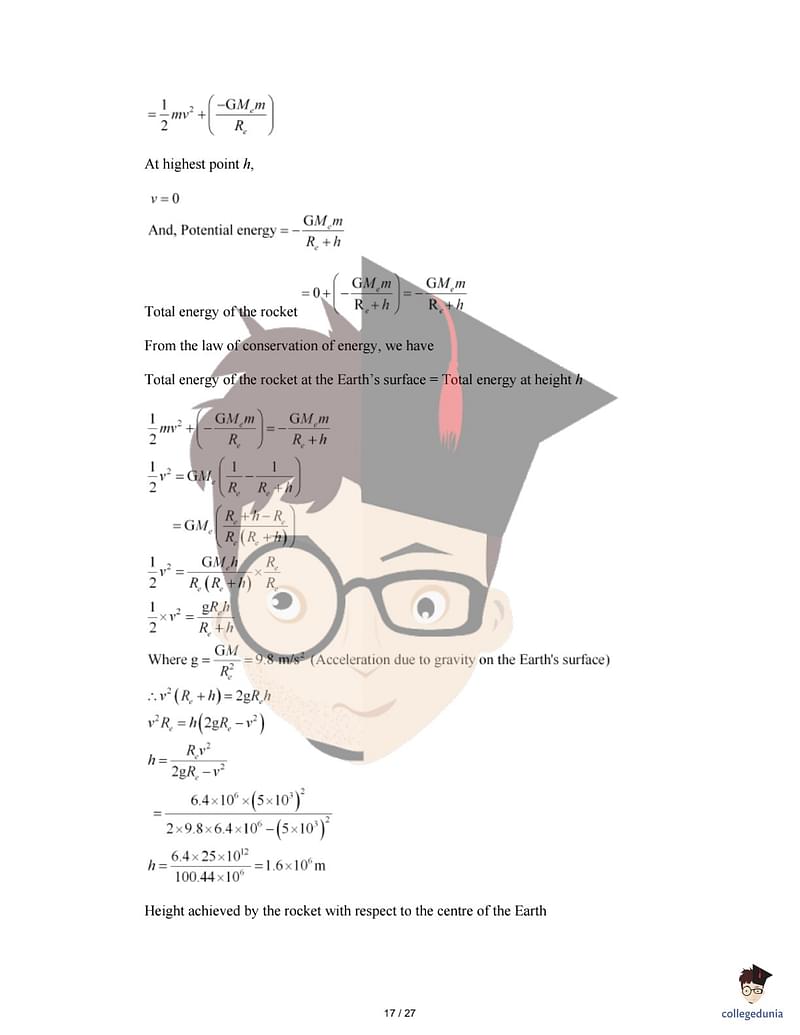
  • Escape Velocity is the minimum velocity that is required to project a body vertically upward from the surface of the Earth so that it comes out of its gravitational field.

\(v_{escape} = \sqrt{2GM \over R}\)

  • Orbital velocity is the minimum velocity required to put a satellite into a given orbit around the Earth.
\(v_{orbital} = \sqrt{GM \over R}\)

CBSE CLASS XII Related Questions

  • 1.
    The figure shows three point charges kept at the vertices of triangle ABC. The net electric field, due to this system of charges, at the midpoint M of base BC will be:

      • \( \frac{q}{4 \pi \epsilon_0 l^2} \) pointing along MA
      • \( \frac{q}{\pi \epsilon_0 l^2} \) pointing along AM
      • \( \frac{q}{2 \pi \epsilon_0 l^2} \) pointing along AM
      • Zero

    • 2.
      Write the expression for the magnetic field due to a current element in vector form. Consider a 1 cm segment of a wire, centered at the origin, carrying a current of 10 A in positive x-direction. Calculate the magnetic field \( \mathbf{B} \) at a point \( (1 \, \text{m}, 1 \, \text{m}, 0) \).


        • 3.
          Suppose a pure Si crystal has \( 5 \times 10^{28} \) atoms per \( \text{m}^3 \). It is doped with \( 5 \times 10^{22} \) atoms per \( \text{m}^3 \) of Arsenic. Calculate majority and minority carrier concentration in the doped silicon. (Given: \( n_i = 1.5 \times 10^{16} \, \text{m}^{-3} \))


            • 4.
              If both the number of protons and the neutrons are conserved in each nuclear reaction, in what way is mass converted into energy (or vice versa) in a nuclear reaction? Explain.


                • 5.
                  Draw the number of scattered particles versus the scattering angle graph for scattering of alpha particles by a thin foil. Write two important conclusions that can be drawn from this plot.


                    • 6.
                      A long solenoid of length \( L \) and radius \( r_1 \) having \( N_1 \) turns is surrounded symmetrically by a coil of radius \( r_2 \, (r_2>r_1) \) having \( N_2 \) turns (\( N_2 \ll N_1 \)) around its mid-point. Derive an expression for the mutual inductance of solenoid and coil. Is \( M_{12} = M_{21} \) valid in this case?

                        CBSE CLASS XII Previous Year Papers

                        Comments


                        No Comments To Show