NCERT Solutions for Class 9 Science Chapter 1: Matter In Our Surroundings

Collegedunia Team logo

Collegedunia Team

Content Curator

The NCERT Solutions for Class 9 Science have been provided in this article. Some of the important concepts in Chapter 1 Matter in Our Surroundings include: 

  1. Properties of Matter
  2. LPG Composition
  3. Condensation
  4. Evaporation

Download: NCERT Solutions for Class 9 Science Chapter 1 pdf


NCERT Solutions for Class 9 Science Chapter 1

NCERT Solutions

NCERT Solutions

NCERT Solutions

NCERT Solutions

NCERT Solutions

NCERT Solutions

NCERT Solutions

NCERT Solutions

NCERT Solutions

NCERT Solutions

NCERT Solutions

NCERT Solutions

NCERT Solutions

NCERT Solutions


NCERT Solutions for Class 9 Science Chapter 1 Matter In Our Surroundings 
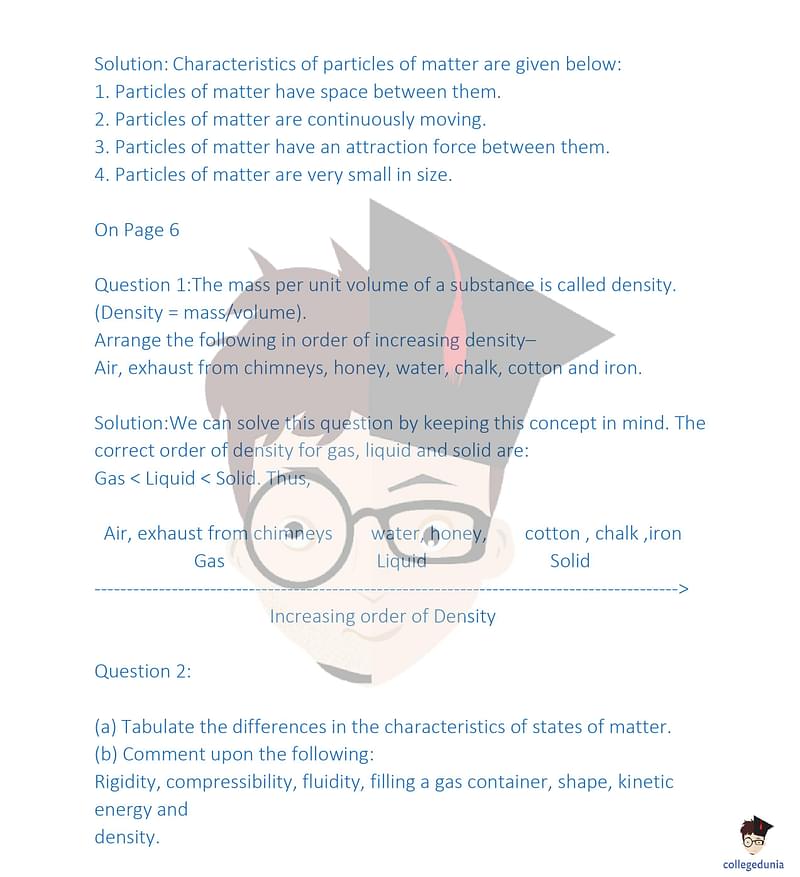
Matter can be defined as something that has mass and occupies space. Every matter is made up of molecules packed together. Matter can be classified into 3 states: solid, liquid and gas. The state of matter depends upon the closeness of molecules.

Properties of Matter

The properties of matter helps us differentiate between different materials and their formation. Properties of matter refers to the traits in materials that can be measured.

Some of the Properties of Matter are:

  1. Matter is any substance that occupies a certain amount of space and has mass. It is made up of atoms.
  2. Atoms are very small in size and is not visible with the naked eyes. 
  3. Particles of matter are found to be in motion constantly.
  4. Particles of matter have gaps or spaces between them.

LPG Composition

Liquified Petroleum Gas (LPG) can be defined as a compressed gas extracted from wet natural gas via the method of absorption.

Example: What are three active components found in LPG?

Solution: The three active components found in LPG include:

  • Propane
  • Butane
  • Propylene

Condensation

Condensation can be defined as the process where water vapor gradually converts into a liquid form. Condensation is also said to be the reverse of evaporation, where liquid water gradually turns into vapor.

Example: Name and define the two primary types of condensation reaction.

Solution: The two types of condensation reactions include:

  • Intramolecular Condensation: Intramolecular condnsation occurs when two functional groups of the same molecule tend to react in order to eliminate a simple molecule in the reaction.
  • Intermolecular Condensation: Intermolecular condensation occurs during the reaction between two molecules (either having same or different compounds). 

Evaporation

Evaporation is a type of vaporization that helps turn liquid water into vapor. One of the primary examples of evaporation is when a ice cube melts.

Example: What are some factors that affect Evaporation?

Solution: Some of the factors that affect Evaporation are:

  • Surface Area
  • Temperature
  • Wind
  • Humidity

Also Read:

Also Check:

CBSE X Related Questions

  • 1.
    When an element 'X' reacts with water, it starts floating. Identify the element 'X':

      • Potassium
      • Calcium
      • Sodium
      • Iron

    • 2.
      Assertion (A): Reflex actions do not involve thinking.
      Reason (R): Most reflex actions are controlled by the spinal cord.

        • Both Assertion (A) and Reason (R) are true and Reason (R) is the correct explanation of the Assertion (A).
        • Both Assertion (A) and Reason (R) are true, but Reason (R) is not the correct explanation of the Assertion (A).
        • Assertion (A) is true, but Reason (R) is false.
        • Assertion (A) is false, but Reason (R) is true.

      • 3.
        Briefly mention the steps in double-circulation through human heart.


          • 4.
            How does the change in curvature of the eye lens help us in the process of seeing the nearby objects clearly?


              • 5.
                What is the function of diaphragm in human respiratory system ? Where is it present in human body ?


                  • 6.
                    When a human egg is fertilized by a sperm having ‘Y’ chromosome, the zygote has the following combination of chromosomes:

                      • 44 + XX
                      • 22 + XX
                      • 44 + XY
                      • 22 + XY

                    Comments


                    No Comments To Show