



Education Journalist | Study Abroad Lead
Evaporation is one of the most important natural phenomena that lies in coherence with the law of nature of determining a water cycle as a whole. Herein, the liquid state of matter also known as water is converted to a gaseous state i.e. vapor. The process requires energy in the form of heat to continue but the heat is not supplied externally rather it is extracted from the liquid itself. It is known as a surface phenomenon. Factors affecting evaporation mark great changes in the process and climate of a region. In this article, we will read about the process of evaporation, factors affecting evaporation, and various other corresponding topics.
| Table of Content |
Key Terms: Evaporation, latent heat, vaporization, hygroscopic nuclei, water cycle, equatorial region, surface area.
What is Evaporation?
[Click Here for Sample Questions]
Evaporation refers to a surface process where the water droplets are converted into a gaseous form. This conversion of a liquid into gas does not involve any external heat rather it uses the latent heat of vaporization. Evaporation also forms a main part of the water cycle when the water vapor from the seas or the water bodies rises to condense around the hygroscopic nuclei and form a cloud. The process of evaporation is similar to that of vaporization but not the same. However, this process of evaporation has multiple factors affecting it.
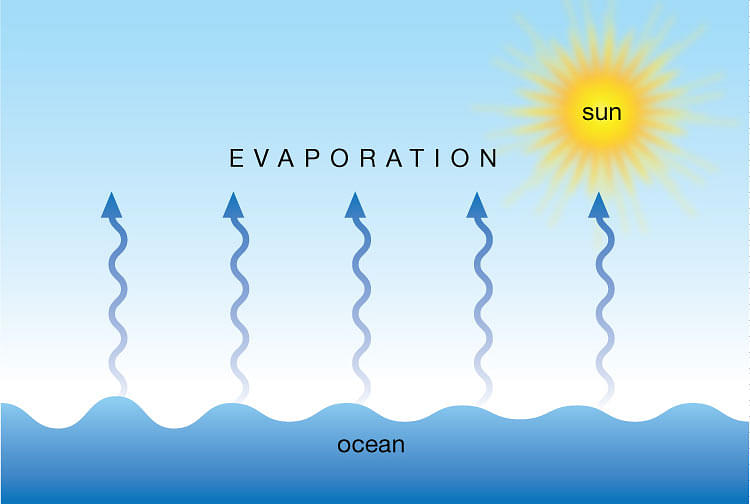
Evaporation
Factors Affecting Evaporation
[Click Here for Sample Questions]
Factors affecting evaporation vary as per climate, region, time, etc. These factors regulate the process of evaporation and as a result, the rate of evaporation varies from place to place and time to time. A brief explanation of the several factors affecting evaporation is given below.
-
Temperature
One of the most important factors affecting evaporation is temperature. As the temperature increases, the kinetic energy of the water molecules also increases which results in resisting the intermolecular forces. Due to this, the liquid is transformed into a vapor, thus affecting the process of evaporation. Higher temperature increases the rate of evaporation and vice – versa.
-
Surface Area
Another important factor affecting evaporation is the surface area over which the process of evaporation is taking place. The greater the surface area, the higher will be the rate of evaporation due to the wider exposure of the molecules which allow them to resist intermolecular force. For instance, spilling the tea in the saucer cools it quickly.
-
Humidity
The relative humidity of an area refers to the moisture carrying capacity of the air. Therefore, the greater the humidity, the lesser shall be the rate of evaporation because air already holds much moisture and resist evaporation. For instance, clothes dry at a faster rate during dry summers as compared to the wet summers.
-
Wind
Wind generally refers to the horizontal movement of air. If this movement occurs at a higher velocity and the wind is dry, then its moisture-holding capacity shall be more, thus, accelerating the rate of evaporation. Whereas, if the wind is already saturated with water, the rate of evaporation shall be slower. For instance, the rate of evaporation is higher in the desert region as compared to the equatorial belts.

Wind
Also Read:
| Related Articles | ||
|---|---|---|
| Vapour Pressure | States of Matter | |
| Irrigation | Biogeochemical Cycles | |
Rate of Evaporation
[Click Here for Sample Questions]
The rate of evaporation represents the ratio at which the liquid changes into the gaseous state.
- The substances which are having a rate of evaporation of 3 or more are known as fast evaporating substances. For example Acetone, hexane, etc.
- The substances which are having a rate of evaporation between 0.8 to 3 are known as medium evaporating substances. For example Ethyl alcohol.
- The substances which are having a rate of evaporation less than 0.8 are known as slow evaporating substances. For example Water, mineral spirit, etc.
Things to Remember
- The process of vaporization is a process that occurs at the boiling point, whereas, the process of evaporation occurs at a temperature below the boiling point.
- The rate of evaporation is faster in the tropics as compared to temperate climates.
- The angle of insolation also affects the rate of evaporation. Vertical rays of the sun mean higher evaporation.
- The rate of evaporation is less in equatorial regions because of the 4’ O clock rainfall.
- Evaporation is a natural phenomenon that is seen in the day–to–day life. For instance, the functioning of a cooler in summers is the best example of evaporation.
- It is affected by temperature, humidity, surface area, and speed of the wind.
Sample Questions
Ques. What is evaporation? Give an example. (3 marks)
Ans. Evaporation refers to a surface process where the water droplets are converted into a gaseous form. This conversion of a liquid into gas does not involve any external heat rather uses the latent heat of vaporization.
Evaporation also forms a main part of the water cycle when the water vapor from the seas or the water bodies rises to condense around the hygroscopic nuclei and form a cloud. The process of evaporation is similar to that of vaporization but not the same. For example, the functioning of cooler in summers.
Ques. How do temperature and insolation impact the rate of evaporation? (3 marks)
Ans. Evaporation refers to a surface process where the water droplets are converted into a gaseous form. However, this process of evaporation has multiple factors affecting the same.
- Temperature – As the temperature increases, the kinetic energy of the water molecules also enhances which results in resisting the intermolecular forces. Due to this, the liquid is transformed into a vapor. Higher temperature increases the rate of evaporation and vice – versa.
- The angle of insolation also affects the rate of evaporation. Vertical rays of the sun mean higher evaporation. However, the insolation is highest in the equatorial region but the rate of evaporation is not high because of the presence of the clouds at all hours and the 4’o clock rainfall.
Ques. Define the phenomenon of evaporation and the rate of evaporation. (5 marks)
Ans. Evaporation refers to a surface process where the water droplets are converted into a gaseous form. This conversion of a liquid into gas does not involve any external heat rather uses the latent heat of vaporization. Evaporation also forms a main part of the water cycle when the water vapor from the seas or the water bodies rises to condense around the hygroscopic nuclei and form a cloud. Whereas, the rate of evaporation represents the ratio at which the liquid changes into the gaseous state, and it could be classified into three sub-types.
- The substances which are having a rate of evaporation of 3 or more are known as fast evaporating substances.
- The substances which are having a rate of evaporation between 0. 8 to 3 are known as medium evaporating substances.
- The substances which are having a rate of evaporation less than 0. 8 are known as slow evaporating substances.
Ques. What are hygroscopic nuclei? How is it related to the process of evaporation? (2 marks)
Ans. Hygroscopic nuclei generally refer to the small or the tiny droplets of aerosols around which the water after being evaporated in the form of water vapor rises upwards and condenses around the hygroscopic nuclei to form the larger clouds which give the rainfall at the end. Not only the rainfall but this process is also responsible for the precipitation of all forms.
Ques. Give a brief difference between the process of vaporization and evaporation. (2 marks)
Ans. Process of vaporization occurs at the boiling point, whereas, process of evaporation occurs at a temperature below the boiling point. Vaporization is usually classified as a transitional phase of an element. However, evaporation is a natural phenomenon that takes place at any time in the presence of certain favorable factors.
Ques. Give three examples of evaporation from the day–to–day life. (3 marks)
Ans. The three examples are as follows.
- Functioning of cooler in summers when it attracts the outdoor air through the pads saturated by the water. The water is then evaporated giving rise to the cold air.
- Ironing the slightly damp clothes evaporate the water the clothes become dry.
- Melting ice is also considered to be an example of evaporation.
Ques. Explain any two factors affecting evaporation. (2 marks)
Ans. The two factors affecting the rate of evaporation are as follows.
- Surface Area – The greater the surface area, the higher will be the rate of evaporation due to the wider exposure of the molecules which allow them to resist intermolecular force.
- Humidity – The relative humidity of an area refers to the moisture carrying capacity of a parcel of air. Therefore, the greater the humidity, the lesser shall be the rate of evaporation because air already holds much moisture and resist evaporation.
Ques. Illustrate if the rate of evaporation is greater in the Arabian Sea or the Bay of Bengal. (2 marks)
Ans. The rate of evaporation will be greater in the Bay of Bengal as compared to the Arabian sea because the Bay of Bengal is an enclosed area due to which the heat trapped will be greater, thus, more evaporation will take place.
For Latest Updates on Upcoming Board Exams, Click Here: https://t.me/class_10_12_board_updates
Check More:



Comments