



Content Curator
Oscillation is termed as any object going back and forth. The simplest form of oscillatory motion is simple harmonic motion. Generally, an oscillating object comes to rest after some period of time due to external factors such as friction. However, applying external forces can help it remain oscillating. Some examples of oscillatory motion include the vibrations of the strings of a guitar that produce sound, and the movement of the membranes of a drum when hit to produce sound.
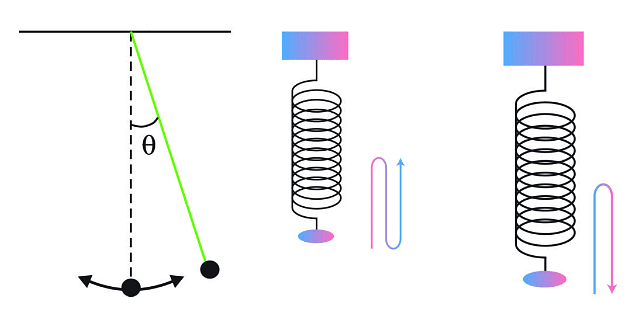
Oscillation
Very Short Answer [1 Marks]
Ques. Highlight the major property that can help a system oscillate.
Ans. In order to oscillate, a system needs to possess elasticity and inertia.
Ques. Briefly differentiate between oscillations and vibrations.
Ans. The differences between oscillations and vibrations are limited. When the frequency of movement is relatively less, it is referred to as oscillation. However, when the frequency is high, it is referred to as a vibration.
Ques. Define periodic motion?
Ans. When the motion of an object repeats at regular periods of time, it is called periodic motion.
Ques. Why does mechanical energy decrease in a real oscillation system?
Ans. Mechanical energy decreases in a real oscillation system due to external forces, such as drag force. These external forces convert the mechanical energy into thermal energy.
Ques. Differentiate between periodic motion and a period?
Ans. Periodic motion can be defined as the repetition at regular intervals of time. However, a period is the shortest interval of time after which periodic motion repeats.
Ques. How can uniform circular motion and simple harmonic motion be related?
Ans. Uniform circular motion can be considered as two SHMs occurring perpendicular to each other.
Ques. What is resonance?
Ans. When the driving force acting on an object is close to the natural frequency of oscillation, there is an increase in amplitude. This phenomenon is called resonance.
Short Answers [2 Marks]
Ques. Elaborate why a passing airplane sometimes causes the windows in our houses to rattle?
Ans. When the sound waves from an airplane hit the glass of our windows, it causes them to vibrate. This is due to forced oscillations. That is why our windows rattle at loud noises such as the passing of an airplane.
Ques. Define simple harmonic motion.
Ans. When a body is oscillating, and the force acting on it is directly proportional to the displacement from its mean position, it is known as simple harmonic motion. The force acting on the object, at any point, is always directed towards the mean position.
Ques. Differentiate between forced and free oscillations.
Ans. When oscillations occur at their natural frequency, they are known as free oscillations. Due to natural damping forces they die out with time. When oscillations occur with the help of an external force so that they do not die out, it is known as forced oscillations.
Ques. The human heart beats at an average of 75 beats per minute. Evaluate its period and frequency.
Ans. Beat frequency of the human heart = 75/(1 min)
= 75/(60 s)
= 1.25 s-1
= 1.25 Hz
The time period T = 1/(1.25) = 0.8 s
Ques. Does the function sin ωt – cos ωt represent simple harmonic motion? If yes, mention the time period?
Ans. The function sin ωt – cos ωt = sin ωt – sin (\(\pi \)/2 – ωt)
= 2 cos (\(\pi\)/4) sin (ωt – \(\pi \)/4)
= \(\sqrt2\) sin (ωt – \(\pi\)/4)
This function represents a simple harmonic motion having a period T = 2π/ω and a phase angle (–\(\pi \)/4).
Long Answers [3 Marks]
Ques. What is frequency? Explain its S.I Unit and formula.
Ans. The total number of oscillations that an object is seen to make about its mean position per unit time, is known as frequency. Its S.I Unit is Hertz or Hz, named after the scientist Heinrich Rudolph Hertz, who made the discovery of radio waves. Further, it can be defined by the below formula.
Frequency, v = 1/T
(Where T is the time period.)
Ques. What is the length of a simple pendulum, which ticks in seconds? (NCERT Solved example)
Ans. The time period of a simple pendulum is given by,
T = 2?\(\sqrt L\over g\)
From this relation one gets,
L = \(gT^2\over4????^2\)
The time period of a simple pendulum, which ticks seconds, is 2 s.
Therefore, for g = 9.8 ms?² and T = 2 s,
L = \(9.8 X 2 \over4 X 3.14^2\)
L = 1 m.
Ques. A body having SHM has an amplitude of 5cm, and a period of 0.2s. When the displacement is 5cm, find the acceleration and velocity.
Ans. Given,
Displacement, x = 5cm = 0.05m
Amplitude, a = 5cm = 0.05m
Time period, T = 0.2s
So, Acceleration, a = -2(x)
= -[2T]2 (x)
= -[20.2]2 (0.05) = - 52 m/s2
Velocity, v = A2 - x2
= [2T] (0.05)2 - (0.05)2
= [2T] 0 = 0
Ques. Differentiate between damped and undamped oscillations. Represent and label an image showing the same.
Ans. In a simple harmonic system, when oscillation takes place with the amplitude decreasing with time, such oscillations are known as damped oscillations. In a simple harmonic system, when oscillation takes place with a constant amplitude that does not change with time, such oscillations are known as undamped oscillations.

Damped and Undamped Oscillation
Very Long Answers [5 Marks]
Ques. A body oscillates with SHM according to the equation (in SI units), x = 5 cos [2π t + π/4]. At t = 1.5 s. As per the equation, evaluated the following:
(a) displacement,
(b) speed
(c) acceleration of the body. (NCERT Solved Example)
Ans. Angular frequency ω of the body = 2π
Time period T = 1 s.
So at t = 1.5 s,
(a) displacement = (5.0) cos [(2π) × 1.5 + π/4]
= (5.0) cos [(3π + π/4)]
= – 5.0 × 0.707
= –3.535 m
(b) Using the equation v(t) = –ωA sin (ωt + φ ),
the speed of the body = – (5.0)(2π) sin [(2π) ×1.5 + π/4]
= – (5.0)(2π) sin [(3π + π/4)]
= 10π × 0.707
= 22 ms-¹
(c) Using the equation v(t) =ddt x(t),
the acceleration of the body = –(2π)² × displacement
= – (2π)² × (–3.535)
= 140 ms-²
Ques. Define the important parameters of simple harmonic motion?
Ans. Out of various parameters, a few are mentioned below,
- Amplitude - The magnitude of maximum displacement of a particle which is responsible for executing SHM is referred to as amplitude.
- Displacement - The displacement of an object or body can simply be defined as the total distance traveled by it from its equilibrium position or phase.
- Phase - For a given SHM, if amplitude is fixed, then the velocity and position of the particle at any time t is given by (t + 0 ). This function is known as phase.
- Angular frequency - For a body executing periodic motion, the angular frequency is the product of frequency and 2.
- Acceleration - For a body executing SHM, acceleration is the rate of change of velocity at any instant of time.
- Velocity - Velocity is basically the function of time. It can be defined as the rate of change of displacement at any given point of time.
Ques. A 5 kg collar is attached to a spring of spring constant 500 N m?¹. It slides without friction over a horizontal rod. The collar is displaced from its equilibrium position by 10.0 cm and released. Calculate (a) the period of oscillation, (b) the maximum speed and (c) maximum acceleration of the collar? (NCERT Solved example)
Ans. (a) The period of oscillation. T, is given by the equation
T= 2mk
= 25 kg 500 N/m
= (2π/10) s
= 0.63 s
(b) The velocity of the collar executing SHM is given by,
v(t) = –Aω sin (ωt + φ)
The maximum speed is given by,
vm = Aω
= 0.1 × km
= 0.1 × 500 N/m/5 kg
= 1 ms-¹ and it occurs at x = 0
(c) To determine the acceleration of collar at displacement x (t) from the equilibrium is given by,
a (t) = –ω2 x(t)
= - km x(t)
= 500 N/m 5 kg × 0.1m
= 10 m s-² and it occurs at the extremities.
Also Check:



Comments