



Content Writer-SME
Oxidative phosphorylation is a cellular process that uses oxygen reduction to produce high-energy phosphate bonds in the form of adenosine triphosphate (ATP). This process occurs in the inner mitochondrial membrane, so it is also known as mitochondrial phosphorylation.
- Electron Transport Chain is a chain of oxidation-reduction reactions occurring in Mitochondria.
- It involves the transportation of electrons from NADH and FADH2 to oxygen.
- NADH and FADH2 are produced by several catabolic cellular processes and are used by the electron transport chain.
- Elemental oxygen is used in oxidative phosphorylation as the final oxidizing agent (electron acceptor).
In comparison to the anaerobic organisms, the electron transport system and oxidative phosphorylation explain the evolution and advancement of aerobic eukaryotic life. It is the distinguishing feature of aerobic respiration, which explains why a wide variety of life forms need oxygen to thrive.
What is Oxidative Phosphorylation?
[Click Here for Sample Questions]
Oxidative Phosphorylation is also known as mitochondrial phosphorylation. It is a metabolic process in which food is oxidized with the help of enzymes and releases chemical energy from molecular oxygen. It is then utilized to form oxidative phosphorylation product called adenosine triphosphate (ATP).
Most eukaryotes engage in oxidative phosphorylation within their mitochondria.
- The movement of electrons from electron donors to electron acceptors occurs during the oxidative phosphorylation process.
- Redox reactions result in the creation of ATP as a result of energy stored in the relatively weak double bond of oxygen.
- In prokaryotes, the proteins are found in the intermembrane space of the cell.
- In eukaryotes, a sequence of protein complexes that catalyze the redox reactions are contained within the inner membranes of the cell's mitochondria.
- These interconnected protein groups are referred to as electron transport chain or system.
Five protein complexes are involved in eukaryotic oxidative phosphorylation:
- Complex I, also known as NADH Dehydrogenase.
- Complex II, also known as Succinate Dehydrogenase.
- Complex III, also known as Cytochrome C Oxidoreductase.
- Complex IV, also known as Cytochrome Oxidase.
- Complex V, also known as ATP Synthase.
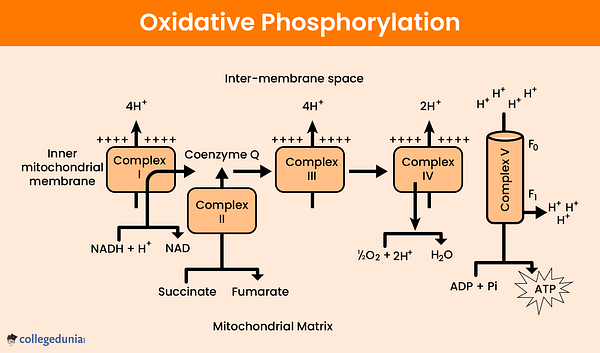
Oxidative Phosphorylation
Prokaryotes have a wide variety of electron donors and acceptors as well as diverse types of enzymes.
- Due to the production of reactive oxygen species including hydrogen peroxide and superoxide, oxidative phosphorylation product is a crucial component of normal body metabolism.
- Additionally, it contributes to the growth of free radicals, cell damage, illnesses, and aging.
- In eukaryotes, oxidative phosphorylation is the final step of cellular respiration that generates enough ATP at the end.
- The two basic requirements to initiate the oxidative phosphorylation phosphorylation are 10 NADH and 2FADH2.
- They are electron carriers from glycolysis, the initial step, and the Krebs cycle.
Steps of Oxidative Phosphorylation
[Click Here for Sample Questions]
The important metabolic process of oxidative phosphorylation occurs in mitochondria. The following are the principal mitochondrial oxidative phosphorylation steps:
Electron Transport by NADH and FADH2
- NADH and FADH2 transfer electrons to the molecules present in the mitochondrial region.
- Once the electrons have been transferred, they are reduced to NAD+ and FAD, respectively.
- They are used in subsequent stages of cellular respiration.
Proton Pumping and Electron Transport
- Energy will be released as electrons move from one energy level to another through hopping.
- The electrons are transferred from the matrix to the intermembrane gap using some of the energy.
- Consequently, an electrochemical gradient is created here.
Splitting of Oxygen Creates Water
- The oxygen molecule is now given electrons.
- It divides in two and absorbs hydrogen ions to create water.
Synthesis of ATP
- As they flow back into the matrix, hydrogen ions (H+) go through an enzyme called ATP synthase.
- As a result, it manages the proton flow necessary for ATP synthesis.
Oxidative Phosphorylation Stages
[Click Here for Sample Questions]
The conversion of food energy into ATP is carried out very efficiently by oxidative phosphorylation. The process of oxidative phosphorylation also called as mitochondrial phosphorylation are divided into two stages: Electron transport system and Chemiosmosis.
Electron Transport System
Electron transport mechanism, also known as oxidative phosphorylation, is transferring electrons along a chain of protein complexes.
- Glycolysis, preparation step, and Krebs cycle-produced carriers are used to transmit electrons.
- Oxygen is the final stop for electrons, where they decrease oxygen to generate H2O.
- As a result, oxygen is referred to as the last electron acceptor.
- Hydrogen ions are blasted out during this process, and with their assistance, ATP is produced.
A mobile protein called ubiquinone floats in the inner mitochondrial membrane and transports electrons between the various complexes.
Complex I
- FMN (Flavin Mononucleotide) is a significant component of Complex I .
- This protein complex serves as the center for Iron and Sulfur (Fe and S).
Complex II
- It starts from the b heme cofactors and quinone in the membrane domain.
- It ends at the flavin and iron-sulfur redox cofactors in the membrane extrinsic domain.
Complex III
- Cytochrome B, Rieske iron-sulfur proteins, and cytochrome C are three of their crucial structural components.
- Cytochrome C, a protein that moves around in the intermembrane gap and is connected to complex III, is the most significant of them.

Electron Transport Chain
Complex IV
- It has 13 subunits, two heme groups, and numerous metal ion cofactors, including 3 Cu atoms, 1 Mg atom, and 1 Zn atom.
- These elements give it an extraordinarily complex structure.
Complex V
- It is ATP Synthase, made up of several subunits, the two most important of which are the F0 and F1 subunits.
- Gamma, epsilon, and alpha and beta subunits make up F1.
- C10, a, and b2 subunits make up the F0 subunit.
- When hydrogen ions pass through this complex, ATP synthase produces ATP.
Chemiosmosis
In oxidative phosphorylation, an energy-requiring chemical reaction is driven by chemical reactions that yield energy.
- The responses in these two sets are linked and connected.
- ATP synthesis process is an endergonic activity, while the flow of electrons through the electron transport chain is an exergonic process.
- As a result, the movement of proteins will transfer energy from the electron transport chain to ATP synthase.
- Chemiosmosis is the name given to this process.
An energetic chemical reaction is known as an endergonic process. A chemical reaction known as an exergonic process will result in a positive energy transfer from the system to the environment. When chemical reactions occur spontaneously, they are also regarded as exergonic.
Factors Affecting Oxidative Phosphorylation
[Click Here for Previous Year Questions]
The oxidative phosphorylation that takes place in inner mitochondrial membrane mainly depends on five important factors which are mentioned below in detail:
Inhibitors
The process of oxidative phosphorylation involves five protein complexes an each one has their own inhibitors. The main purpose of inhibitors are to stop the process by blocking the carrier.
| Complexes | Inhibitors |
|---|---|
| Complex-I | Rotenone |
| Complex-II | Carboxin |
| Complex-III | Antimycin-A |
| Complex-IV | Cynide, Azide, Carbon Monoxide |
| Complex-V | Oligomycin |
Uncouplers
These are the agents that prevents the electron transfer as well as ATP synthesis. An important compound which is used as an uncoupling agent is 2,4-dinitrophenol.
Adeno-di-phosphate
Adeno-di-phosphate or ADP is an important source of energy which is converted into ATP in the presence of inorganic phosphate. ATP is considered the energy currency of the cell which is produced through the process of oxidative phosphorylation. In case of insufficient ADP, the normal functioning of the cell, which normally proceeds by ATP, will be disrupted.
Environmental Conditions
Many environmental factors such as toxins, pollutants, medications and nutrient levels also disrupt the process of oxidative phosphorylation which in turn inhibits the synthesis of ATP.
Mutation in Mitochondrial DNA
Sudden change in the sequence of mitochondrial DNA which occurs either naturally or with the use of artificial mutagens are called mutation in mitochondrial DNA. This is normally associated with diseases which are inherited from mother to their offsprings (children). With sudden change in mitochondrial DNA sequences, levels of ATP also decreases.
Oxidative Phosphorylation Diseases
[Click Here for Previous Year Questions]
Some important diseases that are associated with improper regulation of oxidative phosphorylation and mutation in mitochondrial DNA are mentioned below:
- Cancer
- Hypotonia
- Opthalmoplegia
- Muscle Weakness
- Cardiomyopathy
Things to Remember
- Oxidative phosphorylation is a reaction that uses oxygen reduction to produce high-energy phosphate bonds in the form of ATP.
- Electron transport chain is a chain of oxidation-reduction reactions in the mitochondria.
- Energy released during the oxidation of nutrients by enzymes is used to drive energy-requiring reactions.
- Energy is released as electrons are transferred from electron donors to electron acceptors in a series of redox reactions.
- The energy is used to power an ATP-synthesizing enzyme called ATP synthase.
- Oxidative phosphorylation is efficient only under aerobic conditions.
Previous Years’ Questions
- Oxidative phosphorylation is… (NEET - 2016)
- Mechanism of phosphorylation is depicted in the diagram below…
- Who discovered photophosphorylation… (AIIMS - 2001)
- Oxidative phosphorylation in eukaryotes occurs during… (MHT CET - 2018)
- Phosphorylation of glucose during glycolysis is catalyzed by…
- Phosphorus acid is syrupy because of…
- Oxidative phosphorylation involves simultaneous oxidation… (NEET - 1996)
- In TCA cycle substrate-level phosphorylation takes place during… (AMUEEE - 2013)
- Conversion of phosphoglyceraldehyde to 1, 1-biphosphoglyceric acid…
- Where is the respiratory electron transport system… (NEET - 2019)
Sample Questions
Ques. What is Phosphorylation? (2 Marks)
Ans. Phosphorylation is a biological procedure in which phosphate is added to an organic molecule. For instance, phosphate can be added to glucose to create glucose monophosphate or to adenosine diphosphate (ADP) to create adenosine triphosphate (ATP).
Ques. What is Adenosine triphosphate? Explain. (3 Marks)
Ans. Energy is necessary for the proper operation of cells, tissues, and organs as well as for driving metabolic activities in all living things. The substance that degrades the chemical energy extracted from digested food is Adenosine Triphosphate.
When the released phosphate attaches to another molecule and activates it, the captured energy is utilized by the cell. ATP is referred to as the energy unit of the cell as a result. Adenosine diphosphate (ADP) or adenosine monophosphate are the two products of the conversion of ATP during metabolic activities (AMP).
Ques. Where does the Light Reaction occur? (2 Marks)
Ans. The thylakoid membrane is the site of the light reaction. After a series of activities and reactions that start with the absorption of solar energy, ATP molecules are eventually produced.
Ques. What type of reaction is phosphorylation? (2 Marks)
Ans. Phosphorylation is a reversible reaction, thus, phosphate molecules can be created or destroyed. The word "kinases" refers to the group of enzymes that add phosphate groups to proteins. "Phosphases" are enzymes that work to remove these phosphate groups.
Ques. Why is a steady supply of electrons from chlorophyll necessary? (2 Marks)
Ans. To replace the lost electrons from chlorophyll, a constant source of electrons from it is necessary. These electrons are produced by breaking the water molecule, which also has gas as a byproduct.
Ques. Describe the function of ATP in metabolism. (2 Marks)
Ans. ATP is the currency of energy in a cell. When the terminal phosphate link in ATP is broken, energy is released in the cells. This power is used to power several metabolic-related biochemical operations.
Ques. What are the two sets of Coupled and Related Reactions in Oxidative Phosphorylation? (3 Marks)
Ans. The oxidative phosphorylation process involves chemiosmosis, which employs chemical reactions to release energy that powers another chemical reaction that also needs energy. The two interconnected and coupled reactions in these two sets are as follows:
- A positive change in free energy always results from the exergonic process of energy absorption.
- A positive energy flow occurs from the system to its surroundings during an endergonic process.
Ques. Explain oxidative phosphorylation. (3 Marks)
Ans. When NADH is oxidized in eukaryotic cells, the enzymes use the energy that is generated to pump protons across the inner mitochondrial membrane through the electron transport system. As a result, electrochemical gradients are produced across the membrane. 26 of the 30 ATP molecules that are produced when glucose is entirely oxidized to CO2 and H2O are produced by oxidative phosphorylation.
Ques. Why is ATP called the currency of the cell's energy? (2 Marks)
Ans. The substance known as ATP is known as the energy currency of the cell since it provides energy as and when it is needed. High-energy bonds are one source of energy.
Ques. Describe how oxygen works to provide cells energy. Draw an electron transport schematic diagram. (3 Marks)
Ans. Since oxygen is the final electron acceptor in the electron transport chain, it is necessary for oxidative phosphorylation. Electrons are gathered in the first two stages of glycolysis and the citric acid cycle during aerobic cellular respiration. These electrons are transferred to the chain of electron transport.

Electron Transport Chain



Comments