



Education Journalist | Study Abroad Lead
Respiration is a metabolic biochemical process that occurs within the cells of all living organisms through which they obtain energy. Respiration involves the production of energy (in form of ATP) by the intake of oxygen and the liberation of carbon dioxide. The energy thus produced is further used by cells to perform various bodily functions.
- Respiration is performed by every living organism, from simple unicellular organisms to complex multicellular organisms.
- Energy is produced in the form of Adenosine-triphosphate (ATP) which is also known as the energy currency of the cell.
- From single-celled organisms to complex multicellular organisms, each organism performs respiration.
- Water and carbon dioxide are bi-products of respiration and are excreted by the body.
Also learn: Why is respiration an exothermic reaction?
Key Terms: Aerobic Respiration, Anaerobic Respiration, ATP, Glucose, Energy, Kreb’s Cycle, Cellular Respiration, Glycolysis
What is Respiration?
[Click Here for Sample Questions]
Respiration Definition – Respiration is a metabolic process in which living cells of an organism produce energy by taking in oxygen and liberating carbon dioxide from the oxidation of various organic substances.
- In normal human respiration, glucose reacts with oxygen to produce energy.
- The energy produced is in the form of Adenosine-triphosphate (ATP) and is utilized for the growth, repair and movement of the body.
- It is performed by all living organisms including plants and animals to microorganisms.
- All living species acquire energy from food for different metabolic activities such as growth and development.
External RespirationThrough external respiration, oxygen is obtained from the environment. Some animals have specialized organs or even respiratory systems for gas exchange. For example, spiders respire through tracheae, their respiratory organs. Animals that do not have specialized organs for respiration such as nematodes (roundworms), employ diffusion across external tissue surfaces to get oxygen or other nutrients. Internal RespirationInternal respiration includes processes through which oxygen reaches the body cells. It involves the exchange of gases between the blood and body tissues. Oxygen present in the lungs diffuses into surrounding capillaries having oxygen-depleted blood. Carbon dioxide is expelled as it diffuses from the blood to the lung alveoli. Blood rich in oxygen is transported via the circulatory system from the capillaries of the lungs to body cells and tissues. Checkout Important Question on: Respiration |
Types of Respiration
[Click Here for Previous Years' Questions]
Cellular respiration includes metabolic reactions taking place in living cells to release energy. They do so by converting the biochemical energy from the nutrients of food into ATP. On the basis of oxygen demand, cellular respiration can be divided into two major types:
- Aerobic Respiration
- Anaerobic Respiration
Aerobic Respiration
Aerobic Respiration is a type of cellular respiration which takes place in the presence of oxygen to produce energy. This respiration is performed by both plants and animals. Water and Carbon dioxide are the bi-products of this process.
The reaction that takes place during Aerobic Respiration is as follows:
Glucose (C6H12O6) + Oxygen (6O2) → Carbon-dioxide (6CO2) + Water (6H2O) + Energy (ATP)
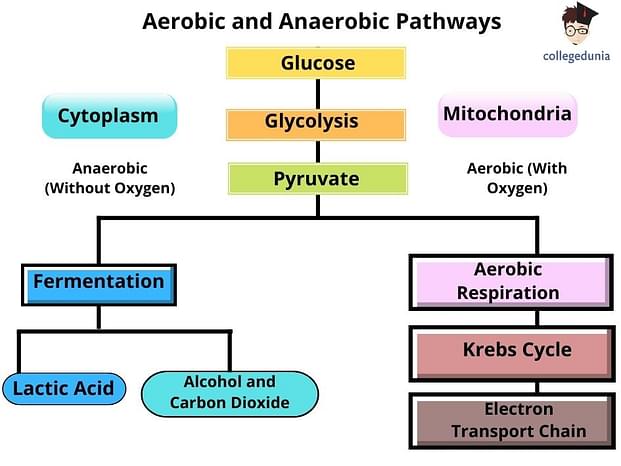
Aerobic and Anaerobic Pathways in Respiration
Read More: Breathing in Other Animals
Anaerobic Respiration
Anaerobic Respiration is the second type of cellular respiration that takes place in the absence of oxygen to produce energy. In anaerobic respiration, glucose breaks down without oxygen to produce energy (ATP), alcohol and CO2. It takes place in the cytoplasm of a cell.
The reaction that takes place during Anaerobic Respiration is as follows:
Glucose (C6H12O6) → Alcohol 2(C2H5OH) + Carbon dioxide 2(CO2) + Energy (ATP)
Anaerobic Respiration in Human MusclesHumans obtain their energy through aerobic respiration. However, anaerobic respiration in human muscles can occur for a short time when they need more energy.
|
Read More: Difference Between Cytosol and Cytoplasm
Stages of Respiration in Organisms
[Click Here for Sample Questions]
Cellular respiration takes place through various metabolic pathways. In prokaryotic cells, respiration occurs in the cytosol and around the plasma membrane. In eukaryotic cells, it takes place in the mitochondria which are referred to as the powerhouse of the cells.
There are three stages or phases of the respiration process:
Glycolysis
Under the process of Glycolysis in respiration, glucose, a six-carbon sugar, glucose gets converted into pyruvic acid through Pyruvate Oxidation.
- Pyruvic Acid is then oxidized to carbon dioxide and water, leaving two carbon molecules, known as acetyl-CoA.
- Two molecules of ATP and NADH are produced in the process of glycolysis.
- Pyruvate enters the inner mitochondrial matrix and undergoes oxidation in Krebs’ cycle.
- Glycolysis can also take place without oxygen and the process is known as fermentation.
Citric Acid Cycle
The citric acid cycle in respiration in organisms is also known as the tricarboxylic acid cycle or Kreb’s cycle.
- Two molecules of ATP are produced in each phase of the citric acid cycle.
- This cycle takes place within the mitochondrial matrix of a cell.
- The electrons generated in this process move across the mitochondrial matrix.
Kreb’s CycleThe Krebs cycle is also called the Citric Acid Cycle, TCA cycle, or Tricarboxylic Cycle. It is the second stage of the cellular respiration process in all aerobic organisms. It is used to release the stored energy for other biological processes. |
Read More: Amphibolic Pathway
Oxidative Phosphorylation
It is a process in respiration in organisms in which ATP molecules are formed due to the transfer of electrons from NADH or FADH2 to O2 by a series of electron carriers via the electron transport chain.
- Oxidative Phosphorylation in respiration takes place within the mitochondria of a cell.
- There is a release of energy as electrons move down the chain.
- This energy is used to pump protons out of the matrix and it forms a gradient.
- The protons then again flow back into the matrix through the help of the ATP synthase enzyme which produces ATP.
- Lastly, at the end of the chain, oxygen accepts the electrons and protons to form water.

Respiration Process
38 molecules of ATP are generated in the end from one glucose molecule.
Read More: Cyclic Photophosphorylation
Significance of Respiration
[Click Here for Previous Years' Questions]
Respiration is one of the most crucial life processes. It is the process that helps to release energy in all living organisms by converting food energy into metabolically usable forms of chemical energy.
- Respiration helps to release energy in a systematic manner which can be used for all cellular activities such as metabolism and cell division.
- The intermediate products of glycolysis and citric acid cycle are used in the synthesis of many organic compounds which are then used in cellular metabolism.
- For photosynthesis, the required carbon dioxide is replenished through the carbon dioxide released in respiration.
- In a similar manner, the oxygen needed for respiration is replenished with the oxygen released in photosynthesis.
- Respiration and photosynthesis are complementary to each other and are crucial to maintaining the balance of carbon dioxide and oxygen in nature.
- It helps to conserve energy. 1 molecule of glucose releases 673Kcal energy of which 456 Kcal is conserved in the form of 38 molecules of ATP.
Things to Remember
- Respiration is a process that involves the production of energy by taking in oxygen and releasing carbon dioxide from the oxidation of complex organic substances.
- Respiration is performed by all living organisms from unicellular organisms to multicellular organisms.
- The energy is produced in the form of Adenosine-Triphosphate (ATP), which is referred to as the energy currency of the cell.
- Aerobic respiration takes place in the presence of oxygen to produce energy, water and carbon dioxide.
- Anaerobic respiration takes place in the absence of oxygen to produce alcohol, CO2 and energy.
- There are three major steps in respiration namely Glycolysis, Oxidative Phosphorylation and Citric Acid Cycle.
Previous Years’ Questions (PYQs)
- The process of respiration…
- Aerobic respiration occurs in…
- Anaerobic respiration in animals produces… (JIPMER 2001)
- The anaerobic respiration is also called as…
- During the process of aerobic respiration, (i) gets
- The end product of anaerobic respiration, in plants is…
- Aerobic respiration produces more usable chemical energy…
- The organelle associated with aerobic respiration is… (JKCET 2005)
- The net gain of ATP molecules during aerobic breakdown…
- ATP acts as the energy currency of the cell. ATP can be broken down to…
- The number of ATP molecules utilised for the breakdown… (KCET 2017)
- The process of ATP synthesis from ADP in the presence of light…
- Glycolysis is the first step of respiration in which…
- End product of glycolysis is… (NEET 1990)
- Pyruvic acid, the last product of glycolysis, is degraded to…
Sample Questions
Ques. Differentiate between aerobic and anaerobic respiration meaning. (5 Marks)
Ans. The major differences between aerobic and anaerobic respiration are as follows:
| Aerobic Respiration | Anaerobic Respiration |
|---|---|
| Aerobic respiration is performed in the presence of oxygen. | Anaerobic respiration is performed in the absence of oxygen. |
| In this respiration, glucose is broken down into carbon dioxide, water and energy. | In this respiration, glucose is broken down into lactic acid or ethyl alcohol, carbon dioxide and energy. |
| It takes place in the cytoplasm of the mitochondria present in the cell. | It takes place in the cytoplasm of the cell. |
| Aerobic respiration takes place in eukaryotic cells such as plants and animals. | Anaerobic respiration takes place in prokaryotes and sometimes in human muscle cells. |
Ques. What is meant by ATP? (3 Marks)
Ans. ATP stands for Adenosine-Triphosphate. It is an organic compound that is composed of ribose sugar, adenine and phosphate groups. ATP is basically utilized to provide energy for various biochemical processes within a cell. This is the reason it is known as the energy currency of a cell.
Ques. Explain Fermentation. (3 Marks)
Ans. When glycolysis takes place in the absence of oxygen, it is known as fermentation. It is a metabolic process through which bacteria, yeast and other microorganisms obtain the energy for their biological processes. It is used for producing alcoholic beverages, yoghurt and other food items.
Ques. Explain anaerobic respiration in muscles. (5 Marks)
Ans. Humans mostly obtain energy by aerobic respiration. However, in case of the requirement of extra energy, anaerobic respiration can take place in our muscles for a briefly short period. For instance, when a person performs the intense physical exercise, the muscles need more oxygen but the supply of oxygen through blood is insufficient.
In this case, some of our muscles respire anaerobically. It causes a partial breakdown of glucose to form lactic acid which accumulates in the muscles. This eventually causes muscle cramps.
Ques. What are external and internal respiration? (3 Marks)
Ans. External respiration also referred to as breathing, is a method to obtain oxygen from the environment. It is performed in different ways by different organisms. Some organisms have special respiratory organs for this purpose.
Internal Respiration is the process of how oxygen gets to body cells. It involves the transportation of gases between the blood and the tissues.
Ques. What is cellular respiration? (3 Marks)
Ans. Cellular respiration is the process in which the oxygen that is obtained from internal respiration is used by cells. To utilize the energy in the foods we eat, biological molecules composing foods such as carbohydrates, proteins, etc have to be broken down into forms that could be utilized by the body. This is done through digestion where food is broken down and nutrients are absorbed into the blood. Lastly, when the blood is circulated throughout the body, nutrients are transported to body cells.
Ques. Give the reaction for aerobic and anaerobic respiration. (3 Marks)
Ans. The reactions that take place in aerobic respiration and anaerobic respiration are as follows:
- Aerobic Respiration
Glucose (C6H12O6) + Oxygen (6O2) → Carbon-dioxide (6CO2) + Water (6H2O) + Energy (ATP)
- Anaerobic Respiration
Glucose (C6H12O6) → Alcohol 2(C2H5OH) + Carbon dioxide 2(CO2) + Energy (ATP)
Ques. Elaborate on aerobic respiration in plants. (3 Marks)
Ans. In plants, aerobic respiration begins when oxygen enters the plant cells through the stomata present in the leaves. Then, plants perform the process of photosynthesis which leads to the production of food for the plant body and releases energy. Here is the chemical equation for the same:
Carbon dioxide 6(CO2) + Water 6(H2O) → Glucose (C6H12O6) + Oxygen 6(O2)
Check-More:



Comments